American writer, suffragist and Women's Rights activist (1815–1902)
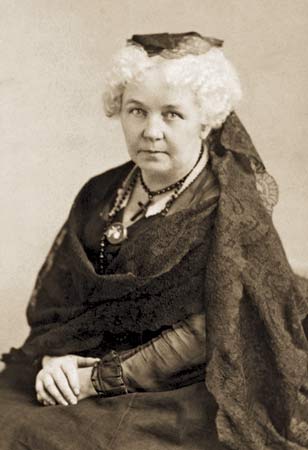
Elizabeth Cady Stanton
Elizabeth Cady Stanton was an American writer and activist who was a leader of the women's rights movement in the U.S.
By globalcelebwiki Editorial Desk, adapted from Wikipedia · Published 29 September 2026
- Profession
- American writer, suffragist and Women's Rights activist (1815–1902)
- Birthplace
- Johnstown
- Nationality
- American
Overview
Elizabeth Cady Stanton (née Cady; November 12, 1815 – October 26, 1902) was an American writer and activist who was a leader of the women's rights movement in the U.S. during the mid- to late-19th century. She was the main force behind the 1848 Seneca Falls Convention, the first convention to be called for the sole purpose of discussing women's rights, and was the primary author of its Declaration of Sentiments. Her demand for women's right to vote generated a controversy at the convention but quickly became a central tenet of the women's movement. She was also active in other social reform activities, especially abolitionism.
In 1851, she met Susan B. Anthony and formed a decades-long partnership that was crucial to the development of the women's rights movement. During the American Civil War, they established the Women's Loyal National League to campaign for the abolition of slavery, and they led it in the largest petition drive in U.S. history up to that time. They started a newspaper called The Revolution in 1868 to work for women's rights.
After the war, Stanton and Anthony were the main organizers of the American Equal Rights Association, which campaigned for equal rights for both African Americans and women, especially the right of suffrage. When the Fifteenth Amendment to the U.S. Constitution was introduced that would provide suffrage for black men only, they opposed it, insisting that suffrage should be extended to all African Americans and all women at the same time. Others in the movement supported the amendment, resulting in a split. During the bitter arguments that led up to the split, Stanton sometimes expressed her ideas in elitist and racially condescending language. In her opposition to the voting rights of African Americans, Stanton was quoted to have said, "It becomes a serious question whether we had better stand aside and let 'Sambo' walk into the kingdom first." Frederick Douglass, an abolitionist friend who had escaped from slavery, reproached her for such remarks.
Stanton became the president of the National Woman Suffrage Association, which she and Anthony created to represent their wing of the movement. When the split was healed more than twenty years later, Stanton became the first president of the united organization, the National American Woman Suffrage Association. This was largely an honorary position; Stanton continued to work on a wide range of women's rights issues despite the organization's increasingly tight focus on women's right to vote.
Stanton was the primary author of the first three volumes of the History of Woman Suffrage, a massive effort to record the history of the movement, focusing largely on her wing of it. She was also the primary author of The Woman's Bible, a redaction criticism of the Bible that is based on the premise that its attitude toward women reflects prejudice from a less civilized age.
Childhood and family background
Elizabeth Cady was born into the leading family of Johnstown, New York. Their family mansion on the town's main square was handled by as many as twelve servants. Her conservative father, Daniel Cady, was one of the richest landowners in the state. A member of the Federalist Party, he was an attorney who served one term in the U.S. Congress and became a justice in the New York Supreme Court.
Her mother, Margaret Cady (née Livingston), was more progressive, supporting the radical Garrisonian wing of the abolitionist movement and signing a petition for women's suffrage in 1867. She was described, at least earlier in her life, as "[n]early six feet tall, strong willed and self-reliant, ... She was the only person in the household not in awe of her husband who was 12 years her senior."
Education and intellectual development
Stanton received a better education than most women of her era. She attended Johnstown Academy in her hometown until the age of 15. The only girl in its advanced classes in mathematics and languages, she won second prize in the school's Greek competition and became a skilled debater. She enjoyed her years at the school and said she did not encounter any barriers there due to her gender.
She was made sharply aware of society's low expectations for women when Eleazar, her last surviving brother, died at the age of 20 just after graduating from Union College in Schenectady, New York. Her father and mother were incapacitated by grief. The ten-year-old Stanton tried to comfort her father, saying she would try to be all her brother had been. Her father said, "Oh my daughter, I wish you were a boy!"
Stanton had many educational opportunities as a young child. Their neighbor, Reverend Simon Hosack, taught her Greek and mathematics. Edward Bayard, her brother-in-law and Eleazar's former classmate at Union College, taught her philosophy and horsemanship. Her father brought her law books to study so she could participate in debates with his law clerks at the dinner table. She wanted to go to college, but no colleges at that time accepted female students. Moreover, her father initially decided she did not need further education. He eventually agreed to enroll her in the Troy Female Seminary in Troy, New York, which was founded and run by Emma Willard. Her uncle Amos Eaton was a friend and supporter of Willard and occasionally lectured at the Seminary.
In her memoirs, Stanton said that during her student days in Troy she was greatly disturbed by a six-week religious revival conducted by Charles Grandison Finney, an evangelical preacher and a central figure in the revivalist movement. His preaching, combined with the Calvinistic Presbyterianism of her childhood, terrified her with the possibility of her own damnation: "Fear of judgment seized my soul. Visions of the lost haunted my dreams. Mental anguish prostrated my health."
Stanton credited her father and brother-in-law with convincing her to disregard Finney's warnings. She said they took her on a six-week trip to Niagara Falls during which she read works of rational philosophers who restored her reason and sense of balance. Lori D. Ginzberg, one of Stanton's biographers, says there are problems with this story. For one thing, Finney did not preach for six weeks in Troy while Stanton was there. Ginzberg suspects that Stanton embellished a childhood memory to underline her belief that women harm themselves by falling under the spell of religion.
Marriage and family
As a young woman, Stanton traveled often to the home of her cousin, Gerrit Smith, who also lived in upstate New York. His views were very different from those of her conservative father. Smith was an abolitionist and a member of the "Secret Six", a group of men who financed John Brown's raid on Harpers Ferry in an effort to spark an armed uprising of enslaved African Americans. At Smith's home, where she spent summers and was considered "part of the family," she met Henry Brewster Stanton, a prominent abolitionist agent. Despite her father's reservations, the couple married in 1840, omitting the word "obey" from the marriage ceremony. Stanton later wrote, "I obstinately refused to obey one with whom I supposed I was entering into an equal relation."
While uncommon, this practice was not unheard of; Quakers had been omitting "obey" from the marriage ceremony for some time.
While on their honeymoon in England in 1840, the Stantons attended the World Anti-Slavery Convention in London. Elizabeth was appalled by the convention's male delegates, who voted to prevent women from participating even if they had been appointed as delegates of their respective abolitionist societies. The men required the women to sit in a separate section, hidden by curtains from the convention's proceedings. William Lloyd Garrison, a prominent American abolitionist and supporter of women's rights who arrived after the vote had been taken, refused to sit with the men and sat with the women instead.
Lucretia Mott, a Quaker minister, abolitionist and women's rights advocate, was one of the women who had been sent as a delegate. Although Mott was much older than Stanton, they quickly bonded in an enduring friendship, with Stanton eagerly learning from the more experienced activist. While in London, Stanton heard Mott preach in a Unitarian chapel, the first time Stanton had heard a woman give a sermon or even speak in public.
Stanton later gave credit to this convention for focusing her interests on women's rights.
An accumulation of experiences was having an effect on Stanton. The London convention had been a turning point in her life. Her study of law books had convinced her that legal changes were necessary to overcome gender inequities. She had personal experience of the stultifying role of women as wives and housekeepers. She said, "the wearied, anxious look of the majority of women, impressed me with a strong feeling that some active measures should be taken to remedy the wrongs of society in general, and of women in particular." This knowledge, however, did not immediately lead to action. Relatively isolated from other social reformers and fully occupied with household duties, she was at a loss as to how she could engage in social reform.
In the summer of 1848, Lucretia Mott traveled from Pennsylvania to attend a Quaker meeting near the Stanton's home. Stanton was invited to visit with Mott and three other progressive Quaker women. Finding herself in sympathetic company, Stanton said she poured out her "long-accumulating discontent, with such vehemence and indignation that I stirred myself, as well as the rest of the party, to do and dare anything." The gathered women agreed to organize a women's rights convention in Seneca Falls a few days later, while Mott was still in the area.
Stanton was the primary author of the convention's Declaration of Rights and Sentiments, which was modeled on the U.S. Declaration of Independence. Its list of grievances included the wrongful denial of women's right to vote, signaling Stanton's intent to generate a discussion of women's suffrage at the convention. This was a highly controversial idea at the time but not an entirely new one. Her cousin Gerrit Smith, no stranger to radical ideas himself, had called for women's suffrage shortly before at the Liberty League convention in Buffalo. When Henry Stanton saw the inclusion of women's suffrage in the document, he told his wife that she was acting in a way that would turn the proceedings into a farce. Lucretia Mott, the main speaker, was also disturbed by the proposal.
An estimated 300 women and men attended the two-day Seneca Falls Convention. In her first address to a large audience, Stanton explained the purpose of the gathering and the importance of women's rights. Following a speech by Mott, Stanton read the Declaration of Sentiments, which the attendees were invited to sign. Next came the resolutions, all of which the convention adopted unanimously except for the ninth, which read, "it is the duty of the women of this country to secure to themselves the sacred right of the elective franchise." Following a vigorous debate, this resolution was adopted only after Frederick Douglass, an abolitionist leader who had formerly been enslaved, gave it his strong support.
Stanton's sister Harriet attended the convention and signed its Declaration of Sentiments. Her husband, however, made her remove her signature.
While visiting Seneca Falls in 1851, Susan B. Anthony was introduced to Stanton by Amelia Bloomer, a mutual friend and a supporter of women's rights. Anthony, who was five years younger than Stanton, came from a Quaker family that was active in reform movements. Anthony and Stanton soon became close friends and co-workers, forming a relationship that was a turning point in their lives and of great importance to the women's movement.
The two women had complementary skills. Anthony excelled at organizing, while Stanton had an aptitude for intellectual matters and writing. Stanton later said, "In writing we did better work together than either could alone. While she is slow and analytical in composition, I am rapid and synthetic. I am the better writer, she the better critic." Anthony deferred to Stanton in many ways throughout their years of work together, not accepting an office in any organization that would place her above Stanton. In their letters, they referred to one another as "Susan" and "Mrs. Stanton."
Because Stanton was homebound with seven children while Anthony was unmarried and free to travel, Anthony assisted Stanton by supervising her children while Stanton wrote.
Among other things, this allowed Stanton to write speeches for Anthony to give.
One of Anthony's biographers said, "Susan became one of the family and was almost another mother to Mrs. Stanton's children." One of Stanton's biographers said, "Stanton provided the ideas, rhetoric, and strategy; Anthony delivered the speeches, circulated petitions, and rented the halls. Anthony prodded and Stanton produced." Stanton's husband said, "Susan stirred the puddings, Elizabeth stirred up Susan, and then Susan stirs up the world!" Stanton herself said, "I forged the thunderbolts, she fired them."
Excessive consumption of alcohol was a severe social problem during this period, one that began to diminish only in the 1850s. Many activists considered temperance to be a women's rights issue because of laws that gave husbands complete control of the family and its finances. The law provided almost no recourse to a woman with a drunken husband, even if his condition left the family destitute and he was abusive to her and their children. If she managed to obtain a divorce, which was difficult to do, he could easily end up with sole guardianship of their children.
In 1852, Anthony was elected as a delegate to the New York state temperance convention. When she tried to participate in the discussion, the chairman stopped her, saying that women delegates were there only to listen and learn. Years later, Anthony observed, "No advanced step taken by women has been so bitterly contested as that of speaking in public. For nothing which they have attempted, not even to secure the suffrage, have they been so abused, condemned and antagonized." Anthony and other women walked out and announced their intention to organize a women's temperance convention. Later that year, about five hundred women met in Rochester and created the Women's State Temperance Society, with Stanton as president and Anthony as state agent. This leadership arrangement, with Stanton in the public role as president and Anthony as the energetic force behind the scenes, was characteristic of the organizations they founded in later years.
In her first public speech since 1848, Stanton delivered the convention's keynote address, one that antagonized religious conservatives. She called for drunkenness to be legal grounds for divorce at a time when many conservatives opposed divorce for any reason. She appealed for wives of drunkard husbands to take control of their marital relations, saying, "Let no woman remain in relation of wife with the confirmed drunkard. Let no drunkard be the father of her children." She attacked the religious establishment, calling for women to donate their money to the poor instead of to the "education of young men for the ministry, for the building up a theological aristocracy and gorgeous temples to the unknown God."
At the organization's convention the following year, conservatives voted Stanton out as president, whereupon she and Anthony resigned from the organization. Temperance was not a significant reform activity for Stanton afterwards, although she continued to use local temperance societies in the early 1850s as conduits for advocating women's rights. She regularly wrote articles for The Lily, a monthly temperance newspaper that she helped transform into one that reported news of the women's rights movement. She also wrote for The Una, a women's rights periodical edited by Paulina Wright Davis, and for the New York Tribune, a daily newspaper edited by Horace Greeley.
The status of married women at that time was in part set by English common law which for centuries had set the doctrine of coverture in local courts. It held wives were under the protection and control of their husbands. In the words of William Blackstone's 1769 book Commentaries on the Laws of England: "By marriage, the husband and wife are one person in law: that is, the very being or legal existence of the woman is suspended during the marriage." The husband of a married woman became the owner of any property she brought into a marriage. She could not sign contracts, operate a business in her own name, or retain custody of their children in the event of a divorce. In practice some American courts followed the common law. Some Southern states like Texas and Florida provided more equality for women. Across the country state legislatures were taking control away from common law traditions by passing legislation.
In 1836, the New York legislature began considering a Married Women's Property Act, with women's rights advocate Ernestine Rose an early supporter who circulated petitions in its favor. Stanton's father supported this reform. Having no sons to pass his considerable wealth to, he was faced with the prospect of having it eventually pass to the control of his daughters' husbands. Stanton circulated petitions and lobbied legislators in favor of the proposed law as early as 1843.
The law eventually passed in 1848. It allowed a married woman to retain the property that she possessed before the marriage or acquired during the marriage, and it protected her property from her husband's creditors. Enacted shortly before the Seneca Falls Convention, it strengthened the women's rights movement by increasing the ability of women to act independently. By weakening the traditional belief that husbands spoke for their wives, it assisted many of the reforms that Stanton championed, such as the right of women to speak in public and to vote.
In 1853, Susan B. Anthony organized a petition campaign in New York state for an improved property rights law for married women.
As part of the presentation of these petitions to the legislature, Stanton spoke in 1854 to a joint session of the Judiciary Committee, arguing that voting rights were needed to enable women to protect their newly won property rights. In 1860, Stanton spoke again to the Judiciary Committee, this time before a large audience in the assembly chamber, arguing that women's suffrage was the only real protection for married women, their children and their material assets. She pointed to similarities in the legal status of woman and slaves, saying, "The prejudice against color, of which we hear so much, is no stronger than that against sex. It is produced by the same cause, and manifested very much in the same way. The negro's skin and the woman's sex are both prima facie evidence that they were intended to be in subjection to the white Saxon man." The legislature passed the improved law in 1860.
In 1851, Elizabeth Smith Miller, Stanton's cousin, brought a new style of dress to the upstate New York area. Unlike traditional floor-length dresses, it consisted of pantaloons worn under a knee-length dress. Amelia Bloomer, Stanton's friend and neighbor, publicized the attire in The Lily, a monthly magazine that she published. Thereafter it was popularly known as the "Bloomer" dress, or just "Bloomers." It was soon adopted by many female reform activists despite harsh ridicule from traditionalists, who considered the idea of women wearing any sort of trousers as a threat to the social order. To Stanton, it solved the problem of climbing stairs with a baby in one hand, a candle in the other, and somehow also lifting the skirt of a long dress to avoid tripping. Stanton wore "Bloomers" for two years, abandoning the attire only after it became clear that the controversy it created was distracting people from the campaign for women's rights. Other women's rights activists eventually did the same.
Stanton had already antagonized traditionalists in 1852 at the women's temperance convention by advocating a woman's right to divorce a drunken husband. In an hour-long speech at the Tenth National Women's Rights Convention in 1860, she went further, generating a heated debate that took up an entire session. She cited tragic examples of unhealthy marriages, suggesting that some marriages amounted to "legalized prostitution." She challenged both the sentimental and the religious views of marriage, defining marriage as a civil contract subject to the same restrictions of any other contract. If a marriage did not produce the expected happiness, she said, then it would be a duty to end it. Strong opposition to her speech was voiced in the ensuing discussion. Abolitionist leader Wendell Phillips, arguing that divorce was not a women's rights issue because it affected both women and men equally, said the subject was out of order and tried unsuccessfully to have it removed from the record.
In later years on the lecture circuit, Stanton's speech on divorce was one of her most popular, drawing audiences of up to 1200 people. In an 1890 essay entitled "Divorce versus Domestic Warfare", Stanton opposed calls by some women activists for stricter divorce laws, saying, "The rapidly increasing number of divorces, far from showing a lower state of morals, proves exactly the reverse. Woman is in a transition period from slavery to freedom, and she will not accept the conditions and married life that she has heretofore meekly endured."
In 1860 Stanton published a pamphlet called The Slaves Appeal written from what she imagined to be the viewpoint of a female slave. The fictional speaker uses vivid religious language ("Men and women of New York, the God of thunder speaks through you") that expresses religious views very different from those that Stanton herself held. The speaker describes the horrors of slavery, saying, "The trembling girl for whom thou didst pay a price but yesterday in a New Orleans market, is not thy lawful wife. Foul and damning, both to the master and the slave, is this wholesale violation of the immutable laws of God." The pamphlet called for defiance of the Federal Fugitive Slave Act, and it included petitions to be used for opposing the practice of hunting escaped slaves.
In 1861, Anthony organized a tour of abolitionist lecturers in upstate New York that included Stanton and several other speakers. The tour began in January just after South Carolina had seceded from the union but before other states had seceded and before the outbreak of war. In her speech, Stanton said that South Carolina was like a willful son whose behavior jeopardized the whole family and that the best course of action was to let it secede. The lecture meetings were repeatedly disrupted by mobs operating under the belief that abolitionist activity was causing southern states to secede. Stanton was not able to participate in some of the lectures because she had to return home to her children. At her husband's urging, she left the lecture tour because of the persistent threat of violence.
Women's Loyal National League
In 1863, Anthony moved into the Stantons' house in New York City and the two women began organizing the Women's Loyal National League to campaign for an amendment to the U.S. Constitution that would abolish slavery. Stanton became president of the new organization and Anthony was secretary.
It was the first national women's political organization in the United States. In the largest petition drive in the nation's history up to that time, the League collected nearly 400,000 signatures to abolish slavery, representing approximately one out of every twenty-four adults in the Northern states.
The petition drive significantly assisted the passage of the Thirteenth Amendment, which ended slavery.
The League disbanded in 1864 after it became clear that the amendment would be approved.
Although its purpose was the abolition of slavery, the League made it clear that it also stood for political equality for women, approving a resolution at its founding convention that called for equal rights for all citizens regardless of race or sex. The League indirectly advanced the cause of women's rights in several ways. Stanton pointedly reminded the public that petitioning was the only political tool available to women at a time when only men were allowed to vote. The success of the League's petition drive demonstrated the value of formal organization to the women's movement, which had traditionally resisted being anything other than loosely organized up to that point. Its 5000 members constituted a widespread network of women activists who gained experience that helped create a pool of talent for future forms of social activism, including suffrage. Stanton and Anthony emerged from this endeavor with significant national reputations.
American Equal Rights Association
After the Civil War, Stanton and Anthony became alarmed at reports that the proposed Fourteenth Amendment to the U.S. Constitution, which would provide citizenship for African Americans, would also for the first time introduce the word "male" into the constitution. Stanton said, "if that word 'male' be inserted, it will take us a century at least to get it out."
Organizing opposition to this development required preparation because the women's movement had become largely inactive during the Civil War. In January 1866, Stanton and Anthony sent out petitions calling for a constitutional amendment providing for women's suffrage, with Stanton's name at the top of the list of signatures. Stanton and Anthony organized the Eleventh National Women's Rights Convention in May 1866, the first since the Civil War began. The convention voted to transform itself into the American Equal Rights Association (AERA), whose purpose was to campaign for the equal rights of all citizens regardless of race or sex, especially the right of suffrage. Stanton was offered the post of president but declined in a favor of Lucretia Mott. Other officers included Stanton as first vice president, Anthony as a corresponding secretary, Frederick Douglass as a vice president, and Lucy Stone as a member of the executive committee. Stanton provided hospitality for some of the attendees at this convention. Sojourner Truth, an abolitionist and women's rights activist who had formerly been enslaved, stayed at Stanton's house as, of course, did Anthony.
Leading abolitionists opposed the AERA's drive for universal suffrage. Horace Greeley, a prominent newspaper editor, told Anthony and Stanton, "This is a critical period for the Republican Party and the life of our Nation... I conjure you to remember that this is 'the negro's hour.'" Abolitionist leaders Wendell Phillips and Theodore Tilton arranged a meeting with Stanton and Anthony, trying to convince them that the time had not yet come for women's suffrage, that they should campaign for voting rights for black men only, not for all African Americans and all women. The two women rejected this guidance and continued to work for universal suffrage.
In 1866, Stanton declared herself a candidate for Congress, the first woman to do so. She said that although she could not vote, there was nothing in the Constitution to prevent her from running for Congress. Running as an independent against both the Democrat and Republican candidates, she received only 24 votes. Her campaign was noted by newspapers as far away as New Orleans.
In 1867, the AERA campaigned in Kansas for referendums that would enfranchise both African Americans and women. Wendell Phillips, who opposed mixing those two causes, blocked the funding that the AERA had expected for their campaign.
The Revolution
In 1868, Anthony and Stanton began publishing a sixteen-page weekly newspaper called The Revolution in New York City. Stanton was co-editor along with Parker Pillsbury, an experienced editor who was an abolitionist and a supporter of women's rights. Anthony, the owner, managed the business aspects of the paper. Initial funding was provided by George Francis Train, the controversial businessman who supported women's rights but who alienated many activists with his political and racial views. The newspaper focused primarily on women's rights, especially suffrage for women, but it also covered topics such as politics, the labor movement and finance. One of its stated goals was to provide a forum in which women could exchange opinions on key issues. Its motto was "Men, their rights and nothing more: women, their rights and nothing less."
Sisters Harriet Beecher Stowe and Isabella Beecher Hooker offered to provide funding for the newspaper if its name was changed to something less inflammatory, but Stanton declined their offer, strongly favoring its existing name.
Their goal was to grow The Revolution into a daily paper with its own printing press, all owned and operated by women. The funding that Train had arranged for the newspaper, however, was less than expected. Moreover, Train sailed for England after The Revolution published its first issue and was soon jailed for supporting Irish independence. Train's financial support eventually disappeared entirely. After twenty-nine months, mounting debts forced the transfer of the paper to a wealthy women's rights activist who gave it a less radical tone. Despite the relatively short time it was in their hands, The Revolution gave Stanton and Anthony a means for expressing their views during the developing split within the women's movement. It also helped them promote their wing of the movement, which eventually became a separate organization.
Stanton refused to take responsibility for the $10,000 debt the newspaper had accumulated, saying she had children to support. Anthony, who had less money than Stanton, took responsibility for the debt, repaying it over a six-year period through paid speaking tours.
National Woman Suffrage Association
In May 1869, two days after the final AERA convention, Stanton, Anthony and others formed the National Woman Suffrage Association (NWSA), with Stanton as president. Six months later, Lucy Stone, Julia Ward Howe and others formed the rival American Woman Suffrage Association (AWSA), which was larger and better funded. The immediate cause for the split in the women's suffrage movement was the proposed Fifteenth Amendment, but the two organizations had other differences as well. The NWSA was politically independent while the AWSA aimed for close ties with the Republican Party, hoping that ratification of the Fifteenth Amendment would lead to Republican support for women's suffrage. The NWSA focused primarily on winning suffrage at the national level while the AWSA pursued a state-by-state strategy. The NWSA initially worked on a wider range of women's issues than the AWSA, including divorce reform and equal pay for women.
As the new organization was being formed, Stanton proposed to limit its membership to women, but her proposal was not accepted. In practice, however, the overwhelming majority of its members and officers were women.
Stanton disliked many aspects of organizational work because it interfered with her ability to study, think, and write. She begged Anthony, without success, to arrange the NWSA's first convention so that she herself would not need to attend. For the rest of her life, Stanton attended conventions only reluctantly if at all, wanting to maintain the freedom to express her opinions without worrying about who in the organization might be offended.
Of the fifteen NWSA meetings between 1870 and 1879, Stanton presided at four and was present at only one other, leaving Anthony effectively in charge of the organization.
In 1869 Francis and Virginia Minor, husband and wife suffragists from Missouri, developed a strategy based on the idea that the U.S. Constitution implicitly enfranchised women. It relied heavily on the Fourteenth Amendment, which says, "No State shall make or enforce any law which shall abridge the privileges or immunities of citizens of the United States … nor deny to any person within its jurisdiction the equal protection of the laws." In 1871 the NWSA officially adopted what had become known as the New Departure strategy, encouraging women to attempt to vote and to file lawsuits if denied that right. Soon hundreds of women tried to vote in dozens of localities. Susan B. Anthony actually succeeded in voting in 1872, for which she was arrested and found guilty in a widely publicized trial. In 1880, Stanton also tried to vote. When the election officials refused to let her place her ballot in the box, she threw it at them. When the Supreme Court ruled in 1875 in Minor v. Happersett that "the Constitution of the United States does not confer the right of suffrage upon anyone," the NWSA decided to pursue the far more difficult strategy of campaigning for a constitutional amendment that would guarantee voting rights for women.
Sources and references
Spotted something wrong? Report a correction.
Related profiles

Actor
Meryl Streep
The most-nominated performer in Academy Awards history, known for her range across four decades of film and stage.
Read biography ↗
Actor and director
Denzel Washington
An American actor and director whose screen work spans Glory, Malcolm X and Training Day, alongside acclaimed stage performances.
Read biography ↗