American basketball player (1934–2022)
Bill Russell
William Felton Russell was an American professional basketball player who played center for the Boston Celtics of the National Basketball Association from 1956 to 1969.
By globalcelebwiki Editorial Desk, adapted from Wikipedia · Published 29 September 2026
- Profession
- American basketball player (1934–2022)
- Born
- 12 February 1934
- Birthplace
- Monroe
- Nationality
- American
Overview
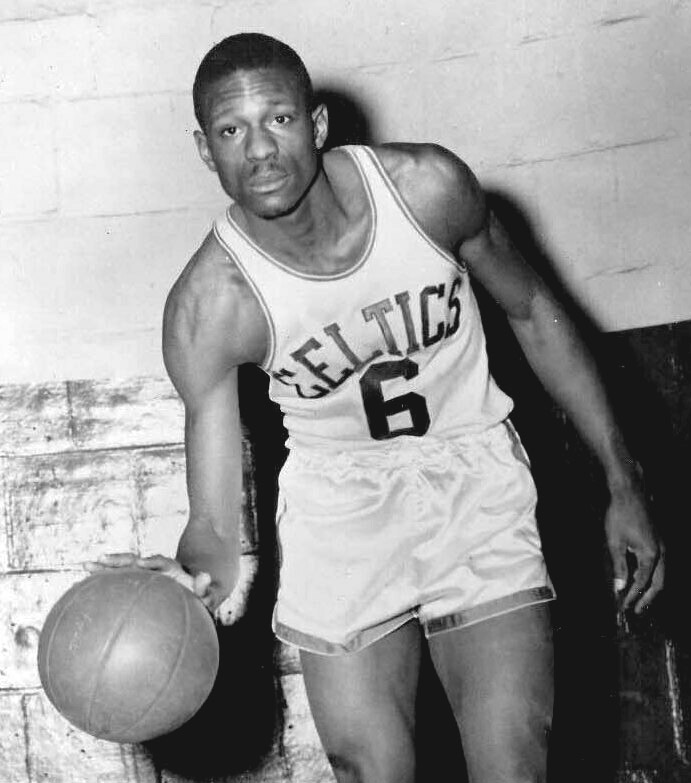
William Felton Russell (February 12, 1934 – July 31, 2022) was an American professional basketball player who played center for the Boston Celtics of the National Basketball Association (NBA) from 1956 to 1969. He was the centerpiece of the Celtics dynasty that played for 12 NBA championships and won 11 during his 13-year career. Russell is widely considered one of the greatest basketball players of all time.
Russell played college basketball for the San Francisco Dons, leading them to consecutive NCAA championships in 1955 and 1956. He was named NCAA tournament Most Outstanding Player (MOP), and captained the gold medal-winning U.S. national basketball team at the 1956 Summer Olympics. These victories along with his NBA championships made Russell one of only eight players in the history of men's basketball to achieve the Triple Crown.
After being chosen by the St. Louis Hawks with the second overall pick in the 1956 NBA draft, Russell was traded to the Boston Celtics for Celtics center Ed Macauley and small forward Cliff Hagan. With Russell as their starting center and defensive anchor, the Celtics went on to win their first NBA championship in 1957 and won an NBA record eight consecutive championships from 1959 to 1966. A five-time NBA Most Valuable Player (MVP) and a 12-time NBA All-Star, Russell's rebounding, defense, and leadership made him one of the dominant players of his era. Standing at 6 ft 10 in (2.08 m) tall, with a 7-foot-4-inch (2.24 m) arm span, his shot-blocking and man-to-man defense were major reasons for the Celtics' dominance during his career. Russell also led the NBA in rebounds four times, had a dozen consecutive seasons of 1,000 or more rebounds, and remains second all-time in both total rebounds and rebounds per game. Russell played in the wake of black pioneers Earl Lloyd, Chuck Cooper, and Sweetwater Clifton, and he was the first black player to achieve superstar status in the NBA. During the final three seasons of his career (1966–1969), he served as player-coach of the Celtics, becoming the first black NBA coach to win a championship. Russell ended his playing career and left his position as Celtics coach after helping the Celtics win the 1969 NBA championship.
Russell served as head coach and general manager of the Seattle SuperSonics from 1973 to 1977. He also coached the Sacramento Kings from 1987 to 1988. Russell also worked as a color commentator and authored several books.
Russell was inducted into the Naismith Memorial Basketball Hall of Fame in 1975, was one of the founding inductees into the National Collegiate Basketball Hall of Fame in 2006 and was enshrined in the FIBA Hall of Fame in 2007. He was selected into the NBA 25th Anniversary Team in 1971 and the NBA 35th Anniversary Team in 1980, was named as one of the 50 Greatest Players in NBA History in 1996 (being one of only four players to receive all three honors), and was selected to the NBA 75th Anniversary Team in 2021. In 2009, the NBA renamed the NBA Finals MVP Award in his honor. In 2011, Barack Obama awarded Russell the Presidential Medal of Freedom for his accomplishments on the court and in the civil rights movement. In 2021, Russell was inducted into the Naismith Memorial Basketball Hall of Fame a second time in recognition of his coaching career. Shortly after his death in 2022, the NBA retired Russell's #6 jersey league-wide, making him the only player in NBA history to receive that honor, as well as the third person in North American major professional sports to have their jersey number retired league-wide, after Jackie Robinson and Wayne Gretzky.
Family
William Felton Russell was born on February 12, 1934, to Charles Russell and Katie Russell in West Monroe, Louisiana. Like many Southern towns and cities of that time, Monroe was segregated, and the Russells often struggled with racism in their daily lives. Russell's father was once refused service at a gas station until the staff had taken care of all the white customers first. When he attempted to leave and find a different station, the attendant stuck a shotgun in his face and threatened to kill him if he did not stay and wait his turn. In another incident, Russell's mother was walking outside in a fancy dress when a white policeman accosted her. He told her to go home and remove the dress, which he described as "white woman's clothing".
During World War II, the Second Great Migration began, with large numbers of Black people leaving the South to find jobs in the rest of the U.S. When Russell was eight years old, his father moved the family to Oakland, California. While there, they fell into poverty and Russell spent his childhood living in a series of public housing projects.
During his early years Russell struggled to develop his skills as a basketball player. Although he was a good runner and jumper and had large hands, he did not understand the game and was cut from the team at Herbert Hoover Junior High School. As a freshman at McClymonds High School in Oakland, Russell was almost cut again, but coach George Powles saw Russell's raw athletic potential and encouraged him to work on his fundamentals. After Russell was cut from the junior varsity basketball team as a junior in high school, Powles gave him a spot on the varsity team and bought him a yearlong community center membership. Since Russell's previous experiences with white authority figures were often negative, warm words from Powles reassured him. Frank Robinson, a future member of the Baseball Hall of Fame, was one of Russell's high school basketball teammates.
Russell soon became noted for his unusual style of defense. He later recalled: "To play good defense ... it was told back then that you had to stay flatfooted at all times to react quickly. When I started to jump to make defensive plays and to block shots, I was initially corrected, but I stuck with it, and it paid off." In an autobiographical account, Russell said that while on a California High School All-Stars tour, he became obsessed with studying and memorizing other players' moves, e.g., footwork such as which foot they moved first on which play, as preparation for defending against them, which included practicing in front of a mirror at night. Russell described himself as an avid reader of Dell Magazines' 1950s sports publications, which he used to scout opponents' moves for the purpose of defending against them.
Russell was ignored by college recruiters and did not receive an offer until recruiter Hal DeJulio from the University of San Francisco (USF) watched him play in a high school game. DeJulio was unimpressed by Russell's meager scoring and "atrocious fundamentals", but he sensed that the young Russell had an extraordinary instinct for the game, especially in the clutch. Russell eagerly accepted the offer. Sports journalist John Taylor described the scholarship offer as a watershed event in Russell's life because Russell realized that basketball was his chance to escape poverty and racism, and he swore to make the best of it. Russell graduated from McClymonds in 1952.
Russell started college at USF in 1952. He averaged 20 points per game on the Dons' freshman basketball team, and made his varsity debut on December 1, 1953. He became the starting center for coach Phil Woolpert, who emphasized defense and deliberate half-court play, which favored Russell's exceptional defensive skills. Woolpert's choice of how to deploy his players was unaffected by their skin color. In 1954, he became the first coach of a major college basketball program to start three African-American players: K. C. Jones, Hal Perry, and Russell. In his USF years, Russell took advantage of his relative lack of bulk to guard other players than the opposing center: using his quickness and speed, he would double-up on forwards and aggressively challenge their shots. Russell played on USF's varsity team from 1953 to 1956.
Combining the stature and shot-blocking skills of a center with the foot speed of a forward, Russell became the centerpiece of a USF team that soon became a force in college basketball. After USF kept Holy Cross Crusaders star Tom Heinsohn scoreless in an entire half, Sports Illustrated wrote: "If [Russell] ever learns to hit the basket, they're going to have to rewrite the rules." The NCAA in fact did; the lane was widened for his junior year. After he graduated, the NCAA rules committee instituted a second new rule to counter the play of big men like Russell; basket interference was now prohibited. Russell became one of several big men who have brought about NCAA rule changes. The NCAA had previously prohibited goaltending in response to George Mikan (1945) and later banned the dunk shot due to Lew Alcindor (1967), although the latter rule was later repealed.
The games were often difficult for the USF squad, as Russell and his black teammates became targets of racist jeers, particularly on the road. In one incident, hotels in Oklahoma City refused to admit Russell and his black teammates while they were in town for the 1954 All-College Tournament. In protest, the whole team decided to fend for themselves in a closed college dorm, which was later called an important bonding experience for the group. Decades later, Russell explained that his experiences hardened him against abuse of all kinds, saying: "I never permitted myself to be a victim."
Racism shaped his lifelong paradigm as a team player, about which Russell said: "At that time it was never acceptable that a black player was the best. That did not happen ... My junior year in college, I had what I thought was the one of the best college seasons ever. We won 28 out of 29 games. We won the National Championship. I was the MVP at the Final Four. I was first team All American. I averaged over 20 points and over 20 rebounds, and I was the only guy in college blocking shots. So after the season was over, they had a Northern California banquet, and they picked another center as Player of the Year in Northern California. Well, that let me know that if I were to accept these as the final judges of my career I would die a bitter old man." He is said to have made a conscious decision to put the team first and foremost, and not worry about individual achievements.
On the court, Russell's experiences were far more pleasant. He led USF to NCAA championships in 1955 and 1956, including a string of 55 consecutive victories, and a 26-point, 27-rebound, 20-block performance in one game. He became known for his strong defense and shot-blocking skills, once denying 13 shots in a game. UCLA Bruins coach John Wooden called Russell "the greatest defensive man I've ever seen". While at USF, he and Jones helped pioneer a play that later became known as the alley-oop. During his college career, Russell was the NCAA tournament MOP in 1955, averaging 20.7 points per game and 20.3 rebounds per game.
Besides basketball, Russell represented USF in track and field events. He was a standout in the high jump and according to Track & Field News was ranked the seventh-best high-jumper in the world in 1956, his graduation year, despite not competing in Olympic high-jump competition. That year, Russell won high jump titles at the Central California Amateur Athletic Union (AAU) meet, the Pacific AAU meet, and the West Coast Relays (WCR). One of his highest jumps occurred at the WCR, where he achieved a mark of 6 feet 9+1⁄4 inches (2.06 m); at the meet, Russell tied Charlie Dumas, who would later in the year win gold in the 1956 Summer Olympics in Melbourne, Australia for the United States and become the first person to high-jump 7 feet (2.13 m). this was all before the Fosbury Flop was introduced, with which all high jump world records after 1978 have been set. Russell later stated that "In '56, I could have made the Olympics in high jump but turned it down to play basketball instead, we could only play one sport then". He also competed in the 440 yards (402.3 m) race, which he could complete in 49.6 seconds.
1956 Summer Olympics
Before his NBA rookie year, Russell was the captain of the 1956 U.S. men's Olympic basketball team that competed at the 1956 Summer Olympics, which was held in November and December in Melbourne, Australia. Avery Brundage, head of the International Olympic Committee, argued that Russell had already signed a professional contract and was no longer an amateur (as nominally required at the time), but Russell prevailed. He had the option to skip the tournament and play a full season for the Celtics, but he was determined to play in the Olympics. He later commented that he would have participated in the high jump if he had been snubbed by the basketball team.
Under head coach Gerald Tucker, Russell helped the U.S. national basketball team win the gold medal in Melbourne, defeating the Soviet Union national basketball team 89–55 in the final game with an 8–0 undefeated run. The U.S. dominated the tournament, winning by an average of 53.5 points per game. Russell led the team in scoring, averaging 14.1 points per game for the competition. His former USF and future Celtics teammate K. C. Jones joined him on the Olympic squad and contributed 10.9 points per game, including a Russell–Jones combined 29 points in the finals.
Professional career
The Harlem Globetrotters invited Russell to join their exhibition basketball squad, but Russell, who was sensitive to racial prejudice, was enraged by the fact that Globetrotters owner Abe Saperstein would only discuss the matter with USF Coach Woolpert, and not Russell. While Saperstein spoke to Woolpert in a meeting, Globetrotters assistant coach Harry Hanna tried to entertain Russell with jokes, but he was livid after this snub and declined the offer. He reasoned that if Saperstein was too smart to speak with him, then he was too smart to play for Saperstein. Russell made himself eligible for the 1956 NBA draft.
In the draft, Boston Celtics coach Red Auerbach set his sights on Russell, thinking his defensive toughness and rebounding prowess were the missing pieces the Celtics needed. Auerbach's thoughts were unorthodox, as in that period centers and forwards were defined by their offensive output, and their ability to play defense was secondary. Boston's chances of getting Russell seemed slim because they had finished second in the previous season and the worst teams had the highest draft picks, and the Celtics had slipped too low in the draft order to pick Russell. In addition, Auerbach had already used his NBA territorial pick to acquire talented forward Tom Heinsohn. Auerbach knew that the Rochester Royals, who owned the first draft pick, already had a strong rebounder in Maurice Stokes, were looking for an outside shooting guard, and were unwilling to pay Russell the $25,000 signing bonus he requested. Celtics owner Walter A. Brown contacted Rochester owner Les Harrison and received an assurance that the Royals could not afford Russell, and they would draft Sihugo Green. Auerbach later said that Brown offered Harrison guaranteed performances of the Ice Capades if they did not draft Russell; it is difficult to verify or disprove this, but it is clear that the Royals underrated Russell.
The St. Louis Hawks, who owned the second pick, drafted Russell but were vying for Celtics center Ed Macauley, a six-time NBA All-Star who had roots in St. Louis. Auerbach agreed to trade Macauley, who had previously asked to be traded to St. Louis to be with his sick son, if the Hawks gave up Russell. The owner of the Hawks called Auerbach later and demanded more in the trade. In addition to Macauley, who was the Celtics' premier player at the time, he wanted Cliff Hagan, who had been serving in the military for three years and had not yet played for the Celtics. After much debate, Auerbach agreed to give up Hagan and the Hawks made the trade. During that same draft, Boston also drafted guard K. C. Jones, Russell's former USF teammate; in total, the team drafted three future Basketball Hall of Famers in 1956: Russell, Jones, and Heinsohn. The Russell draft-day trade was later called one of the most important trades in the history of North American sports.
Due to his Olympic commitment, Russell could not join the Celtics for the 1956–57 NBA season until December. The 1956–57 Boston Celtics season saw the debut of a starting lineup made up of five future Hall-of-Famers: center Russell, forwards Heinsohn and Frank Ramsey, and guards Bill Sharman and Bob Cousy. Russell's first Celtics game came on December 22, 1956, against the St. Louis Hawks. Auerbach assigned him to shut down the Hawks' main scorer, Bob Pettit, and Russell impressed the Boston crowd with his man-to-man defense and shot-blocking. In previous years, the Celtics had been a high-scoring team but lacked the defensive presence needed to close out tight games. With the added defensive presence of Russell, the Celtics had laid the foundation for a dynasty, as the team utilized a strong defensive approach to the game, forcing opposing teams to commit many turnovers, which led to many easy points on fast breaks.
Russell was an elite help defender who allowed the Celtics to play the "Hey, Bill" defense: whenever a Celtic requested additional defensive help, he would shout "Hey, Bill!" Russell was so quick that he could run over for a quick double team and make it back in time if the opponents tried to find the open man. He also became famous for his shot-blocking skills and pundits called his blocks "Wilsonburgers", referring to the Wilson NBA basketballs he "shoved back into the faces of opposing shooters". This skill allowed the other Celtics to play their men aggressively; if they were beaten, they knew that Russell was guarding the basket.
Russell's defense was called into question by Eddie Gottlieb, coach of the Philadelphia Warriors, after the Warriors–Celtics game on January 1, 1957, in which he recorded 17 points and 25 rebounds, plus an assist. Gottlieb protested the next day, saying that Russell played a one-man zone and goaltended numerous times, to only be called once. Auerbach replied that Gottlieb's statements were "absolutely ridiculous" and said any controversy was "a question of sour grapes".
Constantly provoked by New York Knicks center Ray Felix during a game, he complained to coach Auerbach, who told him to take matters into his own hands. After the next provocation, Russell pounded Felix to the point of unconsciousness, paid a modest $25 fine, and rarely was the target of cheap fouls thereafter.
At that time, Russell received much negative publicity as a player. He was notorious for his public surliness. Because Russell ignored virtually any well-wisher who approached him home or away, as well as the vast majority of media, his autograph was among the most difficult to secure of any professional athlete of his time. Russell had a cordial relationship with many of his teammates, with the notable exception of Heinsohn, his old rival and fellow rookie. Russell ignored Heinsohn's request for an autograph on behalf of his cousin and openly said to Heinsohn that he deserved half of his $300 Rookie of the Year check. The relationship between the two was tenuous at best. Despite their different ethnic backgrounds and lack of common off-court interests, his relationship with Cousy was amicable.
In the 1958–59 NBA season, Russell averaged 16.7 points per game and 23.0 rebounds per game. The Celtics broke a league record by winning 52 games and Russell's strong performance once again helped lead the Celtics through the 1959 NBA playoffs, as they returned to the NBA Finals. In the 1959 NBA Finals, the Celtics recaptured the NBA title, sweeping the Minneapolis Lakers 4–0. Lakers head coach John Kundla praised Russell, stating: "We don't fear the Celtics without Bill Russell. Take him out and we can beat them ... He's the guy who whipped us psychologically."
In the 1959–60 NBA season, the NBA witnessed the debut of 7 ft 1 in (2.16 m) Philadelphia Warriors center Wilt Chamberlain, who averaged a record 37.6 points per game in his rookie year. On November 7, 1959, Russell's Celtics hosted Chamberlain's Warriors and pundits called the matchup between the best offensive and defensive centers "The Big Collision" and "Battle of the Titans". Both men awed onlookers with "nakedly awesome athleticism", and while Chamberlain outscored Russell 30 to 22, the Celtics won 115–106, and the match was called a "new beginning of basketball". The matchup between Russell and Chamberlain became one of basketball's greatest rivalries.
On February 5, 1960, Russell had 23 points, 51 rebounds, and 5 assists in a 124–100 win over the Syracuse Nationals. It was the record for most rebounds in a single game until November 24, 1960, when Chamberlain grabbed 55 rebounds against Russell, who led the Celtics to a 132–129 win over the Philadelphia Warriors with 18 points, 19 rebounds, and 5 assists. Boston won a then-record 59 regular-season games, including a then-record tying 17-game win streak. In the 1960 NBA playoffs, Russell's Celtics met Chamberlain's Warriors in the Eastern Division finals. Chamberlain outscored Russell by 81 points in the series, but the Celtics walked off with a 4–2 series win. In the 1960 NBA Finals, the Celtics outlasted the Hawks 4–3 in the series and won their third championship in four years. Russell scored 21 points and grabbed an NBA Finals-record 40 rebounds, plus an assist, in a Game 2 loss, and he added 22 points and 35 rebounds, along with 4 assists, in the deciding Game 7, a 122–103 victory for Boston.
In the 1960–61 NBA season, Russell averaged 16.9 points and 23.9 rebounds per game, leading his team to a regular season mark of 57–22. In the 1961 NBA playoffs, the Celtics defeated the Syracuse Nationals 4–1 in the Eastern Division finals. The Celtics made good use of the fact that the Los Angeles Lakers had exhausted the St. Louis Hawks in a long seven-game Western Conference finals, and Boston won the 1961 NBA Finals in five games.
In the 1961–62 NBA season, Russell scored a career-high 18.9 points per game, accompanied by 23.6 rebounds per game. While his rival had a record-breaking season of 50.4 points per game, including Chamberlain's 100-point game, the Celtics became the first team to win 60 games in a season and Russell was voted as the league's MVP. Both Cousy and Russell called it the greatest Celtics team of all time. In the Eastern Division championships of the 1962 NBA playoffs, the Celtics met the Philadelphia Warriors led by Chamberlain, who averaged 50 points per game that season, and Russell did his best to slow him down. In the pivotal Game 7, Russell managed to hold Chamberlain to 22 points, 28 points below his season average, while scoring 19 points. The game was tied with two seconds left when Sam Jones sank a clutch shot that won the Celtics the series.
Celtics coach Red Auerbach retired before the 1966–67 NBA season. To coach the Celtics, he had initially wanted his old player Frank Ramsey, who was too occupied running his three lucrative nursing homes. His second choice was Cousy, who declined the invitation, stating that he did not want to coach his former teammates. Third choice Tom Heinsohn also said no because he did not think he could handle the often surly Russell, whom he proposed as a player-coach. On April 16, 1966, Russell agreed to become head coach of the Celtics, and a public announcement was made two days later. Russell became the first black head coach in NBA history, and he commented to journalists: "I wasn't offered the job because I am a Negro, I was offered it because Red figured I could do it."
When he became player-coach, Russell bluntly said to his teammates that "he intended to cut all personal ties to other players" and seamlessly made the transition from their peer to their superior. At the time his additional role of coach was announced, Russell publicly stated he believed Red Auerbach's impact as a coach confined every or almost every relationship with each Celtic player to a strictly professional one. Russell regarded Auerbach as "the greatest of all coaches".
Boston's championship streak ended at eight in his first full season as head coach when Chamberlain's Philadelphia 76ers won a record-breaking 68 regular-season games and were the favorites heading into the 1967 NBA playoffs, where they beat the Celtics 4–1 in the Eastern Division finals. During the series, Russell said: "Right now, he (Wilt) is playing like me [to win]." The Sixers outpaced the Celtics when they shredded the famed Boston defense by scoring 140 points in the clinching Game 5 win. Russell acknowledged the first real loss of his career, as he had been injured when the Celtics lost the 1958 NBA Finals, by visiting Chamberlain in the locker room, shaking his hand, and saying: "Great." The game still ended on a high note for Russell. After the loss, he led his grandfather through the Celtics locker rooms and the two saw the white Celtic Havlicek taking a shower next to his black teammate Sam Jones and discussing the game. Suddenly, his grandfather broke down crying. Asked by Russell what was wrong, his grandfather replied how proud he was of him, being coach of an organization in which blacks and whites coexisted in harmony. It would be the only time in Russell's career that the Celtics did not play for the NBA title.
In the 1967–68 NBA season, the 34-year-old Russell averaged 12.5 points per game and 18.6 rebounds per game, the latter of which was good enough for the third-highest average in the league. In the Eastern Division finals of the 1968 NBA playoffs, the Philadelphia 76ers had the better record than Boston and were the favorites. National tragedy struck on April 4, day of the assassination of Martin Luther King Jr. With eight of the ten starting players on Sixers and Celtics being black, both teams were in deep shock and there were calls to cancel the series. In a game called as "unreal" and "devoid of emotion", the Sixers lost 127–118 on April 5. In Game 2, Philadelphia evened the series with a 115–106 win and then went on to win Games 3 and 4. As Chamberlain was often defended by Celtics backup center Wayne Embry, the press speculated that Russell was worn down. Prior to Game 5, no NBA team had ever come back from a 3–1 deficit. The Celtics rallied back, winning Game 5 122–104 and Game 6 114–106, powered by a spirited Havlicek and helped by a terrible Sixers shooting slump.
In Game 7, 15,202 Philadelphia fans witnessed a home-team 100–96 defeat, making it the first time in NBA history a team lost a series after leading 3–1. Russell limited Chamberlain to only two shot attempts in the second half. Despite this, the Celtics were leading only 97–95 with 34 seconds left when Russell closed out the game with several consecutive clutch plays. He made a free throw, blocked a shot by Sixers player Chet Walker, grabbed a rebound off a miss by Greer, and passed the ball to teammate Sam Jones, who scored to clinch the win. Boston then beat the Los Angeles Lakers 4–2 in the 1968 NBA Finals, giving Russell his tenth title in twelve years. For his efforts, Russell was named Sports Illustrated's Sportsman of the Year. After losing for the fifth straight time against Russell and the Celtics, Hall-of-Fame Lakers guard Jerry West stated: "If I had a choice of any basketball player in the league, my No. 1 choice has to be Bill Russell. Bill Russell never ceases to amaze me."
During his playing career, Russell was one of the first big earners in NBA basketball. His 1956 rookie contract was worth $24,000 (equivalent to $284,211 in 2025), only fractionally smaller than the $25,000 of top earner and teammate Bob Cousy. Russell never had to work part-time. This was in contrast to other Celtics who had to work during the offseason to maintain their standard of living; Tom Heinsohn sold insurance, Gene Guarilia was a professional guitar player, Cousy ran a basketball camp, and Red Auerbach invested in plastics and a Chinese restaurant. When Wilt Chamberlain became the first NBA player to earn $100,000 in salary in 1965 (equivalent to $1,021,647 in 2025), Russell went to Auerbach and demanded a $100,001 salary, which he promptly received. For his promotion to coach, the Celtics paid Russell an annual salary of $25,000 which was in addition to his salary as a player. Although the salary was touted in the press as a record for an NBA coach, it is unclear whether Russell's continued $100,001 salary as a player was included in the calculation. Russell also had a shoe designed by Bristol Manufacturing Corporation in 1966, the Bill Russell Professional Basketball Shoe.
For most of his career, Russell and his perennial opponent Wilt Chamberlain were close friends. Chamberlain often invited Russell over for Thanksgiving dinner; at Russell's place, conversation mostly concerned Russell's electric trains. The close relationship ended after Game 7 of the 1969 NBA Finals, when Chamberlain injured his knee with six minutes left and was forced to leave the game. During a conversation with students, a reporter—unknown to Russell—heard Russell describe Chamberlain as a malingerer and accused him of "copping out" of the game when it seemed that the Lakers would lose. He was livid with Russell and saw him as a backstabber.
Chamberlain's knee was injured so badly that he could not play the entire offseason and he ruptured it the next season. The two men did not speak to each other for more than twenty years until Russell met with Chamberlain and personally apologized. After that, the two were often seen together at various events and interviewed as friends. When Chamberlain died in 1999, Chamberlain's nephew said that Russell was the second person he was told to call. In delivering a eulogy for Chamberlain, Russell stated that he did not consider them rivals, but rather to have a competition, and that the pair would "be friends through eternity".
Chamberlain outscored Russell 30 to 14.2 and outrebounded him 28.2 to 22.9 in the regular season, and he also outscored him 25.7 to 14.9 and outrebounded him 28 to 24.7 in the playoffs. Russell's Celtics went 57–37 in the regular season against Chamberlain's teams and 29–20 in the playoffs, Chamberlain's losing seven of the eight series.
Post-playing career and endeavors
In 1971, Russell joined NBA on ABC to do commentary on the Game of the Week. His No. 6 jersey was retired by the Celtics on March 12, 1972, Russell had worn the same number 6 at the USF and for the 1956 U.S. Olympic team. He was inducted into the Naismith Memorial Basketball Hall of Fame in 1975. Russell, who had a difficult relationship with the media, did not attend either ceremony. He attended his 2021 induction into the Basketball Hall of Fame as a coach.
After retiring as a player, Russell had stints as head coach of the Seattle SuperSonics (1973–1977) and Sacramento Kings (1987–1988). His time as a non-playing coach was lackluster; he led the struggling SuperSonics into the playoffs for the first time in franchise history, but Russell's defensive, team-oriented Celtics mindset did not mesh well with the team, and he left in 1977 with a 162–166 record. Russell's stint with the Kings was considerably shorter, his last assignment ending when the Kings went 17–41 to begin the 1987–88 NBA season. He finished with a 341–290 regular season record and was 34–27 in the playoffs. Russell also served as general manager of the SuperSonics during his coaching tenure, and held the same position with the Kings during the 1988–89 season. In addition, Russell ran into financial trouble. He had invested $250,000 in a rubber plantation in Liberia, where he had wanted to spend his retirement, but it went bankrupt. The same fate awaited his Boston restaurant Slade's, after which he had to default on a $90,000 government loan to purchase the outlet. The Internal Revenue Service discovered that Russell owed $34,430 in tax money and put a lien on his house.
Russell became a vegetarian, took up golf, and worked as a color commentator for CBS and TBS throughout the 1970s into the mid-1980s, but he was uncomfortable as a broadcaster. He later said: "The most successful television is done in eight-second thoughts, and the things I know about basketball, motivation, and people go deeper than that." On November 3, 1979, Russell hosted Saturday Night Live, in which he appeared in several sports-related sketches. Russell also wrote books, usually written as a joint project with a professional writer, including 1979's Second Wind, and played Judge Roger Ferguson in the Miami Vice episode "The Fix" (aired March 7, 1986). In 1985, former Celtic teammate Don Chaney, who was head coach of the Los Angeles Clippers, asked Russell to tutor Benoit Benjamin, the third overall draft pick from Creighton University, who left after his junior season; according to Chaney, Russell did not get paid for it.
Russell made few public appearances in the early 1990s, living as a near-recluse on Mercer Island, Washington, near Seattle. Following Chamberlain's death in October 1999, Russell returned to prominence at the turn of the millennium. In 2001, Russell and David Falkner published Russell Rules: 11 Lessons on Leadership from the Twentieth Century's Greatest Winner. Russell convinced Miami Heat superstar center Shaquille O'Neal to bury the hatchet with fellow NBA superstar and former Los Angeles Lakers teammate Kobe Bryant and end the Shaq–Kobe feud in January 2006. On November 17, the two-time NCAA champion Russell was recognized for his impact on college basketball as a member of the founding class of the National Collegiate Basketball Hall of Fame. He was one of five, along with James Naismith, Oscar Robertson, Dean Smith, and John Wooden, selected to represent the inaugural class. On May 20, 2007, Russell was awarded an honorary doctorate by Suffolk University, where he served as its commencement speaker. Russell also received honorary degrees from Harvard University on June 7, 2007, and from Dartmouth College on June 14, 2009. On June 18, 2007, Russell was inducted as a member of the founding class of the FIBA Hall of Fame. In 2008, Russell received the Golden Plate Award of the Academy of Achievement.
On February 14, 2009, NBA Commissioner David Stern announced that the NBA Finals Most Valuable Player Award would be renamed the Bill Russell NBA Finals Most Valuable Player Award in his honor as an 11-time NBA champion. During halftime of the 2009 NBA All-Star Game, Celtics captains Ray Allen, Kevin Garnett, and Paul Pierce presented Russell a surprise birthday cake for his 75th birthday. Russell attended Game 5 of the 2009 NBA Finals to present Bryant the NBA Finals Most Valuable Player award. Russell was awarded the Presidential Medal of Freedom by President Barack Obama in 2011. Russell and Bryant were spectators to a basketball game for Obama's 50th birthday at the White House tennis court. The game featured Shane Battier, LeBron James, Magic Johnson, Maya Moore, Alonzo Mourning, Joakim Noah, Chris Paul, Derrick Rose, and Obama's friends from high school.
Accomplishments and legacy
Russell is one of the most successful and decorated athletes in North American sports history. His awards and achievements include eleven NBA championships with the Boston Celtics in thirteen seasons, two of which were won as player-coach, and he is credited with having raised defensive play in the NBA to a new level. By winning the 1956 NCAA championship with USF and the 1957 NBA title with the Celtics, Russell became the first of only five players in basketball history to win an NCAA championship and an NBA championship in back-to-back seasons, the others being Henry Bibby, Magic Johnson, Billy Thompson, and Christian Braun. He also won two state championships in high school. In the interim, Russell won an Olympic gold medal in 1956. Russell was one of only eight players in the history of basketball to achieve the Triple Crown — winning an NCAA championship, NBA championship, and Olympic gold medal. His stint as coach of the Celtics was also of historical significance, as he became the first black head coach in the NBA, when he succeeded Red Auerbach.
In his first NBA full season (1957–58), Russell became the first player in NBA history to average more than 20 rebounds per game for an entire season, a feat he accomplished ten times in his thirteen seasons. He is one of just two NBA players (the other being Wilt Chamberlain) to have grabbed more than 50 rebounds in a game. He still holds the NBA record for rebounds in one half with 32 (vs. Philadelphia, November 16, 1957). Career-wise in rebounds, Russell ranks second to Chamberlain in regular season total (21,620) and average per game (22.5), and he led the NBA in average rebounds per game four times. As of 2024, Russell is the leader for most career rebounds, most minutes per game (42.3), and most rebounds per game in Celtics franchise history. Russell is the all-time playoff leader in total (4,104) and average (24.9) rebounds per game, he grabbed 40 rebounds in three separate playoff games (twice in the NBA Finals), and he never failed to average at least 20 rebounds per game in any of his thirteen playoff campaigns. Russell also had seven regular-season games with 40 or more rebounds, the NBA Finals record for highest rebound per game average (29.5, 1959) and by a rookie (22.9, 1957). In addition, Russell holds the NBA Finals single-game record for most rebounds (40, March 29, 1960, vs. St. Louis, and April 18, 1962, vs. Los Angeles), most rebounds in a quarter (19, April 18, 1962, vs. Los Angeles), and most consecutive games with 20 or more rebounds (15 from April 9, 1960 – April 16, 1963). He also had 51 in one game, 49 in two others, and twelve straight seasons of 1,000 or more rebounds. Russell was known as one of the most clutch players in the NBA. He played in eleven deciding games (ten times in Game 7s, once in a Game 5) and ended with a 11–0 record. In these eleven games, Russell averaged 18.3 points and 29.4 rebounds.
Russell was considered the consummate defensive center, noted for his defensive intensity, basketball IQ, and will to win. He excelled at playing man-to-man defense, blocking shots, and grabbing defensive rebounds. Chamberlain said Russell's timing as a shot-blocker was unparalleled. In 2009, Russell's erstwhile Knicks opponent Bill Bradley wrote in The New York Times Book Review that Russell "was the smartest player ever to play the game [of basketball]". He could score with putbacks and made mid-air outlet passes to point guard Bob Cousy for easy fast-break points. He was also known as a fine passer and pick-and-roll setter, featured a decent left-handed hook shot, and finished strong on alley oops. On offense, Russell's output was limited and his NBA career personal averages show him to be an average scorer (15.1 points career average), a poor free-throw shooter (56.1%), and average overall shooter from the field (44%, not exceptional for a center). In his thirteen years, he averaged a relatively low 13.4 field goals attempted (normally, top scorers average 20 and more), illustrating that he was never the focal point of the Celtics offense, who instead focused on his elite defense. He ranks No. 1 in NBA history for defensive win shares at 133.6, with Tim Duncan in second at 106.3. While blocked shots were not a recorded basketball statistic during Russell's career, he averaged 8.1 blocks in 135 games, as Boston writers often attempted to tally his blocks. Bill Simmons has estimated that Russell had between 8 and 15 blocks per game in the playoffs.
Russell was driven by "a neurotic need to win", as his Celtic teammate Tom Heinsohn observed. He was so tense before every game that he regularly vomited in the locker room; early in his career, it happened so frequently that his fellow Celtics were more worried when it did not happen than when it did. Later in Russell's career, John Havlicek said of his teammate and coach that he threw up less often than early in his career, only doing so "when it's an important game or an important challenge for him—someone like Chamberlain, or someone coming up that everyone's touting. [The sound of Russell throwing up] is a welcome sound, too, because it means he's keyed up for the game, and around the locker room we grin and say, 'Man, we're going to be all right tonight.'" In a retrospective interview, Russell described the state of mind he felt he needed to enter in order to be able to play basketball: "I had to almost be in a rage. Nothing went on outside the borders of the court. I could hear anything, I could see anything, and nothing mattered. And I could anticipate every move that every player made."
In his career, Russell won five NBA MVP awards (1959, 1961–63, 1965), which is tied with Michael Jordan for second all-time behind Kareem Abdul-Jabbar's six awards. He was selected three times to the All-NBA First Teams (1959, 1963, 1965) and eight Second Teams (1958, 1960–62, 1964, 1966–68), and was a 12-time NBA All-Star (1958–1969). Russell was elected to one NBA All-Defensive First Team. This took place during his last season (1969) and was the first season the NBA All-Defensive Teams were selected. In 1970, The Sporting News named Russell the "Athlete of the Decade". Russell is universally seen as one of the best NBA players ever, and he was declared "Greatest Player in the History of the NBA" by the Professional Basketball Writers Association of America in 1980.
In 2013, Boston honored Russell by erecting a statue of him on City Hall Plaza. He is depicted in-game, surrounded by 11 plinths representing the 11 championships he helped the Celtics win. Each plinth features a key word and related quote to illustrate Russell's multiple accomplishments. The Bill Russell Legacy Foundation, established by the Boston Celtics Shamrock Foundation, funded the project. The art is by Ann Hirsch of Somerville, Massachusetts, in collaboration with Pressley Associates Landscape Architects of Boston. The statue was unveiled on November 1, 2013, with Russell in attendance. During the spring of 2015, two statues of children were added, honoring Russell's commitment to working with children. These statues were modeled by a local boy from Somerville and multiple girls from the surrounding area.
On August 2, 2020, the West Coast Conference (WCC), which has been home to Russell's alma mater of USF since the league's formation in 1952, became the first NCAA Division I conference to adopt a conference-wide diversity hiring commitment, announcing the Russell Rule, named after Russell and based on the National Football League's Rooney Rule. In its announcement, the WCC stated: "The 'Russell Rule' requires each member institution to include a member of a traditionally underrepresented community in the pool of final candidates for every athletic director, senior administrator, head coach and full-time assistant coach position in the athletic department."
Awards and honors
11× NBA champion (1957, 1959–1966, 1968, 1969)
5× NBA Most Valuable Player (1958, 1961–1963, 1965)
8× All-NBA Second Team (1958, 1960–1962, 1964, 1966–1968)
4× NBA rebounding champion (1958, 1959, 1964, 1965)
NBA anniversary team (25th, 35th, 50th, 75th)
Personal life and death
Russell was a resident of Mercer Island, Washington, for nearly five decades.
In 1959, Russell became the first NBA player to visit Africa.
Sources and references
Spotted something wrong? Report a correction.
Related profiles
Actor
Meryl Streep
The most-nominated performer in Academy Awards history, known for her range across four decades of film and stage.
Read biography ↗
Actor and director
Denzel Washington
An American actor and director whose screen work spans Glory, Malcolm X and Training Day, alongside acclaimed stage performances.
Read biography ↗