German poet, playwright, and theatre director (1898–1956)
Bertolt Brecht
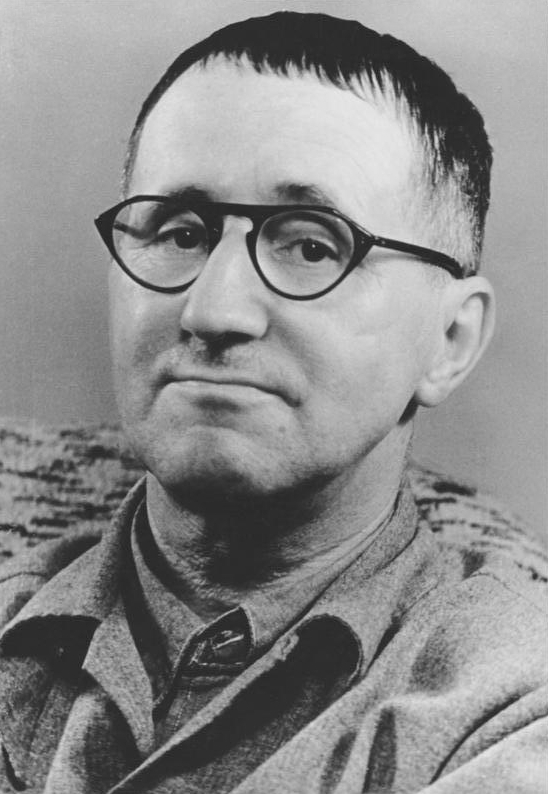
Eugen Berthold Friedrich Brecht, known as Bertolt Brecht and Bert Brecht, was a German theatre practitioner, playwright, and poet.
By globalcelebwiki Editorial Desk, adapted from Wikipedia · Published 29 September 2026
- Profession
- German poet, playwright, and theatre director (1898–1956)
- Born
- 10 February 1898
- Birthplace
- Augsburg
- Nationality
- Austrian
Overview
Eugen Berthold Friedrich Brecht (10 February 1898 – 14 August 1956), known as Bertolt Brecht and Bert Brecht, was a German theatre practitioner, playwright, and poet. Coming of age during the Weimar Republic, he had his first successes as a playwright in Munich and moved to Berlin in 1924, where he wrote The Threepenny Opera with Elisabeth Hauptmann and Kurt Weill and began a lifelong collaboration with the composer Hanns Eisler. Immersed in Marxist thought during this period, Brecht wrote didactic Lehrstücke and became a leading theoretician of epic theatre (which he later preferred to call "dialectical theatre") and the Verfremdungseffekt.
When the Nazis came to power in Germany in 1933, Brecht fled his home country, initially to Scandinavia. During World War II he moved to Southern California, where he established himself as a screenwriter while being surveilled by the FBI. In 1947, he was part of the first group of Hollywood film artists to be subpoenaed by the House Un-American Activities Committee for alleged Communist Party affiliations. The day after testifying, he returned to Europe, eventually settling in East Berlin, where he co-founded the theatre company Berliner Ensemble with his wife and long-time collaborator, actress Helene Weigel.
Bavaria (1898–1924)
Eugen Berthold Friedrich Brecht (as a child known as Eugen) was born on 10 February 1898 in Augsburg, Germany, the son of Berthold Friedrich Brecht (1869–1939) and his wife Sophie, née Brezing (1871–1920). Brecht's mother was a devout Protestant and his father a Roman Catholic (who had been persuaded to have a Protestant wedding). The modest house where he was born is today preserved as a Brecht Museum. His father worked for a paper mill, becoming its managing director in 1914. At Augsburg, his maternal grandparents lived in the neighbouring house. They were Pietists and his grandmother influenced Bertolt Brecht and his brother Walter considerably during their childhood.
Due to his grandmother's and his mother's influence, Brecht knew the Bible, a familiarity that would have a life-long effect on his writing. From his mother came the "dangerous image of the self-denying woman" that recurs in his drama. Brecht's home life was comfortably middle class, despite what his occasional attempt to claim peasant origins implied. At school in Augsburg he met Caspar Neher, with whom he formed a life-long creative partnership. Neher designed many of the sets for Brecht's dramas and helped to forge the distinctive visual iconography of their epic theatre.
When Brecht was 16, World War I broke out. Initially enthusiastic, Brecht soon changed his mind on seeing his classmates "swallowed by the army". Brecht was nearly expelled from school in 1915 for writing an essay in response to the line Dulce et decorum est pro patria mori from the Roman poet Horace, calling it Zweckpropaganda ("cheap propaganda for a specific purpose") and arguing that only an empty-headed person could be persuaded to die for their country. His expulsion was only prevented by the intervention of Romuald Sauer, a priest who also served as a substitute teacher at Brecht's school.
On his father's recommendation, Brecht sought to avoid being conscripted into the army by exploiting a loophole which allowed for medical students to be deferred. He subsequently registered for a medical course at the Ludwig-Maximilians-Universität München, where he enrolled in 1917. There he studied drama with Arthur Kutscher, who inspired in the young Brecht an admiration for the iconoclastic dramatist and cabaret star Frank Wedekind.
From July 1916, Brecht's newspaper articles began appearing under the new name "Bert Brecht" (his first theatre criticism for the Augsburger Volkswille appeared in October 1919). Brecht was drafted into military service in the autumn of 1918, only to be posted back to Augsburg as a medical orderly in a military VD clinic; the war ended a month later.
In 1923 Brecht's marriage to Zoff began to break down (though they did not divorce until 1927). Brecht had become involved both with Elisabeth Hauptmann and with Helene Weigel. Brecht and Weigel's son, Stefan, was born in October 1924.
In his role as dramaturg, Brecht had much to stimulate him but little work of his own. Reinhardt staged Shaw's Saint Joan, Goldoni's Servant of Two Masters (with the improvisational approach of the commedia dell'arte in which the actors chatted with the prompter about their roles), and Pirandello's Six Characters in Search of an Author in his group of Berlin theatres. A new version of Brecht's third play, now entitled Jungle: Decline of a Family, opened at the Deutsches Theater in October 1924, but was not a success.
At this time Brecht revised his important "transitional poem", "Of Poor BB". In 1925, his publishers provided him with Elisabeth Hauptmann as an assistant for the completion of his collection of poems, Devotions for the Home (Hauspostille, eventually published in January 1927). She continued to work with him after the publisher's commission ran out.
In 1925 in Mannheim the artistic exhibition Neue Sachlichkeit ("New Objectivity") had given its name to the new post-Expressionist movement in the German arts. With little to do at the Deutsches Theater, Brecht began to develop his Man Equals Man project, which was to become the first product of "the 'Brecht collective'—that shifting group of friends and collaborators on whom he henceforward depended". This collaborative approach to artistic production, together with aspects of Brecht's writing and style of theatrical production, mark Brecht's work from this period as part of the Neue Sachlichkeit movement. The collective's work "mirrored the artistic climate of the middle 1920s", Willett and Manheim argue:
with their attitude of Neue Sachlichkeit (or New Matter-of-Factness), their stressing of the collectivity and downplaying of the individual, and their new cult of Anglo-Saxon imagery and sport. Together the "collective" would go to fights, not only absorbing their terminology and ethos (which permeates Man Equals Man) but also drawing those conclusions for the theatre as a whole which Brecht set down in his theoretical essay "Emphasis on Sport" and tried to realise by means of the harsh lighting, the boxing-ring stage and other anti-illusionistic devices that henceforward appeared in his own productions.
Fearing persecution, Brecht fled Nazi Germany in February 1933, just after Hitler took power. Following brief spells in Prague, Zurich and Paris, he and Weigel accepted an invitation from journalist and author Karin Michaëlis to move to Denmark. The Brechts first stayed with Michaëlis at her house on the small island of Thurø close to the island of Funen. They later bought their own house in Svendborg on Funen. This Svendborg house at Skovsbo Strand 8 became the Brecht family residence for the next six years. They often received guests there including Walter Benjamin, Hanns Eisler and Ruth Berlau. Brecht also travelled frequently to Copenhagen, Paris, Moscow, New York and London for various projects and collaborations.
When war seemed imminent in April 1939, he moved to Stockholm, where he remained for a year. After Germany invaded Norway and Denmark, Brecht left Sweden for Helsinki, Finland, where he awaited a pending visa to the United States. During this time he co-wrote the play Mr Puntila and His Man Matti (Herr Puntila und sein Knecht Matti) with Hella Wuolijoki, with whom he lived in the Marlebäck manor house in Iitti.
Upon receipt of the U.S. visa in May 1941, the Brecht family relocated to Southern California. They rented a two-story home in the Los Angeles beach suburb of Santa Monica. By the late 1930s, the West Side of Los Angeles had become a thriving expatriate colony of European intellectuals and artists. Because the colony included so many writers, directors, actors, and composers from German-speaking countries, it has been referred to as "Weimar on the Pacific".
At the center of the émigré community was Brecht's old friend Salka Viertel, whom he had known in the Berlin theatre world of the 1920s. From her house in Santa Monica Canyon, Viertel hosted frequent tea parties and salons where European intellectuals could mingle with Hollywood luminaries. Brecht first met actor Charles Laughton at a Viertel party, and it led to the two men collaborating on the English-language version of Life of Galileo.
Although Brecht was not enamored of life in the movie capital, he worked hard to find a place for himself as a screenwriter. He co-wrote the screenplay for the Fritz Lang-directed film Hangmen Also Die! (1943) which was loosely based on the 1942 assassination of Reinhard Heydrich, the Nazi Deputy Reich Protector of the German-occupied Protectorate of Bohemia and Moravia. Heydrich had been Heinrich Himmler's right-hand man in the SS and a chief architect of the Holocaust; he was known as "The Hangman of Prague" (German: der Henker von Prag). For this film, Brecht's fellow expatriate, composer Hanns Eisler, was nominated for an Academy Award in the category of Best Music Score. The fact that three refugee artists from Nazi Germany – Lang, Brecht and Eisler – collaborated to make the film exemplified the influence this generation of German exiles had on American culture. Hangmen Also Die! turned out to be Brecht's only script that became a Hollywood film. The money he earned from selling the script enabled him to write The Visions of Simone Machard, Schweik in the Second World War and an adaptation of Webster's The Duchess of Malfi.
At the onset of the Cold War and "Second Red Scare" in the U.S., Brecht was blacklisted by movie studio bosses and investigated by the House Un-American Activities Committee (HUAC). Along with more than 40 other Hollywood writers, directors, actors and producers, he was subpoenaed in September 1947 by the HUAC. Although he was one of the 19 "unfriendly" witnesses who had declared ahead of time they would not cooperate with the House investigation, Brecht eventually decided to go before the committee and answer questions. He later explained he was following the advice of attorneys and did not want to delay his planned trip to Europe.
On 30 October 1947, Brecht testified to the HUAC that he had never been a member of the Communist Party. He made wry jokes throughout the proceedings, punctuating his inability to speak English well with continuous references to the translators present, who transformed his German statements into English ones unintelligible to himself. It was noted that his interpreter, David Baumgardt, had a heavy German accent which made him more difficult to understand than Brecht himself. With the chairman of the committee, J. Parnell Thomas, complaining that he "cannot understand the interpreter any more than I can the witness.". HUAC vice-chairman Karl Mundt thanked Brecht for his cooperation. The remaining unfriendly witnesses who appeared before the HUAC at that time, the so-called Hollywood Ten, declined on First Amendment grounds to answer about their Communist Party affiliations and were cited for contempt. Brecht's decision to be a "cooperative" witness—albeit in an evasive way and providing no useful information—led to criticism of him, including accusations of betrayal. The day after his testimony, Brecht fled to Europe and never returned to the U.S.
He lived in Zurich, Switzerland, for a year. In February 1948 in the Swiss town of Chur, Brecht staged an adaptation of Sophocles' Antigone, based on a translation by Hölderlin. The play was published under the title Antigonemodell 1948, accompanied by an essay on the importance of creating a "non-Aristotelian" form of theatre.
In 1949 he moved to East Berlin and established his theatre company there, the Berliner Ensemble. He retained Austrian nationality which was granted in 1950, and his overseas bank accounts from which he received valuable hard currency remittances. The copyrights on his writings were held by a Swiss company.
Though he was never a member of the Communist Party, Brecht had been schooled in Marxism by the dissident communist Karl Korsch. Korsch's version of the Marxist dialectic influenced Brecht greatly, both his aesthetic theory and theatrical practice. Brecht received the Stalin Peace Prize in 1954. His proximity to Marxist thought made him controversial in Austria, where his plays were boycotted by directors and not performed for more than ten years.
Brecht died on 14 August 1956 of a heart attack at the age of 58. He is buried in the Dorotheenstadt Cemetery on Chausseestraße in the Mitte neighbourhood of Berlin, overlooked by the residence he shared with Helene Weigel.
According to Stephen Parker, who reviewed Brecht's writings and unpublished medical records, Brecht contracted rheumatic fever as a child, which led to an enlarged heart, followed by life-long chronic heart failure and Sydenham's chorea. A report of a radiograph taken of Brecht in 1951 describes a badly diseased heart, enlarged to the left with a protruding aortic knob and with seriously impaired pumping. Brecht's colleagues characterized him as being very nervous, and sometimes shaking his head or moving his hands erratically. This can be reasonably attributed to Sydenham's chorea, which is also associated with emotional lability, personality changes, obsessive-compulsive behavior, and hyperactivity, which matched Brecht's behavior. "What is remarkable," wrote Parker, "is his capacity to turn abject physical weakness into peerless artistic strength, arrhythmia into the rhythms of poetry, chorea into the choreography of drama."
Theory and practice of theatre
Brecht developed the combined theory and practice of his epic theatre movement by synthesizing and extending the experiments of Erwin Piscator and Vsevolod Meyerhold to explore the theatre as a forum for political ideas and the creation of a critical aesthetics of dialectical materialism.
Epic Theatre proposed that a play should not cause the spectator to identify emotionally with the characters or action before him or her, but should instead provoke rational self-reflection and a critical view of the action on the stage. Brecht thought that the experience of a climactic catharsis of emotion left an audience complacent. Instead, he wanted his audiences to adopt a critical perspective in order to recognize social injustice and exploitation and to be moved to go forth from the theatre and effect change in the world outside. For this purpose, Brecht employed the use of techniques that remind the spectator that the play is a representation of reality and not reality itself. By highlighting the constructed nature of the theatrical event, Brecht hoped to communicate that the audience's reality was equally constructed, and as such, was changeable.
Brecht's modernist concern with drama-as-a-medium led to his refinement of the "epic form" of the drama. This dramatic form is related to similar modernist innovations in other arts, including the strategy of divergent chapters in James Joyce's novel Ulysses, Sergei Eisenstein's evolution of a constructivist "montage" in the cinema, and Picasso's introduction of cubist "collage" in the visual arts.
One of Brecht's most important principles was what he called the Verfremdungseffekt (translated as "defamiliarization effect", "distancing effect", or "estrangement effect", and often mistranslated as "alienation effect"). This involved, Brecht wrote, "stripping the event of its self-evident, familiar, obvious quality and creating a sense of astonishment and curiosity about them". To this end, Brecht employed techniques such as the actor's direct address to the audience, harsh and bright stage lighting, the use of songs to interrupt the action, explanatory placards, the transposition of text to the third person or past tense in rehearsals, and speaking the stage directions out loud. This theory was, however, not formalised until later in Brecht's dramatic career.
In contrast to many other avant-garde approaches, however, Brecht had no desire to destroy art as an institution; rather, he hoped to "re-function" the theatre to a new social use. In this regard he was a vital participant in the aesthetic debates of his era—particularly over the "high art/popular culture" dichotomy—vying with the likes of Theodor W. Adorno, György Lukács, Ernst Bloch, and developing a close friendship with Walter Benjamin. Brechtian theatre articulated popular themes and forms with avant-garde formal experimentation to create a modernist realism that stood in sharp contrast both to its psychological and socialist varieties. "Brecht's work is the most important and original in European drama since Ibsen and Strindberg," Raymond Williams argues, while Peter Bürger dubs him "the most important materialist writer of our time."
Legacy
Brecht's widow, the actress Helene Weigel, continued to manage the Berliner Ensemble until her death in 1971. The theatre company was primarily devoted to performing Brecht's plays. His plays were a focus of the Schauspiel Frankfurt when Harry Buckwitz was general manager, including the world premiere of Die Gesichte der Simone Machard in 1957.
Brecht's son, Stefan Brecht, became a poet and theatre critic interested in New York's avant-garde theatre, and was pivotal in the development of "queer theatre", on which he wrote a book in 1978.
Besides being a prominent dramatist and poet, Bertolt Brecht has also been cited by scholars for making significant original contributions to social and political philosophy.
The aesthetic theories of Brecht had a major influence on radical cinema in the 1960s and 1970s. Jean-Luc Godard, Alexandre Kluge, Rainer Werner Fassbinder, Nagisa Ōshima and Jean-Marie Straub and Danielle Huillet are often cited as the principal exponents of "Brechtian cinema".
Brecht's collaborations with Kurt Weill influenced the evolution of rock. The "Alabama Song" for example, originally published as a poem in Brecht's Hauspostille (1927) and set to music by Weill in Mahagonny, was recorded by The Doors on their self-titled debut album, as well as by David Bowie and various other bands and soloists since the 1960s. In his memoir, Bob Dylan wrote about the huge impact that "Pirate Jenny" from The Threepenny Opera had on him. He first heard the song in a New York theatrical show that featured compositions by Brecht and Weill. At the time, Dylan was performing traditional folk music and had barely ventured into his own songwriting. But the "outrageous power" of "Pirate Jenny" was an epiphany which prompted him to start experimenting with the storytelling possibilities of song.
Collaborators and associates
Collective and collaborative working methods were inherent to Brecht's approach, as Fredric Jameson (among others) stresses. Jameson describes the creator of the work not as Brecht the individual, but rather as 'Brecht': a collective subject that "certainly seemed to have a distinctive style (the one we now call 'Brechtian') but was no longer personal in the bourgeois or individualistic sense." During the course of his career, Brecht sustained many long-lasting creative relationships with other writers, composers, scenographers, directors, dramaturgs and actors; the list includes: Elisabeth Hauptmann, Helene Weigel, Margarete Steffin, Ruth Berlau, Slatan Dudow, Kurt Weill, Hanns Eisler, Paul Dessau, Caspar Neher, Teo Otto, Karl von Appen, Ernst Busch, Lotte Lenya, Peter Lorre, Therese Giehse, Angelika Hurwicz, Carola Neher and Charles Laughton. This is "theatre as collective experiment [...] as something radically different from theatre as expression or as experience."
Stories of Mr. Keuner (Geschichten vom Herrn Keuner)
Threepenny Novel (Dreigroschenroman, 1934)
The Business Affairs of Mr. Julius Caesar (Die Geschäfte des Herrn Julius Caesar, 1937–39, unfinished, published 1957)
Tales from the Calendar (short-story collection)
"The Job", alternate title "By The Sweat of Thy Brow Shalt Thou Fail to Earn Thy Bread"
Entries show: English-language translation of title (German-language title) [year written] / [year first produced]
The Modern Theatre Is the Epic Theatre (1930)
The Threepenny Lawsuit (Der Dreigroschenprozess) (written 1931; published 1932)
The Book of Changes (fragment also known as Me-Ti; written 1935–1939)
The Street Scene (written 1938; published 1950)
The Popular and the Realistic (written 1938; published 1958)
Brecht wrote hundreds of poems throughout his life. He began writing poetry as a young boy, and his first poems were published in 1914. His poetry was influenced by folk-ballads, French chansons, and the poetry of Rimbaud and Villon. The last collection of new poetry by Brecht published in his lifetime was the 1939 Svendborger Gedichte.
Sources and references
Spotted something wrong? Report a correction.
Related profiles

Actor
Meryl Streep
The most-nominated performer in Academy Awards history, known for her range across four decades of film and stage.
Read biography ↗
Actor and director
Denzel Washington
An American actor and director whose screen work spans Glory, Malcolm X and Training Day, alongside acclaimed stage performances.
Read biography ↗