American novelist, poet, essayist, screenwriter (1947-2024)
Paul Auster
Paul Benjamin Auster was an American writer, novelist, memoirist, poet, and filmmaker.
By globalcelebwiki Editorial Desk, adapted from Wikipedia · Published 29 September 2026
- Profession
- American novelist, poet, essayist, screenwriter (1947-2024)
- Born
- 3 February 1947
- Birthplace
- Newark
- Nationality
- American

Overview
Paul Benjamin Auster (February 3, 1947 – April 30, 2024) was an American writer, novelist, memoirist, poet, and filmmaker. His notable works include The New York Trilogy (1987), Moon Palace (1989), The Music of Chance (1990), True Tales of American Life (2001), The Book of Illusions (2002), The Brooklyn Follies (2005), Invisible (2009), Sunset Park (2010), Winter Journal (2012), 4 3 2 1 (2017), and Bloodbath Nation (2023). His books have been translated into more than 40 languages.
Early life
Paul Auster was born in Newark, New Jersey, son of Samuel Auster, a landlord who owned buildings with his brothers in Jersey City, and Queenie, née Bogat. His middle-class parents were Jewish, of Austrian descent; the marriage was an unhappy one, and they divorced during Auster's senior year of high school, he moving with his mother and sister to an apartment at Weequahic, Newark. An uncle was the translator Allen Mandelbaum. Auster grew up in South Orange, New Jersey, and Newark, and graduated from Columbia High School in Maplewood.
During the summers of 1958 and 1959, Auster attended, respectively, Camp LakeView (East Brunswick, NJ) and Camp Pontiac (Copake, NY), where his outstanding athletic talents were recognized, especially as a baseball infielder. While attending summer camp, the 14-year-old Auster witnessed what he called the "seminal experience" of his life: a boy being struck by lightning and dying instantly. The boy was crawling under barbed wire a few inches away from him at the time. This event changed his life, causing him to think about it every day.
Career
After graduating from Columbia University with B.A. and M.A. degrees (English, Comparative Literature) in 1970, he moved to Paris where, among other jobs, he tried to earn a living translating French literature. After returning to the United States in 1974, he continued to work on his poems, essays, and translations of French writers, such as Stéphane Mallarmé and Joseph Joubert. His work as a translator led to the publication in 1982 of The Random House Book of Twentieth-Century French Poetry, which he edited.
Following the appearance in 1982 of his acclaimed debut work, a memoir titled The Invention of Solitude, Auster gained renown for a series of three loosely connected novellas published collectively as The New York Trilogy (1987), and is often cited as his most widely known work to the general reading public.
Although The New York Trilogy gives a nod to the detective genre, they are not conventional detective stories organized around solving mysteries. Rather, Auster uses the detective form to address questions of identity, space, language, and literature, creating his own distinctively postmodern form in the process. Auster disagrees with this analysis, because he believes that "the Trilogy grows directly out of The Invention of Solitude".
Similar to the themes explored in The New York Trilogy, the search for identity and personal meaning continued to permeate the three novels Auster published in quick succession in the late 1980s. Whether writing about the relationships between people caught in the flux of an uncertain future and uncertain identity (In the Country of Last Things [1987] and Moon Palace [1989]), or the role of coincidence and random events in our lives (The Music of Chance [1990]), Auster was steadily increasing his readership and popularity.
During the 1990s, Auster published three more novels, but he increasingly turned his attention to script writing and filmmaking by way of his screenplay and directorial collaborations with Wayne Wang on Smoke (which won Auster the Independent Spirit Award for Best First Screenplay) and Blue in the Face. He also directed the movie Lulu on the Bridge (1998).
Reception
"Over the past twenty-five years", wrote Michael Dirda in The New York Review of Books in 2008, "Paul Auster has established one of the most distinctive niches in contemporary literature". Dirda extolled his virtues in The Washington Post, attesting that Auster had "perfected a limpid, confessional style" and constructed suspenseful, sometimes autobiographical plots. His heroes operated in a world that appeared familiar but they confronted "vague menace and possible hallucination."
Writing about Auster's 2017 novel 4 3 2 1, Booklist critic Donna Seaman remarked that Auster went beyond conventions of storytelling and mixed genres, even crossing over into filmic modes. She praised the complex sense of wonder and gratitude in his works, which often features "sly humor" in an oeuvre which she considered "a grand experiment, not only in storytelling, but also in the endless nature-versus-nurture debate, the perpetual dance between inheritance and free will, intention and chance, dreams and fate. This elaborate investigation into the big what-if is also a mesmerizing dramatization of the multitude of clashing selves we each harbor within."
The English critic James Wood criticized Auster for what he considered "borrowed language" and "bogus dialogue", nonetheless conceding that Auster was "probably America's best-known postmodern novelist". Wood noted: "One reads Auster's novels very fast, because they are lucidly written, because the grammar of the prose is the grammar of the most familiar realism (the kind that is, in fact, comfortingly artificial), and because the plots, full of sneaky turns and surprises and violent irruptions, have what the Times once called 'all the suspense and pace of a bestselling thriller'."
Personal life and death
Auster's first marriage, to writer Lydia Davis, lasted from 1974 until their separation in 1979; they divorced in 1981. Their only child, Daniel, was charged in April 2022 with second-degree manslaughter and criminally negligent homicide following the fentanyl and heroin overdose death of his 10-month-old daughter. He died later that month of an accidental drug overdose.
In 1981, Auster married his second wife, writer Siri Hustvedt, the daughter of professor and scholar Lloyd Hustvedt. They lived in Brooklyn and had one daughter, Sophie Auster, a singer.
Awards and honors
1989: Prix France Culture de Littérature Étrangère
1990: Morton Dauwen Zabel Award from the American Academy of Arts and Letters
1991: PEN/Faulkner Award for Fiction shortlist for The Music of Chance
1993: Prix Médicis Étranger for Leviathan
1995: Independent Spirit award for best first screenplay for Smoke
Squeeze Play (1982) (written under pseudonym Paul Benjamin)
The New York Trilogy (1987) ISBN 9780140169638
In the Country of Last Things (1987) ISBN 9780140097054
The Music of Chance (1990) ISBN 9780140157390
The Red Notebook (1995) (originally printed in Granta (44); 1993)
Collected Prose (contains The Invention of Solitude, The Art of Hunger, The Red Notebook, and Hand to Mouth as well as various other previously uncollected pieces) (first edition, 2005; expanded second edition, 2010)
Here and Now: Letters, 2008–2011 (2013) A collection of letters exchanged with J. M. Coetzee
A Life in Words: In Conversation with I. B. Siegumfeldt (2017)
Talking to Strangers: Selected Essays, Prefaces, and Other Writings, 1967–2017 (2019)
Groundwork: Autobiographical Writings, 1979–2012 (2020)
Ground Work: Selected Poems and Essays 1970–1979 (1990)
White Spaces: Selected Poems and Early Prose (2020)
The Random House Book of Twentieth-Century French Poetry (1982)
True Tales of American Life (first published under the title I Thought My Father Was God, and Other True Tales from NPR's National Story Project) (2001)
Fits and Starts: Selected Poems of Jacques Dupin, translated by Paul Auster, Living Hand Editions, 1974
"The Uninhabited: Selected Poems of André du Bouchet" (1976)
Life/Situations, by Jean-Paul Sartre (1977) (in collaboration with Lydia Davis)
Aboard the Aquitaine, by Georges Simenon (1979) (with Lydia Davis)
A Tomb for Anatole by Stéphane Mallarmé (1983)
The Story of My Typewriter with paintings by Sam Messer (2002)
"The Accidental Rebel" (April 23, 2008: article in The New York Times)
"ALONE" (2015) – Prose piece from 1969 published in six copies along with "Becoming the Other in Translation" (2014) by Siri Hustvedt. Published by Danish small press Ark Editions.
"Film Close Up: Smoke and Blue in the Face" (2022) Book by Chris Wade on Auster and Wayne Wang's 1995 films. Auster was interviewed for the book and helped with the edit.
Other media
In 1993, a movie adaptation of The Music of Chance was released. Auster features in a cameo role at the end of the film.
In 1994 City of Glass was adapted as a graphic novel by artist David Mazzucchelli and Paul Karasik. Auster's close friend, noted cartoonist Art Spiegelman, produced the adaptation.
In 1998, Auster was the executive producer on the short film I Remember from filmmaker Avi Zev Weider, who adapted it from Joe Brainard’s book I Remember.
From 1999 to 2001, Auster was part of NPR's National Story Project, a monthly radio show in which, together With NPR correspondent Jacki Lyden, Auster read stories sent in by NPR listeners across America. Listeners were invited to send in stories of "anywhere from two paragraphs to two pages" that "must be true", from which Auster later selected entries, edited them and subsequently read them on the air. Auster read over 4,000 stories submitted to the show, with a few dozen eventually featured on the show and many more anthologized in two 2002 books edited by Auster.
Jazz trumpeter and composer Michael Mantler's 2001 album Hide and Seek borrows the words and language from Auster's short play Hide and Seek, which Mantler found in Auster's Hand to Mouth.
Sources and references
Spotted something wrong? Report a correction.
Related profiles

Singer and songwriter
Beyoncé
A singer, songwriter and performer whose career spans Destiny's Child and a run of genre-shifting solo albums.
Read biography ↗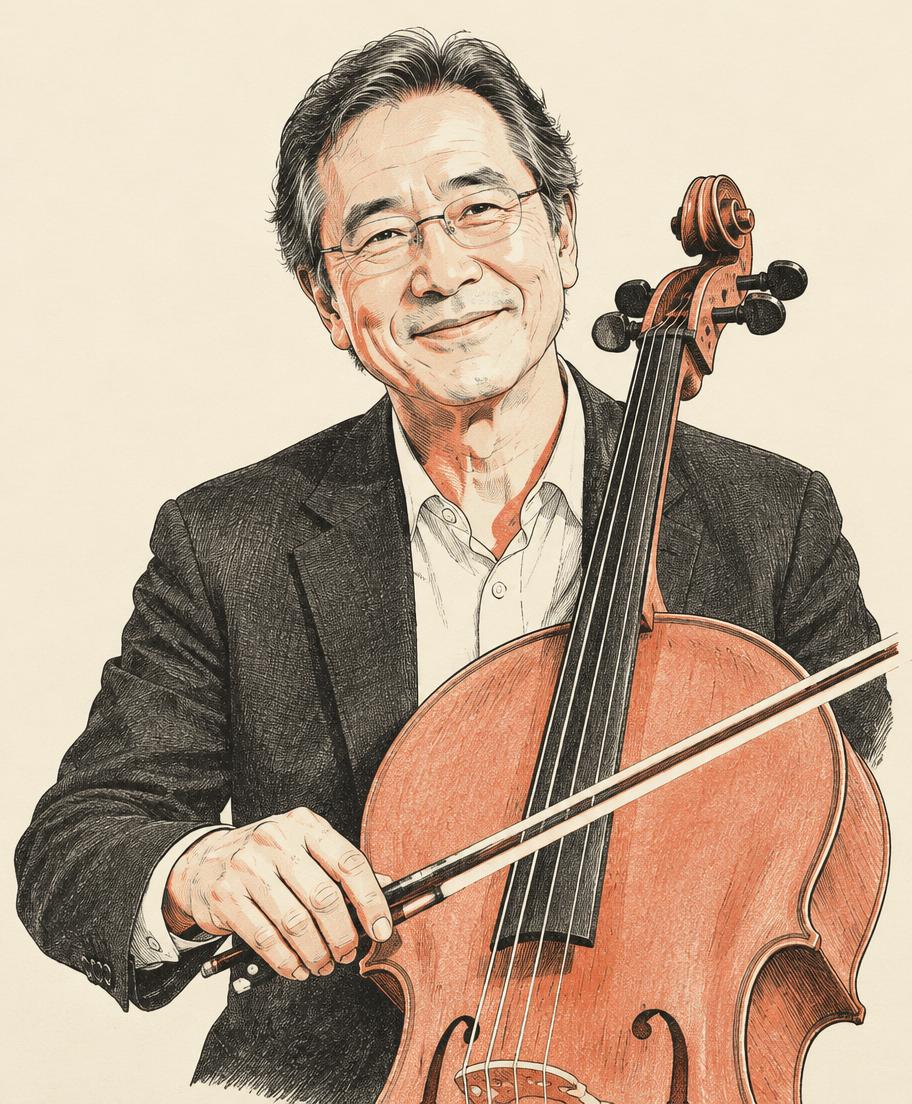
Cellist
Yo-Yo Ma
A cellist known for his recordings of the Bach cello suites and for decades of cross-cultural musical collaboration.
Read biography ↗
British singer (1949–2012)
Robin Gibb
Robin Hugh Gibb was a British singer and songwriter.
Read biography ↗