French musician, conductor, and teacher (1887-1979)
Nadia Boulanger
Juliette Nadia Boulanger was a French music teacher, conductor and composer.
By globalcelebwiki Editorial Desk, adapted from Wikipedia · Published 29 September 2026
- Profession
- French musician, conductor, and teacher (1887-1979)
- Born
- 16 September 1887
- Birthplace
- 9th arrondissement of Paris
- Nationality
- French
Overview
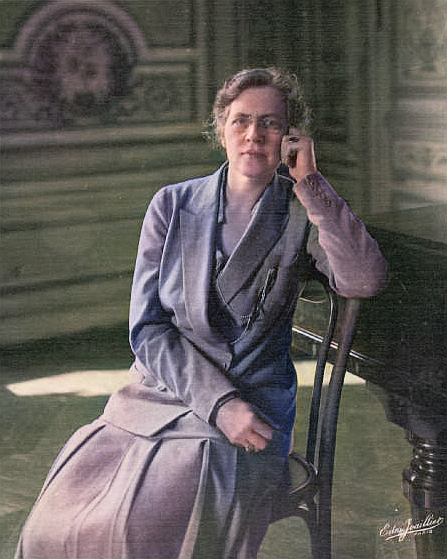
Juliette Nadia Boulanger (French: [ʒyljɛt nadja bulɑ̃ʒe] ; 16 September 1887 – 22 October 1979) was a French music teacher, conductor and composer. She taught many of the leading composers and musicians of the twentieth century, and also performed occasionally as a pianist and organist.
Born into a musical family (her father Ernest and sister Lili were acclaimed composers), Boulanger entered the Conservatoire de Paris at an early age but, believing that she lacked particular compositional talent, she forsook writing music and became a teacher. In that capacity, she influenced generations of young composers, especially those from the United States and other English-speaking countries. Among her students were many important composers, soloists, arrangers, and conductors, including Grażyna Bacewicz, Daniel Barenboim, İdil Biret, Elliott Carter, Aaron Copland, David Diamond, John Eliot Gardiner, Philip Glass, Roy Harris, Quincy Jones, Dinu Lipatti, Igor Markevitch, Astor Piazzolla, Julia Perry, George Walker, and over 250 others.
She taught in the United States and the United Kingdom, working with music academies including the Juilliard School, the Yehudi Menuhin School, the Longy School, the Royal College of Music and the Royal Academy of Music, but her principal base for most of her life was her family flat in Paris. There, she taught for most of the seven decades from the start of her career until her death at the age of 92.
Boulanger was the first woman to conduct many major orchestras in America and Europe, including the BBC Symphony, Boston Symphony, Hallé, and Philadelphia orchestras. She conducted several world premieres, including works by Copland and Stravinsky.
Early life and education
Juliette Nadia Boulanger was born in Paris on 16 September 1887, to French composer and pianist Ernest Boulanger (1815–1900) and his wife Raissa Myshetskaya (1856–1935), a Russian princess, who descended from St. Mikhail Tchernigovsky.
Ernest Boulanger had studied at the Paris Conservatoire and, in 1835 at the age of 20, won the coveted Prix de Rome for composition. He wrote comic operas and incidental music for plays but was most widely known for his choral music. He achieved distinction as a director of choral groups, teacher of voice, and a member of choral competition juries. After years of rejection, in 1872 he was appointed to the Paris Conservatoire as professor of singing.
Raissa qualified as a home tutor (or governess) in 1873. According to Ernest, he and Raissa met in Russia in 1873, and she followed him back to Paris. She joined his voice class at the Conservatoire in 1876, and they were married in Russia in 1877.
Ernest and Raissa had a daughter, Ernestine Mina Juliette, who died as an infant before Nadia was born on her father's 72nd birthday.
Through her early years, although both parents were very active musically, Nadia would get upset by hearing music and hide until it stopped. In 1892, when Nadia was five, Raissa became pregnant again. During the pregnancy, Nadia's response to music changed drastically. "One day I heard a fire bell. Instead of crying out and hiding, I rushed to the piano and tried to reproduce the sounds. My parents were amazed." After this, Boulanger paid great attention to the singing lessons her father gave, and she began to study the rudiments of music.
After leaving the Conservatoire in 1904 and before her sister's untimely death in 1918, Boulanger was a keen composer, encouraged by both Pugno and Fauré. Caroline Potter, writing in The New Grove Dictionary of Music and Musicians, says of Boulanger's music: "Her musical language is often highly chromatic (though always tonally based), and Debussy's influence is apparent." Her goal was to win the First Grand Prix de Rome as her father had done, and she worked tirelessly towards it in addition to her increasing teaching and performing commitments. She first submitted work for judging in 1906, but failed to make it past the first round. In 1907, she progressed to the final round but again did not win.
In late 1907, she was appointed to teach elementary piano and accompagnement au piano at the newly created Conservatoire Femina-Musica. She was also appointed as assistant to Henri Dallier, the professor of harmony at the Conservatoire.
In the 1908 Prix de Rome competition, Boulanger caused a stir by submitting an instrumental fugue rather than the required vocal fugue. The subject was taken up by the national and international newspapers, and was resolved only when the French Minister of Public Information decreed that Boulanger's work be judged on its musical merit alone. She won the Second Grand Prix for her cantata, La Sirène.
In 1908, as well as performing piano duets in public concerts, Boulanger and Pugno collaborated on composing a song cycle, Les Heures claires, which was well-received enough to encourage them to continue working together. Still hoping for a Grand Prix de Rome, Boulanger entered the 1909 competition but failed to win a place in the final round. Later that year, her sister Lili, then sixteen, announced to the family her intention to become a composer and win the Prix de Rome herself.
In 1910, Annette Dieudonné became a student of Boulanger's, continuing with her for the next fourteen years. When her studies ended, she began teaching Boulanger's students the rudiments of music and solfège. She was Boulanger's close friend and assistant for the rest of her life.
Nadia struggled with the death of her sister and according to Jeanice Brooks, "[t]he dichotomy between private grief and public strength was strongly characteristic of Boulanger's frame of mind in the immediate aftermath of World War I. Privately, Nadia kept a shrine to her sister in her home. This was likely influenced by the resurgence of spiritism, the interest in a person’s spiritual existence after death and communication with lost loved ones. It may have also been influenced by her involvement in Catholicism, which utilizes objects, figures, and rituals as mediators between the living and the dead. Guilt at surviving her talented sibling seems to have led to determination to deserve Lili's death, which Nadia framed as redemptive sacrifice, by throwing herself into work and domestic responsibility: as Nadia wrote in her datebook in January 1919, 'I place this new year before you, my little beloved Lili–may it see me fulfill my duty towards you–so that it is less terrible for Mother and that I try to resemble you.'"
In 1919, Boulanger performed in more than twenty concerts, often programming her own music and that of her sister. Since the Conservatoire Femina-Musica had closed during the war, Alfred Cortot and Auguste Mangeot founded a new music school in Paris, which opened later that year as the École normale de musique de Paris. Boulanger was invited by Cortot to join the school, where she taught classes in harmony, counterpoint, musical analysis, organ and composition.
Mangeot also asked Boulanger to contribute articles of music criticism to his paper Le Monde Musical, and she occasionally provided articles for this and other newspapers for the rest of her life, though she never felt at ease setting her opinions down for posterity in this way.
In 1920, Boulanger began to compose again, writing a series of songs to words by Camille Mauclair. In 1921, she performed at two concerts in support of women's rights, both of which featured music by Lili. However, later in life she claimed never to have been involved with feminism, and that women should not have the right to vote as they "lacked the necessary political sophistication."
In the summer of 1921, the French Music School for Americans opened at Fontainebleau, with Boulanger listed on the programme as a professor of harmony. Her close friend Isidor Philipp headed the piano departments of both the Paris Conservatory and the new Fontainebleau School and was an important draw for American students. She inaugurated the custom, which would continue for the rest of her life, of inviting the best students to her summer residence at Gargenville one weekend for lunch and dinner. Among the students attending the first year at Fontainebleau was Aaron Copland.
Boulanger's unrelenting schedule of teaching, performing, composing, and writing letters started to take its toll on her health; she had frequent migraines and toothaches. She stopped writing as a critic for Le Monde musical as she could not attend the requisite concerts. To maintain her and her mother's living standards, she concentrated on teaching which was her most lucrative source of income. Fauré believed she was mistaken to stop composing, but she told him, "If there is one thing of which I am certain, it is that I wrote useless music."
In 1924, Walter Damrosch, Arthur Judson and the New York Symphony Society arranged for Boulanger to tour the USA. She set sail on the Cunard flagship RMS Aquitania on Christmas Eve. The ship arrived on New Year's Eve in New York after an extremely rough crossing. During this tour, she performed solo organ works, pieces by Lili, and premiered Copland's new Symphony for Organ and Orchestra, which he had written for her. She returned to France on 28 February 1925.
Later that year, Boulanger approached the publisher Schirmer to enquire if they would be interested in publishing her methods of teaching music to children. When nothing came of it, she abandoned trying to write about her ideas.
Gershwin visited Boulanger in 1927, asking for lessons in composition. They spoke for half an hour after which Boulanger announced, "I can teach you nothing." Taking this as a compliment, Gershwin repeated the story many times.
In 1936, Boulanger substituted for Alfred Cortot in some of his piano masterclasses, coaching the students in Mozart's keyboard works. Later in the year, she traveled to London to broadcast her lecture-recitals for the BBC, as well as to conduct works including Schütz, Fauré and Lennox Berkeley. Noted as the first woman to conduct the London Philharmonic Orchestra, she received acclaim for her performances.
Boulanger's long-held passion for Monteverdi culminated in her recording six discs of madrigals for His Master's Voice in 1937, which brought his music to a new, wider audience. Not all reviewers approved her use of modern instruments.
When Paul Hindemith published his The Craft of Musical Composition, Boulanger asked him for permission to translate the text into French, and to add her own comments. Hindemith never responded to her offer. After he fled from Nazi Germany to the United States, they did not discuss the matter further.
Late in 1937, Boulanger returned to Britain to broadcast for the BBC and hold her popular lecture-recitals. In November, she became the first woman to conduct a complete concert of the Royal Philharmonic Society in London, which included Fauré's Requiem and Monteverdi's Amor (Lamento della ninfa). Describing her concerts, Mangeot wrote,
She never uses a dynamic level louder than mezzo-forte and she takes pleasure in veiled, murmuring sonorities, from which she nevertheless obtains great power of expression. She arranges her dynamic levels so as never to have need of fortissimo ...
As the Second World War loomed, Boulanger helped her students leave France. She made plans to do so herself. Stravinsky joined her at Gargenville, where they awaited news of the German attack against France. Waiting to leave France till the last moment before the invasion and occupation, Boulanger arrived in New York via Madrid and Lisbon on 6 November 1940.
After her arrival, Boulanger traveled to the Longy School of Music in Cambridge, Massachusetts, to give classes in harmony, fugue, counterpoint and advanced composition. In 1942, she also began teaching at the Peabody Conservatory in Baltimore. Her classes included music history, harmony, counterpoint, fugue, orchestration and composition.
Leaving America at the end of 1945, she returned to France in January 1946. There she accepted a position of professor of accompagnement au piano at the Paris Conservatoire. In 1953, she was appointed overall director of the Fontainebleau School. She also continued her touring to other countries.
As a long-standing friend of the family, and as official chapel-master to the Prince of Monaco, Boulanger was asked to organise the music for the wedding of Prince Rainier of Monaco and the American actress Grace Kelly in 1956. In 1958, she returned to the US for a six-week tour. She combined broadcasting, lecturing, and making four television films.
Also in 1958, she was inducted as an Honorary Member into Sigma Alpha Iota, the international women's music fraternity, by the Gamma Delta chapter at the Crane School of Music in Potsdam, New York.
In 1962, she toured Turkey, where she conducted concerts with her young protégée İdil Biret. Later that year, she was invited to the White House of the United States by President John F. Kennedy and his wife Jacqueline, and in 1966, she was invited to Moscow to a jury for the International Tchaikovsky Competition, chaired by Emil Gilels. While in England, she taught at the Yehudi Menuhin School. She also gave lectures at the Royal College of Music and the Royal Academy of Music, all of which were broadcast by the BBC.
Her eyesight and hearing began to fade toward the end of her life. On 13 August 1977, in advance of her 90th birthday, she was given a surprise birthday celebration at Fontainebleau's English Garden. The school's chef had prepared a large cake, on which was inscribed: "1887–Happy Birthday to you, Nadia Boulanger–Fontainebleau, 1977". When the cake was served, 90 small white candles floating on the pond illuminated the area. Boulanger's then-protégé, Emile Naoumoff, performed a piece he had composed for the occasion. Boulanger worked almost until her death in 1979 in Paris. She is buried at the Montmartre Cemetery with her sister Lili and their parents.
Pedagogy
Asked about the difference between a well-made work and a masterpiece, Boulanger replied,
I can tell whether a piece is well-made or not, and I believe that there are conditions without which masterpieces cannot be achieved, but I also believe that what defines a masterpiece cannot be pinned down. I won't say that the criterion for a masterpiece does not exist, but I don't know what it is. She claimed to enjoy all "good music". According to Lennox Berkeley, "A good waltz has just as much value to her as a good fugue, and this is because she judges a work solely on its aesthetic content." "She was an admirer of Debussy, and a disciple of Ravel. Although she bore little sympathy for Schoenberg and the Viennese dodecaphonicians, she was an ardent champion of Stravinsky."
She insisted on complete attention at all times: "Anyone who acts without paying attention to what he is doing is wasting his life. I'd go so far as to say that life is denied by lack of attention, whether it be to cleaning windows or trying to write a masterpiece."
In 1920, two of her favourite female students left her to marry. She thought they had betrayed their work with her and their obligation to music. Her attitude to women in music was contradictory: despite Lili's success and her own eminence as a teacher, she held throughout her life that a woman's duty was to be a wife and mother. According to Ned Rorem, she would "always give the benefit of the doubt to her male students while overtaxing the females". She saw teaching as a pleasure, a privilege and a duty: "No-one is obliged to give lessons. It poisons your life if you give lessons and it bores you."
Boulanger accepted pupils from any background; her only criterion was that they had to want to learn. She treated students differently depending on their ability: her talented students were expected to answer the most rigorous questions and perform well under stress. The less able students, who did not intend to follow a career in music, were treated more leniently, and Michel Legrand claimed that the ones she disliked were graduated with a first prize in one year: "The good pupils never got a reward so they stayed. I was [there] for seven years. And I never obtained a first prize". Each student had to be approached differently: "When you accept a new pupil, the first thing is to try to understand what natural gift, what intuitive talent he has. Each individual poses a particular problem." "It does not matter what style you use, as long as you use it consistently." Boulanger used a variety of teaching methods, including traditional harmony, score reading at the piano, species counterpoint, analysis, and sight-singing (using fixed-Do solfège).
Honours and awards
1962 Foreign Honorary Member of the American Academy of Arts and Sciences
1975 Médaille d'Or of the Académie des Beaux-Arts of the Institut de France
1977 Grand officier to the Légion d'honneur
2012 Induction into the American Classical Music Hall of Fame
Key works
Allons voir sur le lac d'argent (A. Silvestre), 2 voices, piano, 1905
Ecoutez la chanson bien douce (Verlaine), 1 voice, orchestra, 1905
Les sirènes (Grandmougin), female chorus, orchestra, 1905
À l'aube (Silvestre), chorus, orchestra, 1906
À l'hirondelle (Sully Prudhomme), chorus, orchestra, 1908
Recordings
Mademoiselle: Premiere Audience – Unknown Music of Nadia Boulanger, Delos DE 3496 (2017)
Tribute to Nadia Boulanger, Cascavelle VEL 3081 (2004)
BBC Legends: Nadia Boulanger, BBCL 40262 (1999)
Women of Note. Koch International Classics B000001SKH (1997)
Chamber Music by French Female Composers. Classic Talent B000002K49 (2000)
Sources and references
Spotted something wrong? Report a correction.
Related profiles

Singer and songwriter
Beyoncé
A singer, songwriter and performer whose career spans Destiny's Child and a run of genre-shifting solo albums.
Read biography ↗
Cellist
Yo-Yo Ma
A cellist known for his recordings of the Bach cello suites and for decades of cross-cultural musical collaboration.
Read biography ↗
British singer (1949–2012)
Robin Gibb
Robin Hugh Gibb was a British singer and songwriter.
Read biography ↗