Irish singer-songwriter and political activist (born 1951)
Bob Geldof
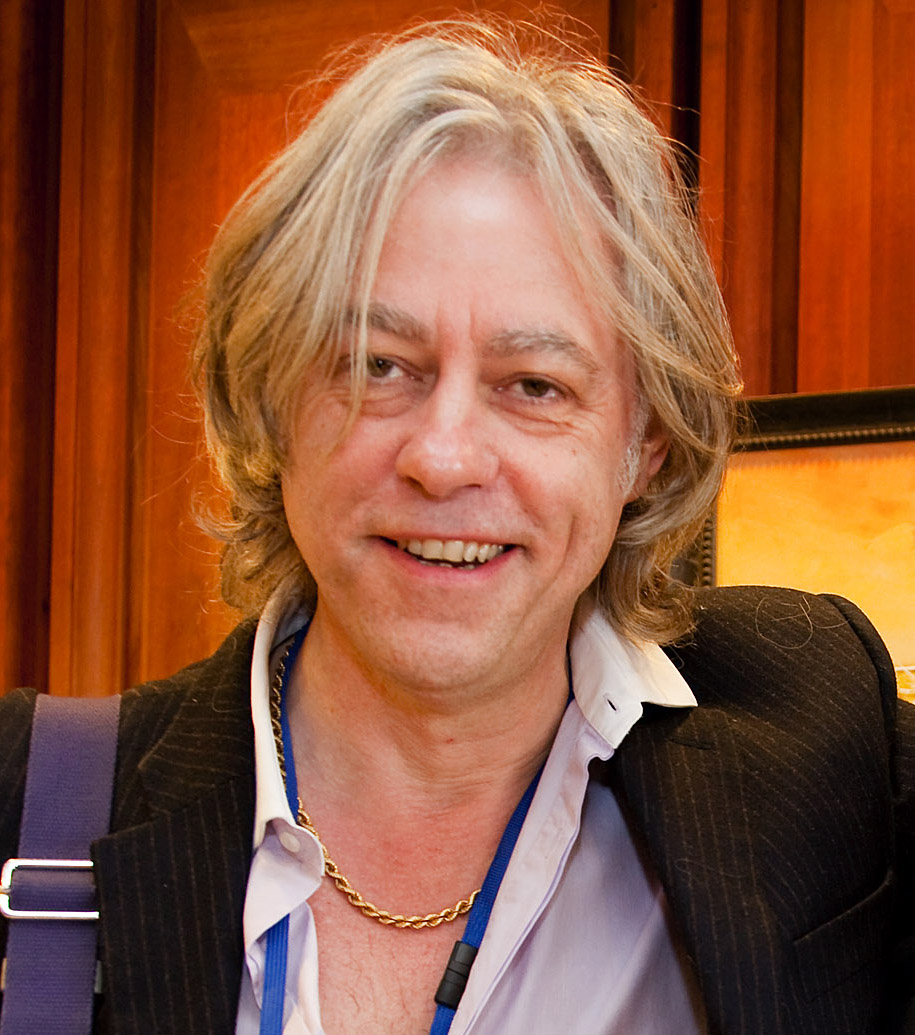
Robert Frederick Zenon Geldof is an Irish singer-songwriter, political activist, television producer and entrepreneur.
By globalcelebwiki Editorial Desk, adapted from Wikipedia · Published 29 September 2026
- Profession
- Irish singer-songwriter and political activist (born 1951)
- Born
- 5 October 1951
- Birthplace
- Dún Laoghaire
- Nationality
- Irish
Overview
Robert Frederick Zenon Geldof (; born 5 October 1951) is an Irish singer-songwriter, political activist, television producer and entrepreneur. He rose to prominence in the late 1970s as the lead singer of the Irish rock band the Boomtown Rats, who achieved popularity as part of the punk rock movement. The band had UK number one hits with his co-compositions "Rat Trap" and "I Don't Like Mondays". Geldof starred as Pink in Pink Floyd's film Pink Floyd – The Wall (1982).
Geldof is widely recognised for his activism, especially his anti-poverty efforts concerning Africa. In 1984, Geldof and Midge Ure organised the charity supergroup Band Aid for famine relief in Ethiopia, and co-wrote the best-selling single "Do They Know It's Christmas?". They organised the charity super-concert Live Aid the following year and the Live 8 concerts in 2005. Geldof serves as an adviser to the ONE Campaign, co-founded by fellow Irish rock singer and activist Bono, and is a member of the Africa Progress Panel (APP), a group of ten distinguished individuals who advocate at the highest levels for equitable and sustainable development in Africa.
Geldof was granted an honorary knighthood (KBE) by Queen Elizabeth II in 1986 for his charity work in Africa. It was an honorary award as Geldof is an Irish citizen, but he is often referred to as 'Sir Bob'. Among numerous other awards and nominations he was a recipient of the Man of Peace title, which recognised individuals who had made "an outstanding contribution to international social justice and peace". In 2005, he received the Brit Award for Outstanding Contribution to Music.
Early life
Geldof was born and brought up in Dún Laoghaire in County Dublin in Ireland, a son of Robert Geldof (1914–2010) and Evelyn (née Weller). His paternal grandfather, Zenon Geldof, was a Belgian immigrant and a hotel chef. His paternal grandmother, Amelia Falk, was a British Jew from London of German-Jewish descent. His maternal grandfather Frederick Weller was a dentist. His mother, Evelyn, was head cashier at a cinema in Cork City, where she met her husband, Robert. Bob Geldof has relatives in County Cork. His maternal aunt Catherine Weller was married to Tommy Nott, who worked as night foreman at the Cork Examiner newspaper, but whose relationship to Geldof has been twice misreported in that newspaper.
Regarding his Jewish ancestry, in a 2011 interview with the Manchester-based Jewish Telegraph, Geldof said "I was a quarter Catholic, a quarter Protestant, a quarter Jewish and a quarter nothing – the nothing won."
On 5 June 1960, when Geldof was eight years old, his mother Evelyn died at age 45 of a cerebral haemorrhage. He had two sisters, Cleo and Lynn. Cleo died in 2010 and Lynn is a writer, journalist, and Unicef campaigner.
Geldof attended Blackrock College, Dublin where he was bullied for being a poor rugby player and for his middle name, Zenon. After working as a slaughterman, a road navvy and pea canner in Wisbech, England, he was hired as a music journalist in Vancouver, British Columbia, Canada, for The Georgia Straight. He briefly guest hosted the Canadian Broadcasting Corporation children's program Switchback.
Geldof returned to Ireland in 1975 and became the lead singer of the Boomtown Rats, a rock group closely linked with the punk movement. In 1978, the Boomtown Rats had their first No. 1 single in the UK with "Rat Trap", the first new wave chart-topper in Britain. In 1979, they gained international attention with their second UK No. 1, "I Don't Like Mondays". This song was both successful and controversial. Geldof had written it in the aftermath of Brenda Ann Spencer's attempted massacre at an elementary school in San Diego, California, in 1979. In 1980, the Boomtown Rats released the album Mondo Bongo.
Geldof became known as a colourful interview subject. The Boomtown Rats' first appearance on Ireland's The Late Late Show saw Geldof as deliberately brusque to host Gay Byrne and during his interview, he attacked Irish politicians and the Catholic Church, which he described as "a form of social repression" and blamed for many of the country's problems. He responded to nuns in the audience who tried to shout him down by saying they had "an easy life with no material worries in return for which they gave themselves body and soul to the church". He also criticised Blackrock College, where he had been beaten by the priests. The interview, which "lit a fire under Ireland's youth", caused uproar, making it impossible for the Boomtown Rats to play in Ireland again.
In January 2013, Geldof announced that the Boomtown Rats would be reforming to play together for the first time since 1986 at that year's Isle of Wight Festival in June. They subsequently announced further tour dates and released a new CD Back to Boomtown: Classic Rats Hits.
Geldof left the Boomtown Rats in 1986 to launch a solo career and publish his autobiography, Is That It?, which was a UK best-seller.
His first solo records sold reasonably well and spawned the hit singles "This Is The World Calling" (co-written with Dave Stewart of Eurythmics) and "The Great Song of Indifference". He also occasionally performed with other artists, such as David Gilmour and Thin Lizzy. A performance of "Comfortably Numb" with Gilmour is documented in the DVD release David Gilmour in Concert (2002). In 1992, he performed at the Freddie Mercury Tribute Concert with the surviving members of Queen at the old Wembley Stadium, singing a song he jokingly claimed to have co-written with Mercury, called "Too Late God". (The song was actually co-written by Karl Hyde.)
Geldof has also worked as a DJ for XFM radio. In 1998, he erroneously announced Ian Dury's death from cancer, possibly due to hoax information from a listener who was disgruntled at the station's change of ownership. The event caused music paper NME, which had been involved in a running feud with Geldof since his Boomtown Rats days, primarily because of his disparagement of The Clash, to call Geldof 'the world's worst DJ'.
In 2002, he was listed as one of the 100 Greatest Britons in a poll conducted among the general public, despite not being British.
After Live 8, Geldof returned to his career as a musician by releasing a box set containing all of his solo albums, titled Great Songs of Indifference – The Anthology 1986–2001, in late 2005. Following that release, Geldof toured, although with mixed success.
Charity work
Geldof's first major charity involvement took place in September 1981 when he performed as a solo artist for Amnesty International's benefit show The Secret Policeman's Other Ball, held at Drury Lane theatre in London's West End. At the invitation of Amnesty show producer Martin Lewis, Geldof performed a solo version of "I Don't Like Mondays". Other rock artists had 'planted a seed' and appeared to have affected Geldof in a similar manner. Monty Python alumnus John Cleese conceived and directed the show, and on its impact on Geldof, Sting stated "he took the 'Ball' and ran with it."
In 1984, Geldof responded to a BBC News report from Michael Buerk about the famine in Ethiopia by mobilising the pop world to do something about the images he had seen. With Midge Ure of Ultravox he wrote "Do They Know It's Christmas?" in order to raise funds. The song was recorded in a single day at Sarm West Studios in Notting Hill, London on 25 November 1984, by various artists performing under the name of Band Aid.
In its first week of release, the single became the UK's fastest-seller of all time. It entered the UK singles chart at number one and stayed there for five weeks, becoming the Christmas number one of 1984. It sold over three million copies, making it the biggest-selling single in UK history up to that point, a title it held for almost 13 years. The single was also a major US hit, peaking at number 13 on the Billboard Hot 100 and selling an estimated 2.5 million copies in the US by January 1985. The single sold 11.7 million copies worldwide.
New versions of "Do They Know It's Christmas?" were recorded in 1989 and 2004. In November 2014, Geldof announced that he would be forming a further incarnation of Band Aid, to be known as Band Aid 30, to record an updated version of the charity single, with the proceeds going to treat victims of the Ebola virus in West Africa.
As Geldof began to learn more about the situation, he discovered that one of the main reasons why African nations were in such dire peril was the obligation to make repayments on loans that their countries had taken from Western banks. For every pound donated in aid, ten times as much would have to leave the country in loan repayments. It became obvious that one song was not enough.
Geldof and Ure organised Live Aid, a huge event staged simultaneously on 13 July 1985 at Wembley Stadium in London and John F. Kennedy Stadium in Philadelphia. Thanks to an unprecedented decision by the BBC to clear its schedules for 16 hours of rock music, the event was also broadcast live in the UK on television and radio. It was one of the most monumental stage shows in history. Phil Collins flew on Concorde so that he could play at both Wembley and Philadelphia on the same day. During the broadcast of Live Aid, Geldof shocked viewers into giving cash by twice mouthing profanities, and also by slamming his fist on the table and ordering them not to go out to the pub, but to stay in and watch the show. Nearly seven hours into the concert in London, Geldof gave an infamous interview in which he used the word fuck. The BBC presenter David Hepworth, conducting the interview, had attempted to provide a list of addresses to which potential donations should be sent. Geldof interrupted him in mid-flow and shouted: "Fuck the address, let's get the [phone] numbers!" It has passed into folklore that he yelled at the audience, "Give us your fucking money!" although Geldof has stated that this phrase was never uttered. Because of his Irish accent, the profanity was stated to be misheard as "fock" and "focking" respectively. After the outburst, donations increased to £300 per second. A harrowing video of dying skeletal children was introduced by David Bowie after the end of his set that had been made by CBC photo-journalists, who set their films to the tune of "Drive" by the Cars.
In total, Live Aid raised over £150 million for famine relief. Geldof subsequently received an honorary knighthood, at age 34, for his efforts. His autobiography, written soon after with Paul Vallely, was titled Is That It?. The book achieved further fame for being featured on the General Certificate of Secondary Education examination syllabus.
Much of the money raised by Live Aid went to NGOs in Ethiopia, some of which were under the influence or control of the Derg military junta. Some journalists suggested that the Derg had used Live Aid and Oxfam money to fund its enforced resettlement and "villagification" programmes, under which at least 3 million people were said to have been displaced and between 50,000 and 100,000 killed. In November 2010 the BBC formally apologised to Geldof for misleading implications in its stories on the subject of Band Aid, and said it had 'no evidence' that Band Aid money specifically went to buy weapons.
In January 2004, on a visit to Africa, Geldof came to believe that more people were at risk of starvation there than had died in the famine of 1984-85 which had prompted Live Aid. He telephoned the British Prime Minister Tony Blair from Addis Ababa. According to the Live 8 programme notes by Geldof's biographer and friend Paul Vallely, the Prime Minister responded: "Calm down Bob. ... And come and see me as soon as you get back."
The result was the Commission for Africa. Blair invited Geldof and 16 other Commissioners, the majority from Africa and many of them politicians in power, to undertake a year-long study of Africa's problems. They came up with two conclusions: that Africa needed to change, to improve its governance and combat corruption; and that the rich world needed to support that change in new ways. That meant doubling aid, cancelling debts, and reforming trade rules. The Commission drew up a detailed plan of how that could be done and reported in March 2005. To force the issue, Geldof decided to create a new international lobby for Africa with eight simultaneous concerts performing around the world to put pressure on the G8, which he called Live 8. The commission's recommendations later became the blueprint for the G8 Gleneagles African debt and aid package.
Geldof is a member of the Africa Progress Panel (APP), a group of ten distinguished individuals who advocate at the highest levels for equitable and sustainable development in Africa. Every year, the Panel releases a report, the Africa Progress Report, that outlines an issue of immediate importance to the continent and suggests a set of associated policies. In 2012, the Africa Progress Report highlighted issues of Jobs, Justice and Equity. The 2013 report outlined issues relating to oil, gas and mining in Africa.
Geldof worked closely with DATA (Debt, AIDS, Trade, Africa), an organisation founded by U2's Bono in 2002 to promote debt relief, third-world trade and AIDS relief in Africa. It merged with One Campaign in 2008, where Geldof also is very active. In June 2009, on behalf of One Campaign, he co-edited a special edition of the Italian newspaper La Stampa with a view on 35th G8 summit.
On 31 March 2005, Geldof and Ure announced the Live 8 project, to raise awareness of issues that burden Africa, including government debt, trade barriers, hunger, and AIDS issues. Geldof organised ten concerts on 2 July 2005 in large cities throughout the industrialised world. They featured musicians from different genres and locations around the world. The cities where Live 8 concerts were played were in industrialised countries and drew huge crowds. The locations were London, Paris, Berlin, Rome, Philadelphia, Barrie, Chiba, Johannesburg, Moscow, Cornwall and Edinburgh.
The concerts were free, and were scheduled just days before world leaders gathered in Gleneagles, for the G8 economic summit, on 6 July. Ure organised the 'final push' Live 8 concert at Edinburgh. 'The boys and girls with guitars will finally get to turn the world on its axis,' Geldof said in a statement. Pink Floyd's performance in London was their first since 1981 to include original vocalist/bassist Roger Waters.
Geldof performed his rendition of Nick Lowe's "(What's So Funny 'Bout) Peace, Love, and Understanding" at Night for Ukraine, a fundraising benefit held at the Roundhouse in north London on the evening of 9 March 2022, with the funds raised being donated to the Disasters Emergency Committee appeal, to provide aid to people fleeing Ukraine following the Russian invasion. The event was organized by Fabien Riggall in collaboration with the Ukrainian pop duo Bloom Twins.
Businessman
By 1992, Geldof had established himself as a businessman through co-ownership of the TV production company Planet 24, which made early-morning Channel 4 show The Big Breakfast. Planet 24 was sold to Carlton TV in 1999. TV production company Ten Alps was founded the next day by Geldof and business partner Alex Connock. In April 2011, a new entertainment-formats company, Pretend, was launched.
The Dictionary of Man, announced by Geldof in 2007, is a project he started with director John Maguire, and is financed by the BBC. It was planned that the collected material would be displayed on a website and be available for distribution through DVDs, books, magazines, CDs, and exhibitions. Geldof reportedly had been planning it since he visited Niger in the 1980s when he became aware of the number of native languages becoming lost forever as native speakers died.
As of 2009, he served a term as patron of the Exeter Entrepreneurs' Society at the University of Exeter.
Geldof is chairman of 8 Miles, a private equity firm active in Africa.
In 2002, he became a founding partner of Groupcall, which specialises in providing communication software and data extraction tools to the education, public and business sectors. His initial involvement arose from concerns for his children's safety.
In 2002, Geldof appeared in an advertisement opposing the possibility of the United Kingdom joining the single EU currency, saying it was "not anti-European to be against the euro". He also criticised the European Union in 2003 for what he called its "pathetic" response to Ethiopia's food crisis. MEP Glenys Kinnock responded that Geldof's comments were "unhelpful and misinformed".
In 2003, during a visit to Ethiopia, Geldof praised President George W. Bush's proposal to fight AIDS in Africa.
Geldof has stated that he is uninterested in party politics: "I've said I'll shake hands with the devil on my left and the devil on my right to get to where we need to be." In December 2005, Geldof agreed to give advice on global poverty to the Conservative Party. Ahead of the 2024 United Kingdom general election Geldof posted a video endorsing the re-election of Andrew Mitchell, a Conservative candidate and the Minister of State for Development and Africa.
In July 2025, Geldof accused Israeli authorities of "lying" about the famine caused by the Israeli blockade of the Gaza Strip. "Israel is preventing food from reaching hungry, terrified, and exhausted mothers. While these mothers gather to receive a small amount of food through the absurd spectacle created under the guise of humanitarian aid, they are enticed and then mercilessly shot," he said. He also criticised the strict censorship of news and social media in Israel.
Geldof generally holds anti-nationalist views, having broadly condemned nationalism as an ideology, condemning both Irish and English nationalism specifically over the decades. Geldof has described patriotism as "entirely good and healthy" in that it provides "a real sense of who you are, who you belong to, a sense of place and belonging to something" but warns that "Evil men and women of ill intent can turn that natural sense of place and belonging into a political philosophy that only leads to blood".
In 2016, when Ireland was marking the 100th anniversary of the Easter Rising, Geldof caused controversy when he likened Patrick Pearse's call for a "blood sacrifice" to the dogma of Islamist suicide bombers. The uprising in Dublin against British rule was a key event that led to Irish independence. In 2018, Geldof called the Easter Rising the "original sin" of the Irish state, rejecting the idea that the blood sacrifice of 1916 was heroic, and linking it to the isolationism and theocratic oppression of de Valera's Ireland, while viewing the Irish Famine as the true linchpin moment in Irish history that shaped the country's trajectory.
In 2017, Geldof returned his Freedom of Dublin award in protest at Burmese leader Aung San Suu Kyi holding the same honour. He said he does not want to be associated "with an individual currently engaged in the mass ethnic cleansing of the Rohingya people". He added that if Suu Kyi "is stripped of her Dublin Freedom, perhaps the council would see fit to restore to me that which I take such pride in". The Lord Mayor of Dublin, Mícheál Mac Donncha, accused Geldof of hypocrisy, saying "I find it ironic that he makes this gesture while proudly retaining his title as Knight Commander of the Order of the British Empire, given the shameful record of British imperialism".
One month later, Dublin City Council voted to revoke the Freedom of the City from both Suu Kyi and Geldof, with several councillors saying Geldof had "insulted" Dublin. Geldof was furious at the decision to revoke his award, calling it a "Sinn Féin stitch-up" because of his Easter Rising comments.
Geldof opposed Brexit, the withdrawal of the United Kingdom from the European Union, and repudiated it as "an expression of English nationalism", describing it as a serious mistake and predicting it would be a "disaster" for both Britain and Ireland. He criticised the British government under Prime Minister Theresa May as "incapable and inept". He contrasted its handling of the issue with what he saw as the patient and pragmatic approach of the Irish government, emphasising that in Ireland "we know where [nationalism] leads to". While arguing against Brexit, he acknowledged the broader debate over Europe's future and argued that the European Union itself needed restructuring from top to bottom.
Shortly before the Brexit referendum on 23 June 2016, in what was described as the "most surreal day in British politics ever", Geldof led a flotilla on the River Thames to attack an opposition flotilla led by Eurosceptic politician Nigel Farage. Later that year, Geldof campaigned for the Liberal Democrat candidate Sarah Olney at the Richmond Park by-election. He described Brexit as "the greatest act of national self-harm" in British history and vowed to "undermine" Theresa May every step of the way. He said the EU was "a mess" but warned Britain's young people had their futures "taken from them" as a result of the referendum.
Geldof has criticised authoritarian leaders around the world. In 2016, he denounced Putin, Erdogan, Xi Jinping and Donald Trump as "thugs", adding in 2020 that "Putin is a weak man, a gangster. Xi Jinping is a repressive dictator. Erdogan is a religious fantasist, Trump is a vulgar fool".
From January 2002 until sometime in 2005, Geldof listened very closely to Father's Rights campaigners; it was reported that he had sacks of mail arriving at his door on a daily basis from fathers who were unhappy with the British family courts. He said: "I am heartbroken. I just cannot believe what happens to people, what is done to them in the name of the law. You only have to open your eyes to see what I call the 'Sad Dads on Sundays Syndrome'". He has also called for the Children Act to be repealed, and his latest statement to Father's Rights campaigners was, "It's not in my nature to shut up".
In 2007, Geldof contributed to an online debate on hybrid cars and climate change, expressing scepticism about the effectiveness of renewable energy initiatives. While acknowledging he drove a hybrid car mainly to avoid London's congestion charge, he described hybrid technology as "not coherent" and dismissed wind and wave power as "Mickey Mouse". Geldof argued that behavioural change through taxation can influence actions, but technologies like hybrids alone are insufficient to address climate change. He advocated for a rapid expansion of nuclear power as the most effective way to reduce environmental impact.
In March 2012, Geldof expressed concern about rising population and falling water levels in Arab countries. He also predicted famine, plague, and wars if the population did not stabilise. Geldof asked countries to lower their birth rates to lessen the burden on the environment. "We must see the possibility of life, not just to individual children, but to the human species," he said. "And I'm not that optimistic."
In a 2019 Guardian article, Geldof discussed his climate action views; he noted that after decades of decline, global hunger has begun rising again, with 820 million people facing chronic food insecurity, and that small-holder farmers are particularly affected by extreme weather events. He also emphasised that food production contributes to climate change through methane emissions and deforestation. Geldof argued that achieving the UN Sustainable Development Goals, particularly zero hunger, requires immediate investment in small-holder farmers and coordination among governments, international organisations, and private actors. He cited the Global Agriculture and Food Security Programme as an example of effective international cooperation and noted upcoming global summits as opportunities to address hunger while maintaining environmental sustainability.
In October 2022, Geldof expressed support for climate activists who threw soup over Van Gogh's Sunflowers at the National Gallery in London, describing their actions as "1,000% right" and "clever" because the painting was protected by glass and not damaged. He acknowledged that while the act was annoying, it drew attention to the urgency of climate change, which he considered a greater threat than temporary disruption. Geldof also commented on the broader climate movement, stating he supported the passion and bravery of activists and rejected the idea that Western humanitarian efforts should be dismissed as "white saviour" interventions.
During a special session at the XX International AIDS Conference, 2014, Geldof referred to sex workers as "hookers", for which he was subsequently criticised. Christian Vega, a sex workers' rights activist, criticised speakers (including Geldof) for their use of what he viewed as pejorative language; Vega contended that this language perpetuated stigmas that are among the key barriers to HIV prevention. Geldof responded to the criticism during the closing session of the conference: "I read today in the paper that my talk yesterday was littered with profanities – fuck them." In Geldof's view, rights-based language hampered HIV prevention, and he defended using terms such as "hookers" and "junkies", saying: "Let's not get distracted by diversionary language. Let's call it as it is." In a radio show after the conference on Joy 94.9, Vega dismissed Geldof's view that rights-based language was a waste of time as "ridiculous". In Vega's view, this language served as an important tool to challenge stigma and discrimination, particularly within an HIV context.
Awards and honours
Geldof has received many awards for his fundraising work including being invested by Elizabeth II as an honorary Knight Commander of the Order of the British Empire in 1986. Geldof is entitled to use the post-nominal letters "KBE" but not to be styled "Sir", as he is not a citizen of a Commonwealth realm; nevertheless the nickname "Sir Bob" has stuck, and media reports continue to refer to him as "Sir Bob Geldof".
In 1985, Geldof was made a Grand Officer of the Order of the Two Niles by Sudan's president Abdel Rahman Swar al-Dahab. In 1986 Geldof was made a Freeman of the Borough of Swale in north Kent, England. Geldof had for some years been resident in the borough at Davington Priory, Faversham, and he was still living there as of 2013. He received his award during a special meeting of the Swale Borough Council from the mayor, Councillor Richard Moreton, and the mayoress, Rose Moreton.
In 2006 the New Statesman magazine conducted a survey of their readers to find the Heroes of our Time; Geldof was voted third behind Aung San Suu Kyi and Nelson Mandela.
2006: awarded the medal of Chevalier de l'Ordre des Arts et des Lettres.
2006: awarded the Freedom of the City of Dublin for his humanitarian work. In 2017, Geldof returned the award in a protest at Myanmar leader Aung San Suu Kyi holding the same honour. Dublin City Council voted to revoke both Suu Kyi's and Geldof's awards.
2010: awarded Hon. Master of Arts degree from the University for the Creative Arts.
2013: awarded the Freedom of the City of London.
2014: awarded with BASCA Gold Badge Award in recognition of his unique contribution to the field of music production.
Personal life
Geldof's longtime girlfriend and first wife was Paula Yates. Yates was a rock journalist, and later became the presenter of the music show The Tube, which ran from 1982 to 1987. She was known for her in-bed interviews on the show The Big Breakfast from 1992. Geldof met Yates when she became an obsessed fan of The Boomtown Rats during the band's early days. They became a couple in 1976 after Yates flew to Paris to surprise him when the band was playing there.
Before they were married, the couple had their first daughter, Fifi Trixibelle Geldof, born 31 March 1983. She was named Fifi after Bob's aunt Fifi and Trixibelle because Yates wanted a 'belle' in the family.
Film appearances
Bernard and the Genie (1991 film) – as Himself (cameo)
I am Bob (short film 2007) – in which he loses a lookalike contest (even after singing the Boomtown Rats' hit "I Don't Like Mondays".)
In literature
In the story "Le jour du jugement dernier", from the collection "Les Mémoires de Satan", by Pierre Cormon, God tries to judge Bob Geldof but doesn't succeed.
Sources and references
Spotted something wrong? Report a correction.
Related profiles
Singer and songwriter
Beyoncé
A singer, songwriter and performer whose career spans Destiny's Child and a run of genre-shifting solo albums.
Read biography ↗
Cellist
Yo-Yo Ma
A cellist known for his recordings of the Bach cello suites and for decades of cross-cultural musical collaboration.
Read biography ↗
British singer (1949–2012)
Robin Gibb
Robin Hugh Gibb was a British singer and songwriter.
Read biography ↗