Estonian politician and diplomat, fourth president of Estonia (born 1953)
Toomas Hendrik Ilves
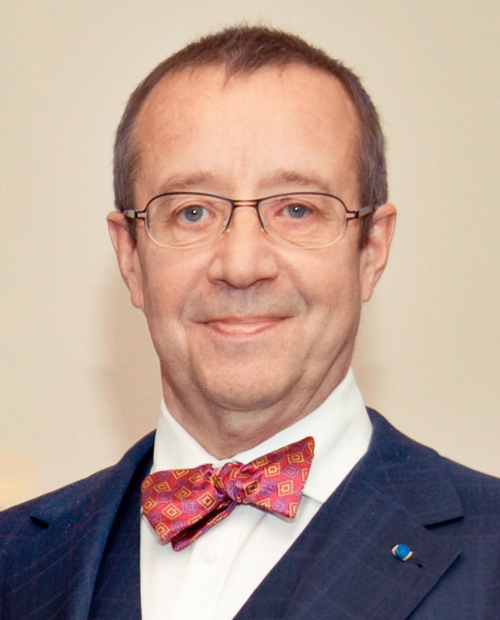
Toomas Hendrik Ilves is an Estonian politician who served as the fourth president of Estonia from 2006 until 2016.
By globalcelebwiki Editorial Desk, adapted from Wikipedia · Published 29 September 2026
- Profession
- Estonian politician and diplomat, fourth president of Estonia (born 1953)
- Born
- 26 December 1953
- Birthplace
- Stockholm
- Nationality
- Estonian
Overview
Toomas Hendrik Ilves (Estonian pronunciation: [ˈtoːmɑs ˈhendrik ˈilves]; born 26 December 1953) is an Estonian politician who served as the fourth president of Estonia from 2006 until 2016.
Ilves worked as a diplomat and journalist, and he was the leader of the Social Democratic Party in the 1990s. He served in the government as Minister of Foreign Affairs from 1996 to 1998 and again from 1999 to 2002. Later, he was a Member of the European Parliament from 2004 to 2006. He was elected as President of Estonia by an electoral college on 23 September 2006 and his term as President began on 9 October 2006. He was reelected by Parliament in 2011.
On 1 May 2025, Ilves announced that he had "broken with my promise to avoid all party politics" and joined Volt Europa.
Early life and education
Ilves was born in Stockholm, Sweden; his parents Endel Ilves (1923–1991) and Irene Ilves (née Rebane; 1925–2018) fled Estonia after its occupation by the Soviet Union during World War II. It had been reported that his maternal grandmother was a Russian from Saint Petersburg, but Ilves clarified this, stating that she was an ethnic Karaim.
Ilves moved to the United States with his family in 1957 and grew up in Leonia, New Jersey. He graduated from Leonia High School in 1972 as valedictorian. He received a bachelor's degree in psychology from Columbia University in 1976 and a master's degree in the same subject from the University of Pennsylvania in 1978. He also received an honorary degree from St. Olaf College in 2014 in recognition of his relationship with the college. In addition to his native Estonian, Ilves also speaks English, German, Spanish and Latvian. By Ilves's own admission, he speaks Estonian with a comparatively strong American accent, on account of spending his formative and young adult years in America and Germany.
Career
Ilves worked as a research assistant in Columbia University Department of Psychology from 1973 to 1979. From 1979 to 1981 he served as assistant director and English teacher at the Open Education Center in Englewood, New Jersey. Ilves then moved to Vancouver, British Columbia, Canada; from 1981 to 1983 he was director and administrator of arts at Vancouver Arts Centre and from 1983 to 1985, he taught Estonian literature and linguistics at Simon Fraser University.
From 1985 to 1993, Ilves worked in Munich, Germany as a journalist for Radio Free Europe, being the head of its Estonian desk since 1988. As Estonia had restored its independence in 1991, Ilves became Ambassador of Estonia to the United States in 1993, also serving as Ambassador to Canada and Mexico at the same time. As a condition for the job, he had to renounce his US citizenship.
In December 1996, Ilves became Estonian Minister of Foreign Affairs, serving until he resigned in September 1998, when he became a member of a small opposition party (Peasants' Party, agrarian-conservative). Ilves was soon elected chairman of the People's Party (reformed Peasants' Party), which formed an electoral cartel with the Moderates, a centrist party. After the March 1999 parliamentary election he became foreign minister again, serving until 2002, when the so-called Triple Alliance collapsed. He supported Estonian membership in the European Union and succeeded in starting the negotiations which led to Estonia joining the European Union on 1 May 2004. From 2001 to 2002 he was the leader of the People's Party Moderates. He resigned from the position after the party's defeat in the October 2002 municipal elections, in which the party received only 4.4% of the total votes nationwide. In early 2004, the Moderates party renamed itself the Estonian Social Democratic Party.
In 2003, Ilves became an observer member of the European Parliament and, on 1 May 2004, a full member. In the 2004 elections to the European Parliament, Ilves was elected MEP in a landslide victory for the Estonian Social Democratic Party. He sat with the Party of European Socialists group in the Parliament. Katrin Saks took over his MEP seat when Ilves became President of Estonia in 2006. In 2011, he was re-elected for a second five-year term.
In 2013, it was announced that Ilves had accepted a position on the Council on CyberSecurity's Advisory Board. In 2015, it was announced that Ilves had agreed to join the group of advisers to the World Bank president Jim Yong Kim.
Presidential elections
Ilves was nominated along with Ene Ergma as a candidate for the 2006 Estonian presidential election by four parties: the Reform Party, the Social Democratic Party, the Union of Pro Patria and Res Publica and the Estonian Centre Party that attempted to agree on a joint candidate. Ilves was the only candidate in the second and the third rounds of elections in Riigikogu where he gathered 64 votes of 65 ballots, less than the two-thirds majority of the 101-seat parliament. His candidacy was automatically transferred to the next round in the Electors' Assembly on September 23, 2006.
On September 13, 2006, a group of 80 Estonian cultural figures (including Neeme Järvi, Jaan Kross, Arvo Pärt and Jaan Kaplinski, among others) published a letter in support of Ilves over the incumbent, Arnold Rüütel, in the upcoming presidential election.
On 23 September 2006, he received 174 ballots in the first round of the presidential election in the Electors' Assembly, thereby being elected the next president of Estonia. His five-year term started on 9 October 2006.
On 29 August 2011, he was reelected by the 101-seat legislature to a second five-year term. His opponent was Indrek Tarand. He received support from 73 members of the legislature, and is the first candidate to be elected in the first round since Estonia regained independence in 1991.
Personal life
Ilves has been married three times. With his first wife, American psychologist Merry Bullock, he has two children, Luukas Kristjan (b. 1987) and Juulia Kristiine (b. 1992). In 2004, Ilves married his longtime partner Evelin Int-Lambot, with whom he has one daughter, Kadri Keiu (b. 2003). They divorced in April 2015. In January 2016 he married Ieva Kupče, the head of the Cybersecurity Division in the Defense Ministry of Latvia. They have a son. They divorced in December 2023.
He maintains a Twitter account, personally posting on a regular basis to comment on both current events and his own interests, usually in English.
Estonia: Collar of the Order of the Cross of Terra Mariana (2006)
Estonia: Collar of the Order of the National Coat of Arms, also known as the Presidential Chain (2008)
Estonia: Third Class of the Order of the National Coat of Arms (2004)
Belgium: Grand Cordon of the Order of Leopold (2008)
Finland: Grand Cross with Collar of the Order of the White Rose of Finland (2007)
France: Commander of the National Order of Legion of Honour (2001)
Greece: Grand Cross of the Order of Honour (1999)
Recipient of the St. George's Order of Victory (2010)
International awards and honorary degrees
2013 NDI Democracy Award by the National Democratic Institute
2014 Freedom Award by the Atlantic Council
2015 Aspen Prague Award by the Aspen Institute
2016 Knight of Freedom Award by The Casimir Pulaski Foundation
2016 John Jay Award by Columbia College, Columbia University
Sources and references
Spotted something wrong? Report a correction.
Related profiles
Broadcaster and natural historian
David Attenborough
The broadcaster whose natural history series have shaped how audiences understand life on Earth.
Read biography ↗
Animator and film director
Hayao Miyazaki
The animator and co-founder of Studio Ghibli whose hand-drawn films reached audiences worldwide.
Read biography ↗
Pope
Benedict I
Pope Benedict I was the bishop of Rome from 2 June 575 to his death on 30 July 579.
Read biography ↗