American writer and playwright (1885–1951)
Sinclair Lewis
Harry Sinclair Lewis was an American novelist, short-story writer, and playwright.
By globalcelebwiki Editorial Desk, adapted from Wikipedia · Published 29 September 2026
- Profession
- American writer and playwright (1885–1951)
- Born
- 7 February 1885
- Birthplace
- Sauk Centre
- Nationality
- American

Overview
Harry Sinclair Lewis (February 7, 1885 – January 10, 1951) was an American novelist, short-story writer, and playwright. In 1930, he became the first author from the United States (and the first from the Americas) to receive the Nobel Prize in Literature, which was awarded "for his vigorous and graphic art of description and his ability to create, with wit and humor, new types of characters." Lewis wrote six popular novels: Main Street (1920), Babbitt (1922), Arrowsmith (1925), Elmer Gantry (1927), Dodsworth (1929), and It Can't Happen Here (1935).
Several of his notable works were critical of American capitalism and materialism during the interwar period. Lewis is respected for his strong characterizations of modern working women. H. L. Mencken wrote of him, "[If] there was ever a novelist among us with an authentic call to the trade ... it is this red-haired tornado from the Minnesota wilds."
Early life
Lewis was born February 7, 1885, in the village of Sauk Centre, Minnesota, to Edwin J. Lewis, a physician of Welsh descent, and Emma Kermott Lewis. He had two older siblings, Fred (born 1875) and Claude (born 1878). His father was a stern disciplinarian, who had difficulty relating to his sensitive, unathletic third son. Lewis's mother died in 1891. The next year Edwin married Isabel Warner, whom young Lewis apparently liked. Lewis began reading books while young, and kept a diary. Throughout his lonely boyhood, the ungainly child—tall, extremely thin, stricken with acne and somewhat pop-eyed—had trouble making friends and pined after local girls. At the age of 13, he ran away from home and unsuccessfully tried to become a drummer boy in the Spanish–American War. In late 1902, Lewis left home for a year at Oberlin Academy (the then-preparatory department of Oberlin College) to qualify for acceptance at Yale University. While at Oberlin, he developed a religious enthusiasm that waxed and waned for much of his remaining teenage years. Lewis later became an atheist. He entered Yale in 1903, but did not receive his bachelor's degree until 1908, taking time off to work at Helicon Home Colony, Upton Sinclair's cooperative-living colony in Englewood, New Jersey, and to travel to Panama. Lewis's undistinguished looks, country manners and seeming self-importance made it difficult for him to win and keep friends at Oberlin and Yale. He did make a few friends among the students and professors, some of whom recognized his promise as a writer.
Career
Lewis's earliest published creative work—romantic poetry and short sketches—appeared in the Yale Courant and the Yale Literary Magazine, of which he became an editor. After graduation Lewis moved from job to job and from place to place in an effort to make ends meet, writing fiction for publication and to chase away boredom. In the summer of 1908, Lewis worked as an editorial writer at a newspaper in Waterloo, Iowa. In September of that year, he moved to the Carmel-by-the-Sea writers' colony near Monterey, California to work for the MacGowan sisters and to meet poet George Sterling in person. He left Carmel after six months, moving to San Francisco where Sterling helped him get a job at the San Francisco Evening Bulletin. Lewis returned to Carmel in spring 1910 and met Jack London.
In fall 1910, Lewis moved to New York to work for Frederick A. Stokes. The next year, he joined the New York chapter of the Socialist Party of America. Among his colleagues in the intellectual wing of the party were Walter Lippmann, William English Walling, Ernest Poole, and John Sloan.
While working for newspapers and publishing houses he developed a facility for turning out shallow, popular stories that were purchased by a variety of magazines. He also earned money by selling plots to London, including one for the latter's unfinished novel The Assassination Bureau, Ltd.
Lewis's first published book was Hike and the Aeroplane, a Tom Swift-style potboiler that appeared in 1912 under the pseudonym Tom Graham.
Sinclair Lewis's first serious novel, Our Mr. Wrenn: The Romantic Adventures of a Gentle Man, appeared in 1914, followed by The Trail of the Hawk: A Comedy of the Seriousness of Life (1915) and The Job (1917). That same year also saw the publication of another potboiler, The Innocents: A Story for Lovers, an expanded version of a serial story that had originally appeared in Woman's Home Companion. Free Air, another refurbished serial story, was published in 1919.
Upon moving to Washington, D.C., Lewis devoted himself to writing. As early as 1916, he began taking notes for a realistic novel about small-town life. Work on that novel continued through mid-1920, when he completed Main Street, which was published on October 23, 1920. His biographer Mark Schorer wrote in 1961 that the phenomenal success of Main Street "was the most sensational event in twentieth-century American publishing history". Lewis's agent had the most optimistic projection of sales at 25,000 copies. In its first six months, Main Street sold 180,000 copies, and within a few years, sales were estimated at two million. Richard Lingeman wrote in 2002, "Main Street made [Lewis] rich—earning him about 3 million current dollars" (almost $5 million, as of 2022).
Lewis followed up this first great success with Babbitt (1922), a novel that satirized the American commercial culture and boosterism. The story was set in the fictional Midwestern town of Zenith, Winnemac, a setting to which Lewis returned in future novels, including Arrowsmith, Elmer Gantry, Gideon Planish and Dodsworth.
Lewis continued his success in the 1920s with Arrowsmith (1925), a novel about the challenges faced by an idealistic doctor. It was awarded the Pulitzer Prize, which Lewis declined, still upset that Main Street had not won the prize. It was adapted as a 1931 Hollywood film directed by John Ford and starring Ronald Colman which was nominated for four Academy Awards.
Next Lewis published Elmer Gantry (1927), which depicted an evangelical minister as deeply hypocritical. The novel was denounced by many religious leaders and banned in some U.S. cities. It was adapted for the screen more than a generation later as the basis of the 1960 movie starring Burt Lancaster, who earned a Best Actor Oscar for his performance in the title role. The film won two more awards as well.
Lewis next published Dodsworth (1929), a novel about the most affluent and successful members of American society. He portrayed them as leading essentially pointless lives in spite of great wealth and advantages. The book was adapted for the Broadway stage in 1934 by Sidney Howard, who also wrote the screenplay for the 1936 film version directed by William Wyler, which was a great success at the time. The film is still highly regarded; in 1990, it was selected for preservation in the National Film Registry, and in 2005 Time magazine named it one of the "100 Best Movies" of the past 80 years.
In 1930 Lewis won the Nobel Prize in Literature, the first writer from the United States to receive the award, after he had been nominated by Henrik Schück, member of the Swedish Academy. In the academy's presentation speech, special attention was paid to Babbitt. In his Nobel Lecture, Lewis praised Theodore Dreiser, Willa Cather, Ernest Hemingway, and other contemporaries, but also lamented that "in America most of us—not readers alone, but even writers—are still afraid of any literature which is not a glorification of everything American, a glorification of our faults as well as our virtues," and that America is "the most contradictory, the most depressing, the most stirring, of any land in the world today." He also offered a profound criticism of the American literary establishment: "Our American professors like their literature clear and cold and pure and very dead."
Later years
After winning the Nobel Prize, Lewis wrote eleven more novels, ten of which appeared in his lifetime. The best remembered is It Can't Happen Here (1935), a novel about the election of a fascist to the American presidency.
After praising Dreiser as "pioneering", that he "more than any other man, marching alone, usually unappreciated, often hated, has cleared the trail from Victorian and Howellsian timidity and gentility in American fiction to honesty and boldness and passion of life" in his Nobel Lecture in December 1930, in March 1931 Lewis publicly accused Dreiser of plagiarizing a book by Dorothy Thompson, Lewis's wife, which led to a well-publicized fight, wherein Dreiser repeatedly slapped Lewis. Thompson initially made the accusation in 1928 regarding her work "The New Russia" and Dreiser's "Dreiser Goes to Russia", though The New York Times also linked the dispute to competition between Dreiser and Lewis over the Nobel Prize. Dreiser fired back that Sinclair's 1925 novel Arrowsmith (adapted later that year as a feature film) was unoriginal and that Dreiser himself was first approached to write it, which was disputed by the wife of Arrowsmith's subject, microbiologist Dr. Paul de Kruif. The feud carried on for some months. In 1944, Lewis campaigned to have Dreiser recognized by the American Academy of Arts and Letters.
After an alcoholic binge in 1937, Lewis checked in for treatment to the Austen Riggs Center, a psychiatric hospital in Stockbridge, Massachusetts. His doctors gave him a blunt assessment that he needed to decide "whether he was going to live without alcohol or die by it, one or the other." Lewis checked out after ten days, lacking any "fundamental understanding of his problem", as one of his physicians wrote to a colleague.
In the autumn of 1940, Lewis visited his old acquaintance, William Ellery Leonard, in Madison, Wisconsin. Leonard arranged a meeting with the chancellor of the University of Wisconsin–Madison and a tour of the campus. Lewis immediately became enthralled with the university and the city and offered to remain and teach a course in creative writing in the upcoming semester. For a month he was quite enamored of his professorial role. Suddenly, on November 7, after giving only five classes to his select group of 24 students, he announced that he had taught them all that he knew. He left Madison the next day.
In the 1940s, Lewis and rabbi-turned-popular-author Lewis Browne frequently appeared on the lecture platform together, touring the United States and debating before audiences of as many as 3,000 people, addressing such questions as "Has the Modern Woman Made Good?", "The Country Versus the City", "Is the Machine Age Wrecking Civilization?", and "Can Fascism Happen Here?". The pair were described as "the Gallagher and Shean of the lecture circuit" by Lewis biographer Richard Lingeman.
Personal life
In 1914 Lewis married Grace Livingston Hegger (1887–1981), an editor at Vogue magazine. They had one son, Wells Lewis (1917–1944). It is commonly claimed, erroneously, that Wells Lewis was named after British author H. G. Wells. However, Hegger denies this in her autobigraphical book With Love From Gracie. ""We named the baby Wells. Not after H.G. Wells, the person, as is generally assumed. We did not know the distinguished English novelist then...."
Serving as a U.S. Army lieutenant during World War II, Wells Lewis was killed in action on October 29, 1944, amid Allied efforts to rescue the "Lost Battalion" in France. Dean Acheson, the future Secretary of State, was a neighbor and family friend in Washington, and observed that Sinclair's literary "success was not good for that marriage, or for either of the parties to it, or for Lewis's work" and the family moved out of town.
Legacy
Compared to his contemporaries, Lewis's reputation suffered a precipitous decline among literary scholars throughout the 20th century. Despite his enormous popularity during the 1920s, by the 21st century most of his works had been eclipsed in prominence by other writers with less commercial success during the same time period, such as F. Scott Fitzgerald and Ernest Hemingway.
Since the 2010s there has been renewed interest in Lewis's work, in particular his 1935 dystopian satire It Can't Happen Here. In the aftermath of the 2016 United States presidential election, It Can't Happen Here surged to the top of Amazon's list of best-selling books. Scholars have found parallels in his novels to the COVID-19 crisis, and to the rise of Donald Trump.
He has been honored by the U.S. Postal Service with a postage stamp in the Great Americans series. In 1960 Polish American sculptor Joseph Kiselewski was commissioned to create a bust of Lewis, now in the Great River Regional public library in Sauk Centre.
1912: Hike and the Aeroplane (juvenile, as Tom Graham)
1914: Our Mr. Wrenn: The Romantic Adventures of a Gentle Man
1915: The Trail of the Hawk: A Comedy of the Seriousness of Life
1919: Free AirSerialized in The Saturday Evening Post, May 31, June 7, June 14 and 21, 1919
1922: BabbittExcerpted in Hearst's International, October 1922
1907: "That Passage in Isaiah", The Blue Mule, May 1907
1907: "Art and the Woman", The Gray Goose, June 1907
1911: "The Way to Rome", The Bellman, May 13, 1911
1915: "Commutation: $9.17", The Saturday Evening Post, October 30, 1915
1915: "The Other Side of the House", The Saturday Evening Post, November 27, 1915
Samuel J. Rogal edited The Short Stories of Sinclair Lewis (1904–1949), a seven-volume set published in 2007 by Edwin Mellen Press. The first attempt to collect all of Lewis's short stories.
Volume 1 (June 1904 – January 1916) ISBN 9780773454873
Volume 2 (August 1916 – October 1917) ISBN 9780773454897
Volume 3 (January 1918 – February 1919) ISBN 9780773454910
Volume 4 (February 1919 – May 1921) ISBN 9780773454194
1915: "Nature, Inc.", The Saturday Evening Post, October 2, 1915
1917: "For the Zelda Bunch", McClure's, October 1917
1918: "Spiritualist Vaudeville", Metropolitan Magazine, February 1918
1919: "Adventures in Autobumming: Gasoline Gypsies", The Saturday Evening Post, December 20, 1919
1919: "Adventures in Autobumming: Want a Lift?", The Saturday Evening Post, December 27, 1919
1934: Jayhawker: A Play in Three Acts (with Lloyd Lewis)
1936: It Can't Happen Here (with John C. Moffitt)
1938: Angela Is Twenty-Two (with Fay Wray)Adapted for the feature film This Is the Life (1944)
1943: Storm In the West (with Dore Schary – unproduced)
1907: "The Ultra-Modern", The Smart Set, July 1907
1907: "Dim Hours of Dusk", The Smart Set, August 1907
1907: "Disillusion", The Smart Set, December 1907
1909: "Summer in Winter", People's Magazine, February 1909
1912: "A Canticle of Great Lovers", Ainslee's Magazine, July 1912
1942: Henry Ward Beecher: An American Portrait (by Paxton Hibben; publisher: The Press of the Readers Club, NY NY)
1915: Tennis As I Play It (ghostwritten for Maurice McLoughlin)
1926: John Dos Passos' Manhattan Transfer
1929: Cheap and Contented Labor: The Picture of a Southern Mill Town in 1929
1935: Selected Short Stories of Sinclair Lewis
1952: From Main Street to Stockholm: Letters of Sinclair Lewis, 1919–1930 (edited by Alfred Harcourt and Oliver Harrison)
Sources and references
Spotted something wrong? Report a correction.
Related profiles
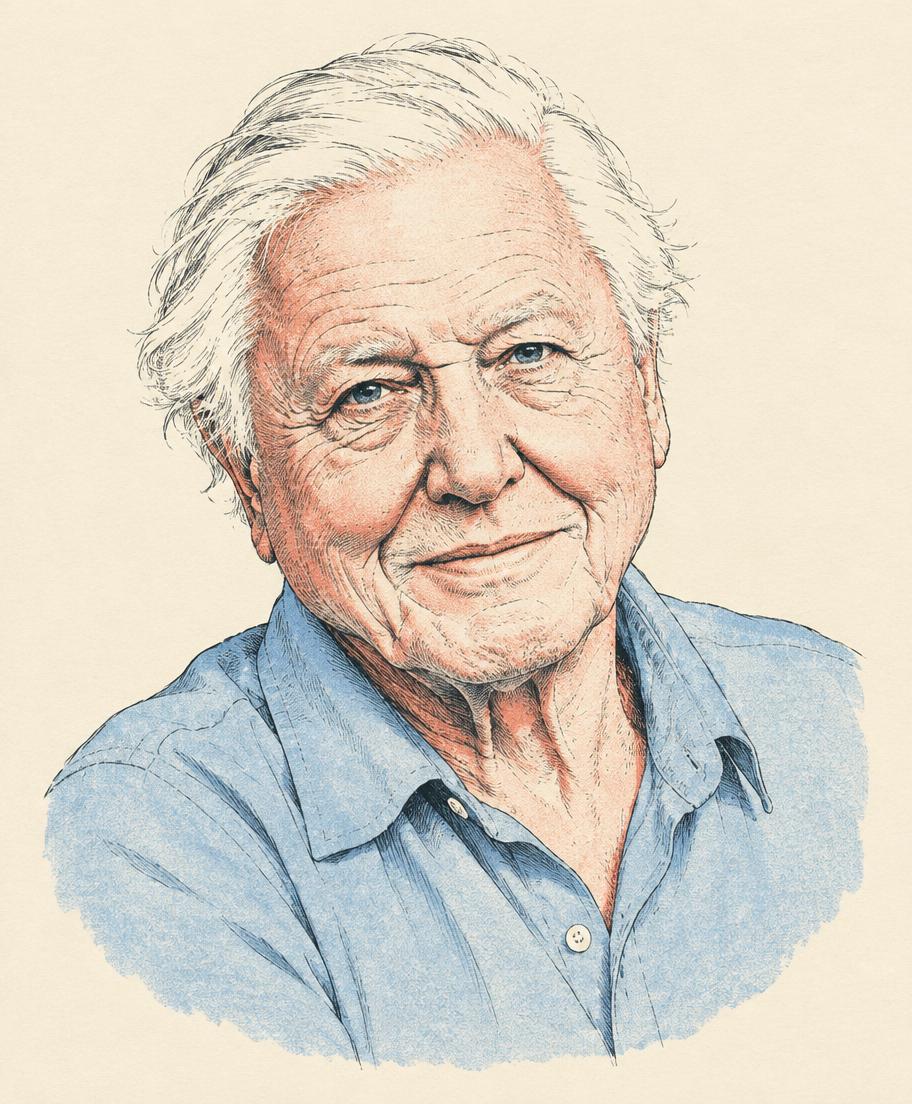
Broadcaster and natural historian
David Attenborough
The broadcaster whose natural history series have shaped how audiences understand life on Earth.
Read biography ↗
Animator and film director
Hayao Miyazaki
The animator and co-founder of Studio Ghibli whose hand-drawn films reached audiences worldwide.
Read biography ↗
Pope
Benedict I
Pope Benedict I was the bishop of Rome from 2 June 575 to his death on 30 July 579.
Read biography ↗