Indian poet (1797-1869)
Mirza Ghalib
Mirza Asadullah Beg Khan, commonly known as Mirza Ghalib, was an Indian poet and letter writer of the Mughal Empire.
By globalcelebwiki Editorial Desk, adapted from Wikipedia · Published 29 September 2026
- Profession
- Indian poet (1797-1869)
- Born
- 27 December 1797
- Birthplace
- Kala Mahal
- Nationality
- British Raj
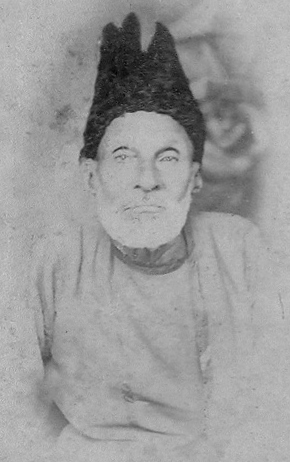
Overview
Mirza Asadullah Beg Khan (27 December 1797 – 15 February 1869), commonly known as Mirza Ghalib, was an Indian poet and letter writer of the Mughal Empire. Writing in Persian and Urdu during the final years of the Mughal Empire and the rise of British colonial rule, his poetry often addressed themes of love, loss, philosophy, the human condition, and socio-political disturbances with a depth and complexity that influenced the literary traditions of his time. His ghazals, noted for their intricate imagery and layered meanings, form a significant part of Urdu literature. He spent most of his life in poverty.
He wrote in both Urdu and Persian. Although his Persian Divan (body of work) is at least five times longer than his Urdu Divan, his fame rests on his poetry in Urdu. Today, Ghalib remains popular not only in South Asia, but also among the South Asian diaspora.
Early life
Mirza Ghalib was born on 27 December 1797 in Kala Mahal, Agra into a family of Mughals who moved to Samarkand (in modern-day Uzbekistan) after the downfall of the Seljuk kings. His paternal grandfather, Mirza Qoqan Baig, was a Seljuq Turk, and a descendant of Sultan Berkyaruq who had immigrated to India from Samarkand during the reign of Ahmad Shah (1748–54). He worked in Lahore, Delhi and Jaipur, was awarded the sub-district of Pahasu (Bulandshahr) and finally settled in Agra. He had four sons and three daughters.
Mirza Abdullah Baig (Ghalib's father) married Izzat-ut-Nisa Begum, an ethnic Kashmiri, and then lived at the house of his father-in-law. He was employed first by the Nawab of Lucknow and then the Nizam of Hyderabad. He died in a battle in 1803 in Alwar and was buried at Rajgarh, Alwar, when Ghalib was a little over 5 years old. He was then raised by his Uncle Mirza Nasrullah Baig Khan, but in 1806, Nasrullah fell off an elephant and died from related injuries.
In 1810, at the age of thirteen, Ghalib married Umrao Begum, daughter of Nawab Ilahi Bakhsh (brother of Ahmad Baksh Khan, the Nawab of Ferozepur Jhirka and Loharu and nephew of Qasim Jan). He soon moved to Delhi, along with his younger brother, Mirza Yousuf, who had developed schizophrenia at a young age and later died in Delhi during the chaos of 1857.
None of his seven children survived beyond infancy. In one of his letters, he describes his marriage as the second imprisonment after the initial confinement that was life itself. The idea that life is one continuous painful struggle that can end only when life itself ends, is a recurring theme in his poetry. One of his couplets puts it in a nutshell:
There are conflicting reports regarding his relationship with his wife. She was considered to be pious, conservative, and God-fearing.
Mughal titles
In 1850, Emperor Bahadur Shah Zafar bestowed upon Mirza Ghalib the title of Dabir-ul-Mulk (Persian: دبیر الملک, lit. 'secretary of state'). The Emperor also added to it the additional title of Najm-ud-daula (Persian: نجم الدولہ, lit. 'star of the state'). The conferment of these titles was symbolic of Mirza Ghalib's incorporation into the nobility of Delhi. He also received the title of Mirza Nosha (Persian: مرزا نوشہ) from the Emperor, thus enabling him to add Mirza to his name. He was also an important courtier of the royal court of the Emperor. As the Emperor was himself a poet, Mirza Ghalib was appointed as his poet tutor in 1854. He was also appointed as a tutor of Prince Fakhr-ud Din Mirza, eldest son of Bahadur Shah II, (d. 10 July 1856). He was also appointed by the Emperor as the royal historian of the Mughal Court.
Being a member of declining Mughal nobility and old landed aristocracy, he never worked for a livelihood, lived on either royal patronage of Mughal Emperors, credit, or the generosity of his friends. His fame came to him posthumously. He had himself remarked during his lifetime that he would be recognized by later generations. After the decline of the Mughal Empire and the rise of the British Raj, despite his many attempts, Ghalib could never get the full pension restored.
Literary career
Ghalib started composing poetry at the age of 11. His first language was Urdu, but Persian and Turkish were also spoken at home. He received an education in Persian and Arabic at a young age. During Ghalib's period, the words "Hindi" and Urdu" were synonyms (see Hindi–Urdu controversy). Ghalib wrote in Perso-Arabic script which is used to write modern Urdu, but often called his language "Hindi"; one of his works was titled Ode-e-Hindi (Urdu: عود هندی, lit. 'Perfume of Hindi').
When Ghalib was 14 years old a newly converted Muslim tourist from Iran (Abdus Samad, originally named Hormuzd, a Zoroastrian) came to Agra. He stayed at Ghalib's home for two years and taught him Persian, Arabic, philosophy, and logic.
Although Ghalib valued Persian over Urdu, his fame rests on his writings in Urdu. Numerous commentaries on Ghalib's ghazal compilations have been written by Urdu scholars. The first such elucidation or Sharh was written by Ali Haider Nazm Tabatabai of Hyderabad during the rule of the last Nizam of Hyderabad. Before Ghalib, the ghazal was primarily an expression of anguished love; but Ghalib expressed philosophy, the travails, and mysteries of life and wrote ghazals on many other subjects, vastly expanding the scope of the ghazal.
In keeping with the conventions of the classical ghazal, in most of Ghalib's verses, the identity and the gender of the beloved are indeterminate. The critic/poet/writer Shamsur Rahman Faruqui explains that the convention of having the "idea" of a lover or beloved instead of an actual lover/beloved freed the poet-protagonist-lover from the demands of realism. Love poetry in Urdu from the last quarter of the seventeenth century onwards consists mostly of "poems about love" and not "love poems" in the Western sense of the term.
The first complete English translation of Ghalib's ghazals was Love Sonnets of Ghalib, written by Sarfaraz K. Niazi and published by Rupa & Co in India and Ferozsons in Pakistan. It contains complete Roman transliteration, explication, and an extensive lexicon.
Ghalib has been described as having been concerned about receiving pensions more so than building an estate or engaging in commerce. Ghalib was paid a monthly salary of 52 rupees and 8 annas from his uncle's government pension until 1827. He travelled to Calcutta and presented a petition to the Governor-General to keep receiving money from this pension.
One of Ghalib's ambitions in life was to become the highest-ranking Ustaad for the royal Mughal Court. This position not only would prove his artistic mastership but also provide a salary of 400 rupees a month. Before becoming the official poet laureate of the court, Ghalib was paid a salary of 50 rupees a month to write histories on the history of the House of Taimur.
Mirza Ghalib was a gifted letter writer. Not only Urdu poetry but prose is indebted to Mirza Ghalib. His letters gave foundation to easy and popular Urdu. Before Ghalib, letter writing in Urdu was highly ornamental. He made his letters "talk" by using words and sentences as if he were conversing with the reader. According to Ghalib:
His letters were very informal; sometimes he would just write the name of the person and start the letter. He was very humorous and wrote very interesting letters. In a letter he wrote, "Main koshish karta hoon ke koi aisi baat likhoon jo padhe khush ho jaaye'" (I want to write lines such that whoever reads them would enjoy them). Some scholars say that Ghalib would have the same place in Urdu literature based on his letters only. They have been translated into English by Ralph Russell in The Oxford Ghalib.
Ghalib was a chronicler of a turbulent period. One by one, Ghalib saw the bazaars – Khas Bazaar, Urdu Bazaar, Kharam-ka Bazaar, disappear, and whole mohallas (localities) and katras (lanes) vanish. The havelis (mansions) of his friends were razed to the ground. Ghalib wrote that Delhi had become a desert. Water was scarce. Delhi was "a military camp". It was the end of the feudal elite to which Ghalib had belonged. He wrote:
His original Takhallus (pen-name) was Asad (meaning lion), drawn from his given name, Asadullah Khan. At some point early in his poetic career he also decided to adopt the pen-name of Ghalib (meaning all conquering, superior, most excellent).
Ghalib’s poetry or shayari had smitten Mughal Badshah of Delhi, Bahadur Shah Zaffar. During the reign of the British, the badshah became a British pensioner. He was kept under strict supervision by the British along with his visitors including Ghalib as they grew suspicious of him. The shayari maestro’s pension was suspended by the British. This made Ghalib take a long journey to Calcutta to make an appeal about his pension to the British Governor General.
Mirza Ghalib’s journey to Kolkata, or erstwhile Calcutta
made a huge difference in his literary journey. Mirza Ghalib came to the city of joy and fell in love. His love for Kolkata is depicted in one of his creations, Safar-e-Kalkattah where he talks about his stay in his humble abode, Haveli No 133 situated in the Simla Market Area during his stay in Kolkata. He used to write his verses in Urdu but started writing his poetry in Persian after this visit. He realized that the literary circle of Calcutta was very different from his known world. During his stay in Kolkata, he attended many literary gatherings which were not courtly in nature unlike Delhi. These were far liberal and flexible in nature which is imperative for any individual with a creative bent of mind.
Mirza Ghalib’s sojourn in Calcutta widened the horizons of his literary journey. He established himself as one of the renowned poets in Calcutta and received both appreciation and criticism from the enlightened audience of the city. During this time, he penned two masnavis in Persian like Chiragh-e Dair (Lamp of the Temple) and Bad-e Mukhalif (Adverse Winds).
His letters bear a testimony of his tale of love with Calcutta. In a letter that he wrote to Mirza Ali Bakhsh Khan, he says how the city has stolen his heart and left him mesmerized. He referred to the city as a place which offered a remedy for everything except death and also praised the talented people of the city.
Mirza Ghalib and Sir Syed Ahmad Khan
1855, Sir Syed Ahmed Khan finished his scholarly, well-researched, and illustrated edition of Abul Fazl's Ai’n-e Akbari. Having finished the work to his satisfaction, and believing that Mirza Asadullah Khan Ghalib was a person who would appreciate his labors, he approached the great Ghalib to write a taqriz (in the convention of the times, a laudatory foreword) for it. Ghalib obliged, but what he produced was a short Persian poem castigating the Ai’n-e Akbari and, by implication, the imperial, sumptuous, literate and learned Mughal culture of which it was a product. The least that could be said against it was that the book had little value even as an antique document. Ghalib practically reprimanded Khan for wasting his talents and time on dead things. Worse, he highly praised the "sahibs of England" who at that time held all the keys to all the a’ins in this world.
The poem was unexpected, but it came at a time when Khan's thought and feelings were already inclining toward change. Ghalib seemed to be acutely aware of a European[English]-sponsored change in world polity, especially Indian polity. Syed Ahmed Khan might well have been piqued at Ghalib's admonitions, but he would also have realized that Ghalib's reading of the situation, though not nuanced enough, was basically accurate. Khan may also have felt that he, being better informed about the English and the outside world, should have himself seen the change that now seemed to be just around the corner. Sir Khan never again wrote a word in praise of the Ai’n-e Akbari and in fact gave up taking an active interest in history and archaeology and became a social reformer.
Religious views
Ghalib placed a greater emphasis on seeking of God rather than ritualistic religious practices; although he followed Shia theology and had said many verses in praise of Alī ibn Abī Ṭālib. Ghalib states:
Like many other Urdu poets, Ghalib was capable of writing profoundly religious poetry, yet was skeptical about some interpretations of the Islamic scriptures done by certain religious leaders. On the idea of paradise, he once wrote in his Persian masnavi (مثنوی), "Abr-i-Guhar Baar" :
How canst Thou burn with a fire-mark in Hell a heart that finds no rest even in a garden? And, in Paradise, it is true that I shall drink at dawn the pure wine mentioned in the Quran, but where shall I find again the star of dawn I used to see on earth, and my crystal cup? Where in Paradise are the long walks of intoxicated friends in the night, or the drunken crowds shouting merrily? In that holy tavern, silent and still, how canst Thou introduce the sounds of the flute and the gay bustle of the taverns of this earth? Where shall I find, there, the intoxication of raining clouds? Where there is no autumn, how can spring exist? If the beautiful houries are eternally in one's heart, what of the sweet thought of them? Where will be the sadness of separation and the joy of union? How could we be thankful to an unknown beauty? What will be the pleasure of a sure fruition of love, without waiting? Where shall we find, there, a girl who flees away when we would kiss her? Where will be, there, one who betrays us with false oaths of love? The beauties of Paradise will obey us and their lips will never say anything bitter; they will give us pleasure, but with a heart forever closed to the desire for pleasure. Will there be in Paradise oglings, the pleasure of coquettish glances from afar? Where will it be, in Paradise, the dear window in a well-known wall?.
He staunchly disdained the practices of certain Ulema, who in his poems represent narrow-mindedness and hypocrisy:
In another verse directed towards certain maulavis (clerics), he criticized them for their ignorance and arrogant certitude: "Look deeper, it is you alone who cannot hear the music of his secrets". In his letters, Ghalib frequently contrasted the narrow legalism of the Ulema with "its pre-occupation with teaching the baniyas and the brats, and wallowing in the problems of menstruation and menstrual bleeding" and real spirituality for which you had to "study the works of the mystics and take into one's heart the essential truth of God's reality and his expression in all things".
A large part of Ghalib's poetry focuses on the Naʽat, poems in praise of Muhammad, which indicates that Ghalib was a devout Muslim. Ghalib wrote his Abr-i gauharbar (Urdu: ابر گہر بار, lit. 'The Jewel-carrying Cloud') as a Naʽat poem. Ghalib also wrote a qasida of 101 verses in dedication to a Naʽat. Ghalib described himself as a sinner who should be silent before Muhammad as he was not worthy of addressing him, who was praised by God.
Views on Hindustan
In his Persian poem Chiragh-i-Dair (Urdu: چراغ دیر, The Lamp of the Temple) which was composed during his trip to Benares during the spring of 1827, Ghalib mused about the land of Hindustan (India) and how Qiyamah (Doomsday) has failed to arrive, in spite of the numerous conflicts plaguing it.
Father and son are at each other's throat;
Who holds the reins of the Final Catastrophe?'.
Persian works
Ghalib held Persian in high regard, and his knowledge of the language was a point of pride for him. He believed his compositions in Persian were superior to those in Urdu, and hoped readers would evaluate him by the former:
See my Persian [poetry] so that you may see colorful pictures of many hues.
Pass over my Urdu collection; it’s only a sketch.
The majority of Ghalib's poetic compositions in Persian were qasidahs dedicated to numerous patron rulers. Ghalib also created ghazals and mathnawis in Persian. His first published work in the language was a collection of poems titled May-ḵāna-ye ārzū, released in 1845. He also created prose works, such as Panj ahang, initially published in 1849. Mehr-e nīmrūz, published in 1855, was a history of the universe from its creation to the death of Mughal Emperor Humayun. Another such historical work was Dastanbu, an eyewitness account of the 1857 revolt and its aftermath. Ghalib's last significant work in Persian was Qaat'i-e Burhaan, a critique of Burhaan-e-Qaat'i, a controversial Persian dictionary.
In 2010, Maulana Azad National Urdu University published a compilation of 11,337 poems by Ghalib titled "Kulliyat-e-Ghalib Farsi". A few years before his death, Ghalib had written over 11,000 Persian poems in Persian while also writing over 1,700 Urdu poems.
Sources and references
Spotted something wrong? Report a correction.
Related profiles
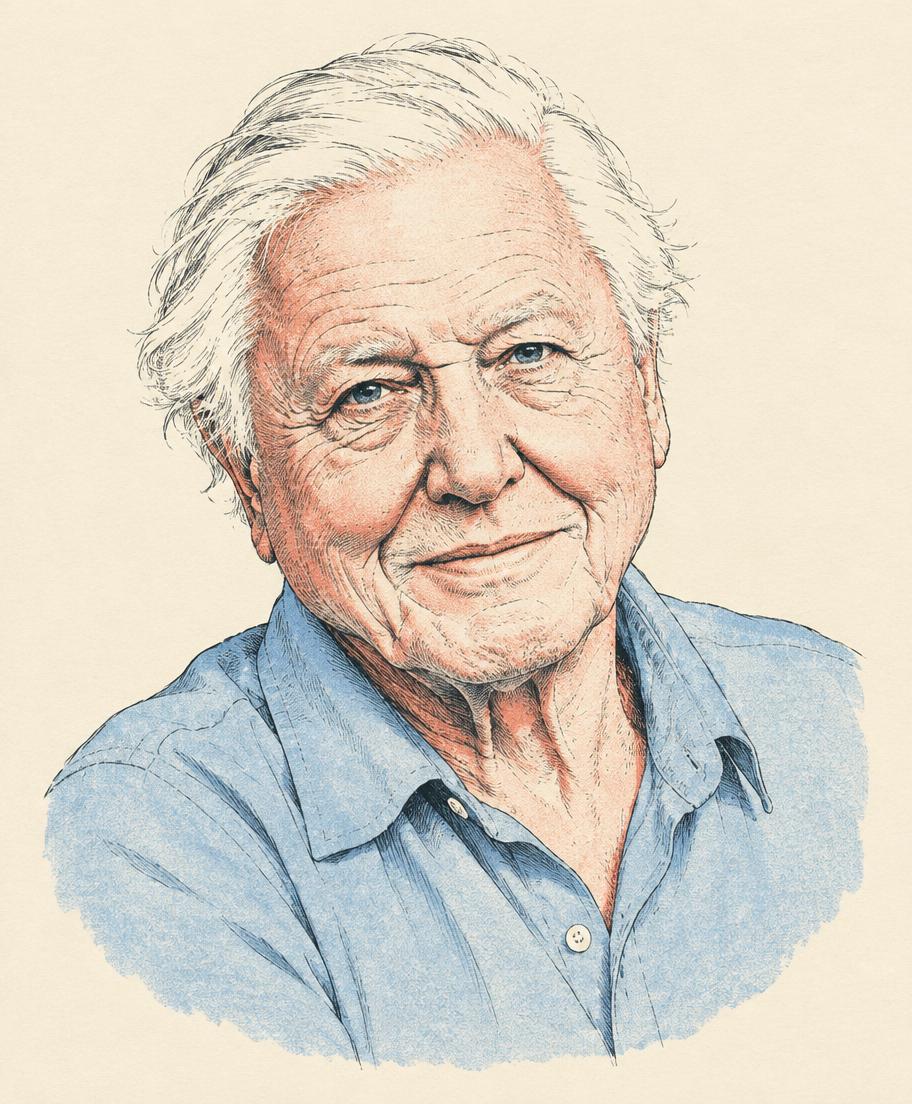
Broadcaster and natural historian
David Attenborough
The broadcaster whose natural history series have shaped how audiences understand life on Earth.
Read biography ↗
Animator and film director
Hayao Miyazaki
The animator and co-founder of Studio Ghibli whose hand-drawn films reached audiences worldwide.
Read biography ↗
Pope
Benedict I
Pope Benedict I was the bishop of Rome from 2 June 575 to his death on 30 July 579.
Read biography ↗