German Romantic writer (1763-1825)
Jean Paul
Jean Paul was a German Romantic writer, best known for his humorous novels and stories.
By globalcelebwiki Editorial Desk, adapted from Wikipedia · Published 29 September 2026
- Profession
- German Romantic writer (1763-1825)
- Born
- 21 March 1763
- Birthplace
- Wunsiedel
- Nationality
- Roman
Overview
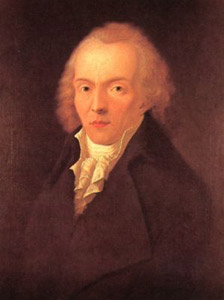
Jean Paul (German: [ʒɑ̃ paʊl] ; born Johann Paul Friedrich Richter, 21 March 1763 – 14 November 1825) was a German Romantic writer, best known for his humorous novels and stories.
Life and work
Jean Paul was born at Wunsiedel, then under the Principality of Bayreuth, in the Fichtel Mountains (Franconia). His father was an organist at Wunsiedel. In 1765 his father became a pastor at Joditz near Hof and, in 1767 at Schwarzenbach, but he died on 25 April 1779, leaving the family in great poverty. Later in life, Jean Paul noted, "The words that a father speaks to his children in the privacy of home are not heard by the world, but as in whispering-galleries, they are clearly heard at the end and by posterity." After attending the Gymnasium at Hof, in 1781 Jean Paul went to the University of Leipzig. His original intention was to enter his father's profession, but theology did not interest him, and he soon devoted himself wholly to the study of literature. Unable to maintain himself at Leipzig he returned in 1784 to Hof, where he lived with his mother. From 1787 to 1789, he served as a tutor at Töpen, a village near Hof; and from 1790 to 1794, he taught the children of several families in a school he had founded in nearby Schwarzenbach.
Jean Paul began his career as a man of letters with Grönländische Prozesse ("Greenland Lawsuits"), published anonymously in Berlin in 1783–84, and Auswahl aus des Teufels Papieren ("Selections from the Devil's Papers", signed J. P. F. Hasus), published in 1789. These works were not received with much favour, and in later life even their author had little sympathy for their satirical tone.
Jean Paul's outlook was profoundly altered by a spiritual crisis he suffered on 15 November 1790, in which he had a vision of his own death. His next book, Die unsichtbare Loge ("The Invisible Lodge"), a romance published in 1793 under the pen-name Jean Paul (in honour of Jean-Jacques Rousseau), had all the qualities that were soon to make him famous, and its power was immediately recognized by some of the best critics of the day.
Encouraged by the reception of Die unsichtbare Loge, Richter composed a number of books in rapid succession: Leben des vergnügten Schulmeisterleins Maria Wutz in Auenthal ("Life of the Cheerful Schoolmaster Maria Wutz", 1793), the best-selling Hesperus (1795), which made him famous, Biographische Belustigungen unter der Gehirnschale einer Riesin ("Biographical Recreations under the Brainpan of a Giantess", 1796), Leben des Quintus Fixlein ("Life of Quintus Fixlein", 1796), Der Jubelsenior ("The Parson in Jubilee", 1797), and Das Kampaner Tal ("The Valley of Campan", 1797). Also among these was the novel Siebenkäs in 1796–97.
Siebenkäs' slightly supernatural theme, involving a Doppelgänger and pseudocide, stirred some controversy over its interpretation of the Resurrection, but these criticisms served only to draw awareness to the author. This series of writings assured Richter a place in German literature, and during the rest of his life every work he produced was welcomed by a wide circle of admirers.
Characteristics of his work
Jean Paul occupies an unusual position in German literature and has always divided the literary public. Some hold him in highest veneration while others treat his work with indifference. He took the Romantic formlessness of the novel to extremes: Schlegel called his novels soliloquies, in which he makes his readers take part (in this respect going even further than Laurence Sterne in Tristram Shandy). Jean Paul habitually played with a multitude of droll and bizarre ideas: his work is characterized by wild metaphors as well as by digressive and partly labyrinthine plots. He mixed contemplation with literary theory: alongside spirited irony the reader finds bitter satire and mild humour; next to soberly realistic passages there are romanticized and often ironically curtailed idylls, social commentary and political statements. The quick changes of mood attracted the composer Schumann whose Papillons was inspired by Jean Paul's Flegeljahre.
His novels were especially admired by women. This was due to the empathy with which Jean Paul created the female characters in his works: never before in German literature were women represented with such psychological depth. At the same time however, his work contains misogynistic quips. Jean Paul's character may have been as diverse and as confusing as many of his novels: he was said to be very sociable and witty, while at the same time extremely sentimental: having an almost childlike nature, quickly moved to tears. It is obvious from his works that his interests encompassed not only literature but also astronomy and other sciences.
Paul's relationship with the Weimar classicists Goethe and Schiller always remained ambivalent: Schiller once remarked that Jean Paul was as alien to him as someone who fell from the Moon, and that he might have been worthy of admiration "if he had made as good use of his riches as other men made of their poverty." Herder and Wieland on the other hand fully appreciated his work and supported him. Although he always kept his distance from the classicists, who wanted to "absolutize" art, and although his theoretical approach (most notably in his Introduction to Aesthetics) was considerably influenced by Romanticism, it would be misleading to call him a Romantic without qualification. Here too he kept his distance: with all his subjectivism he didn't absolutize the subject of the author as the Romantics often did. Jean Paul had what had become rare amidst classical severity and romantic irony: humour. He also was one of the first who approached humour from a theoretical standpoint.
He thought that both the Enlightenment and metaphysics had failed, though they still held importance for his worldview. He arrived at a philosophy without illusions, and a state of humorous resignation. Correspondingly he was one of the first defenders of Schopenhauer's philosophy. He didn't try to indoctrinate, but to portray human happiness, even (and especially) in an increasingly alienated environment — the rococo castles and seemingly-bleak villages of Upper Franconia. Jean Paul was not only the first to use and name the literary motif of the Doppelgänger, he also utilised it in countless variations (e.g. Siebenkäs and Leibgeber, Liane and Idoine, Roquairol and Albano). In his novel Siebenkäs he coined the word Doppelgänger, which he defined as the "people who see themselves."
Jean Paul was a lifelong defender of freedom of the press and his campaigns against censorship went beyond many of his contemporaries. In his Freiheitsbüchlein (1805), he maintains that books belong to humanity and should have the chance to have an impact on all times, not just the present moment, and therefore preventing a book from being published renders the censor a judge not just for contemporary society but for all future societies. Censorship is not feasible because it would be impossible to find a person able to fulfill the true requirements of the office. After the great achievements of the eighteenth century, the prospect of complete freedom of opinion, speech, and printing was real. Even under the tightened conditions of the Napoleonic occupation, Jean Paul continued to speak out in favor of reason, as in his Friedens-Predigt an Deutschland (1808). The last section of his Politische Fastenpredigten (1816) contains a warning to rulers that minds cannot be controlled, and that police action will only cause them to eventually explode like a champagne bottle.
Other
Rudolf Steiner edited a multi-volume collection of the works of Jean Paul. In published lectures, Steiner often mentioned the realization by the 7-year-old Jean Paul that he was an individual "Ego", expressed in Paul's surprise at understanding that "I am an I".
Quotations
The long sleep of death closes our scars, and the short sleep of life our wounds. (Der lange Schlaf des Todes schliesst unsere Narben zu, und der kurze des Lebens unsere Wunden, Hesperus, XX).
Works
Leben des vergnügten Schulmeisterlein Maria Wutz in Auenthal. Eine Art Idylle 1790
Des Feldpredigers Schmelzle Reise nach Flätz 1809
Clavis Fichtiana (see also Johann Gottlieb Fichte)
Das heimliche Klaglied der jetzigen Männer
Die wunderbare Gesellschaft in der Neujahrsnacht
Most of Richter's long novels were translated into English during the mid-nineteenth century. Several editions of translated passages from various works were also published. In the twenty-first century, Sublunary Editions of Seattle began publishing more English translations of his works (see final entries below).
The Invisible Lodge, trans. Charles T. Brooks, New York: Holt 1883 | Project Gutenberg
Maria Wuz, trans. Francis and Rose Storr, Maria Wuz and Lorenz Stark, London: Longmans, Green, & Co, 1881
Maria Wutz, trans. John D. Grayson, 19th Century German Tales, ed. Angel Flores, 1959, reissued 1966
Maria Wutz, trans. Erika Casey, The Jean Paul Reader, Johns Hopkins U, 1990
Musical reception (selection)
Robert Schumann: Papillons pour le pianoforte seul, 1832.
Johann Friedrich Kittl: Wär' ich ein Stern, 1838.
Carl Grünbaum: Lied (Es zieht in schöner Nacht der Sternenhimmel), 1840.
Ernst Friedrich Kauffmann: Ständchen nach Jean Paul, 1848.
Carl Reinecke: O wär' ich ein Stern (from: Flegeljahre), 1850.
Sources and references
Spotted something wrong? Report a correction.
Related profiles
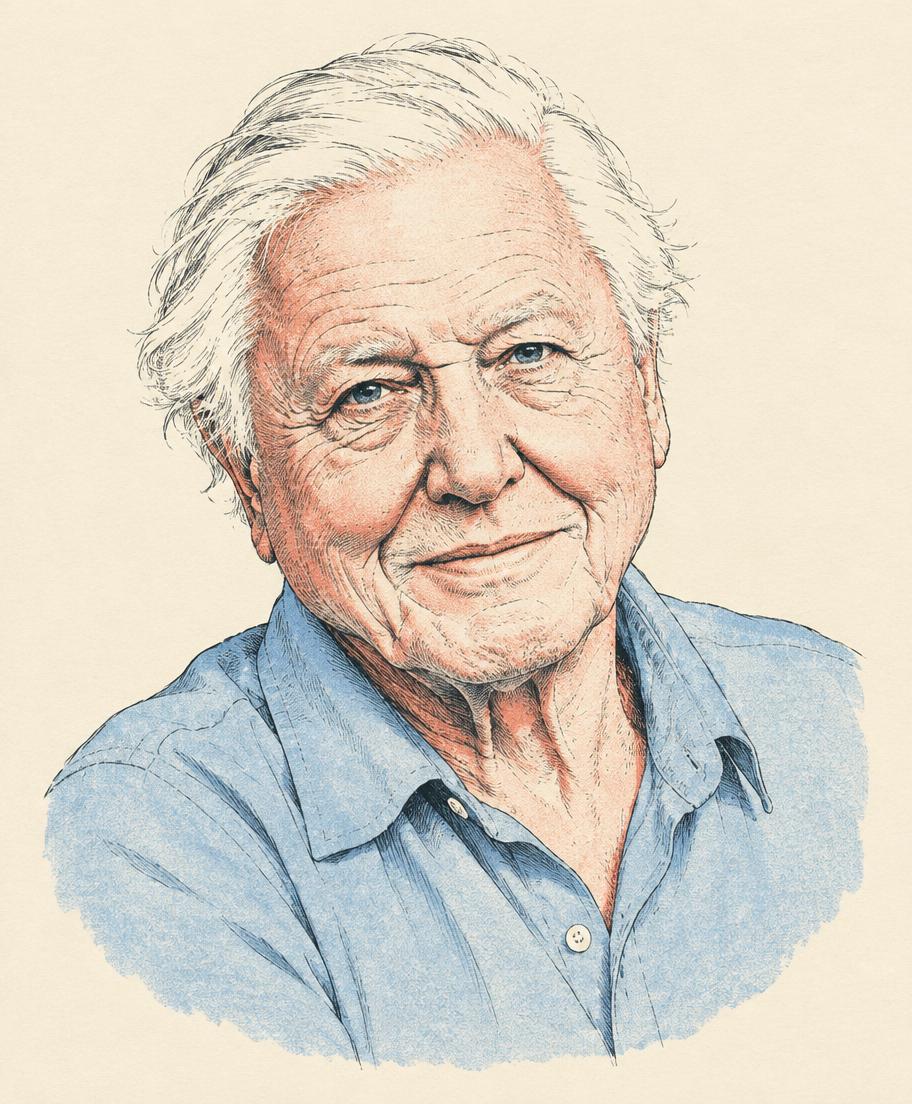
Broadcaster and natural historian
David Attenborough
The broadcaster whose natural history series have shaped how audiences understand life on Earth.
Read biography ↗
Animator and film director
Hayao Miyazaki
The animator and co-founder of Studio Ghibli whose hand-drawn films reached audiences worldwide.
Read biography ↗
Pope
Benedict I
Pope Benedict I was the bishop of Rome from 2 June 575 to his death on 30 July 579.
Read biography ↗