Scottish writer and playwright (1860–1937)
J. M. Barrie
Sir James Matthew Barrie, 1st Baronet was a British novelist and playwright.
By globalcelebwiki Editorial Desk, adapted from Wikipedia · Published 29 September 2026
- Profession
- Scottish writer and playwright (1860–1937)
- Born
- 9 May 1860
- Birthplace
- Kirriemuir
- Nationality
- British
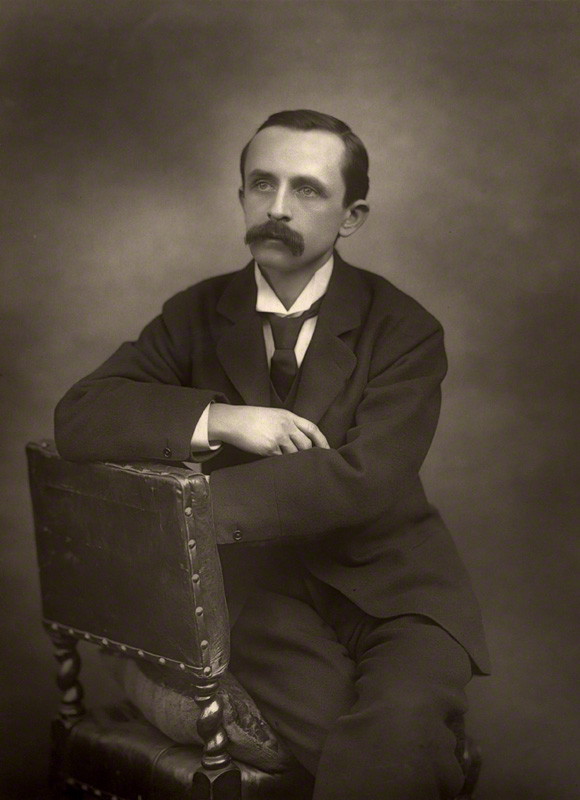
Overview
Sir James Matthew Barrie, 1st Baronet (; 9 May 1860 – 19 June 1937) was a British novelist and playwright. He was born and educated in Scotland and then moved to London, where he wrote several successful novels and plays. There he met the Llewelyn Davies boys, who inspired him to write about a baby boy who has magical adventures in Kensington Gardens (first included in Barrie's 1902 adult novel The Little White Bird), then to write Peter Pan, or The Boy Who Wouldn't Grow Up, a 1904 West End "fairy play" about an ageless boy and an ordinary girl named Wendy who have adventures in the fantasy setting of Neverland.
Although he continued to write successfully, Peter Pan overshadowed his other work, and is credited with popularising the name Wendy. Barrie unofficially adopted the Davies boys following the deaths of their parents. Barrie was made a baronet by George V on 14 June 1913, and a member of the Order of Merit in the 1922 New Year Honours. Before his death, he gave the rights to the Peter Pan works to Great Ormond Street Hospital for Children in London, which continues to benefit from them.
Childhood and adolescence
James Matthew Barrie was born in 1860 in Kirriemuir, Angus, Scotland, into a conservative Calvinist family during the Victorian era. His father, David Barrie, was a moderately successful handloom weaver, a common occupation in the Scottish textile industry at the time. His mother, Margaret Ogilvy, came from a working-class Scottish background. After her own mother died when Margaret was only eight years old, she was forced to take on many of the responsibilities of managing the household at a very young age. These experiences later influenced Barrie’s understanding of childhood, family, and loss.
Barrie was the ninth of ten children, although two of his siblings died before he was born. Education was important in the Barrie household. The children were taught the basic “three Rs,” reading, writing, and arithmetic, which were considered important foundations for children who might eventually enter professional occupations. Growing up in nineteenth-century Scotland, Barrie was also surrounded by religious traditions, Scottish culture, storytelling, and literature. From an early age, he was known for being small in stature and for entertaining others with stories. His ability to create stories would eventually become one of the most important parts of his career as a writer and playwright.
A major event in Barrie’s childhood occurred in 1866, when he was six years old. His older brother David, who was fourteen, died in an ice-skating accident on the day before his birthday. David had been especially loved by their mother, and his death had a lasting emotional impact on the family. Margaret was deeply affected by the loss of her son. Barrie attempted to comfort her and, in some ways, tried to take David’s place in her life. He wore David’s clothing and even copied the way his brother whistled.
Margaret eventually found comfort in the belief that David would remain a boy forever because he had died before reaching adulthood. For Barrie, this idea of childhood being preserved and protected from the responsibilities of adulthood became an important theme throughout his later writing. He and his mother spent time together telling stories and reading books, including Robinson Crusoe, works by Scottish author Walter Scott, and The Pilgrim’s Progress. These experiences helped shape Barrie’s imagination and his lifelong interest in childhood, storytelling, memory, and the contrast between childhood and adulthood.
Barrie’s early life therefore took place within a particular historical setting: Victorian Scotland, where family, religion, education, work, and social expectations strongly influenced children’s lives. His experiences with his mother, the death of his brother, and the importance of storytelling in his childhood would later appear in his literary work, most famously in his creation of Peter Pan and the idea of a child who refuses to grow up.
Literary career
Barrie knew that he wished to follow a career as an author; however, his family attempted to persuade him to choose a profession such as the ministry. With advice from Alexander, he was able to work out a compromise of attending a university, but studying literature. Barrie enrolled at the University of Edinburgh where he wrote drama reviews for the Edinburgh Evening Courant. He graduated and obtained an M.A. on 21 April 1882.
Following a job advertisement found by his sister in The Scotsman, he worked for a year and a half as a staff journalist on the Nottingham Journal some way south into the East Midlands of England. Back in Kirriemuir after this, he submitted a piece to the St. James's Gazette, a London newspaper, using his mother's stories about the town where she grew up (renamed "Thrums"). The editor "liked that Scotch thing" so well that Barrie ended up writing a series of these stories. They served as the basis for his first novels: Auld Licht Idylls (1888), A Window in Thrums (1889), and The Little Minister (1891).
The stories depicted the "Auld Lichts", a strict religious sect to which his grandfather had once belonged. Modern literary criticism of these early works has been unfavourable, tending to disparage them as sentimental and nostalgic depictions of a parochial Scotland, far from the realities of the industrialised 19th century, seen as characteristic of what became known as the Kailyard School. Despite, or perhaps because of, this, they were popular enough at the time to establish Barrie as a successful writer. Following that success, he published Better Dead (1888) privately and at his own expense, but it failed to sell. His two "Tommy" novels, Sentimental Tommy (1896) and Tommy and Grizel (1900), were about a boy and young man who clings to childish fantasy, with an unhappy ending. The English novelist George Gissing read the former in November 1896 and wrote that he "thoroughly dislike[d it]".
Meanwhile, Barrie's attention turned increasingly to works for the theatre, beginning with a biography of Richard Savage, written by Barrie and H. B. Marriott Watson; it was performed only once and critically panned. He immediately followed this with Ibsen's Ghost, or Toole Up-to-Date (1891), a parody of Henrik Ibsen's dramas Hedda Gabler and Ghosts. Ghosts had been unlicensed in the UK until 1914, but had created a sensation at the time from a single "club" performance.
The production of Ibsen's Ghost at Toole's Theatre in London was seen by William Archer, the translator of Ibsen's works into English. Apparently comfortable with the parody, he enjoyed the humour of the play and recommended it to others. Barrie's third play Walker, London (1892) resulted in his being introduced to a young actress named Mary Ansell. He proposed to her and they were married on 9 July 1894. Barrie bought her a Saint Bernard puppy, Porthos, who played a part in the 1902 novel The Little White Bird. He used Ansell's first name for many characters in his novels. Barrie also authored Jane Annie, a comic opera for Richard D'Oyly Carte (1893), which failed; he persuaded Arthur Conan Doyle to revise and finish it for him.
The character of "Peter Pan" first appeared in The Little White Bird. The novel was published in the UK by Hodder & Stoughton in 1902 and serialised in the US in the same year in Scribner's Magazine. Barrie's more famous and enduring work Peter Pan, or The Boy Who Wouldn't Grow Up had its first stage performance on 27 December 1904 at the West End’s Duke of York's Theatre. The tradition of having a woman play the title role started because at the time children were not allowed to act on stage, and smaller women were considered more believable in the role of a young boy. This play introduced audiences to the name "Wendy"; it was inspired by a young girl named Margaret Henley who called Barrie "Friendy", but could not pronounce her Rs very well. The Bloomsbury scenes show the societal constraints of late Victorian and Edwardian middle class domestic reality, contrasted with Neverland, a world where morality is ambivalent.
George Bernard Shaw described the play as "ostensibly a holiday entertainment for children but really a play for grown-up people", suggesting deeper social metaphors at work in Peter Pan. In 1907, it was parodied by H. G. Pélissier and The Follies at the Apollo Theatre on Shaftesbury Avenue in a sketch entitled Baffles or the Peterpan-tomime. This parody was in fact reviewed by Barrie himself in a magazine called Sphere as being "funny in little bits", although he also concluded that The Follies were "one of the funniest things now to be seen in London."
Barrie had a long string of successes on the stage after Peter Pan, many of which discuss social concerns, as Barrie continued to integrate his work and his beliefs. The Twelve Pound Look (1910) concerns a wife leaving her 'typical' husband once she can gain an independent income. Other plays, such as Mary Rose (1920) and Dear Brutus (1917), revisit the idea of the ageless child and parallel worlds. Barrie was involved in the 1909 and 1911 attempts to challenge the censorship of the theatre by the Lord Chamberlain, along with a number of other playwrights.
In 1911, Barrie developed the Peter Pan play into the novel Peter and Wendy. In April 1929, Barrie gave the copyright of the Peter Pan works to Great Ormond Street Hospital, a leading children's hospital in London. The current status of the copyright is somewhat complex. His final play was The Boy David (1936), which dramatised the Biblical story of King Saul and the young David. Like the role of Peter Pan, that of David was played by a woman, Elisabeth Bergner, for whom Barrie wrote the play.
Social connections
Barrie moved in literary circles and had many famous friends in addition to his professional collaborators. Novelist George Meredith was an early social patron. He had a long correspondence with Robert Louis Stevenson, who lived in Samoa at the time. Stevenson invited Barrie to visit him, but the two never met. He was also friends with S. R. Crockett who like Barrie would sometimes write in the Scots dialect. George Bernard Shaw was his neighbour in London for several years, and once participated in a Western that Barrie scripted and filmed. H. G. Wells was a friend of many years, and tried to intervene when Barrie's marriage fell apart. Barrie met Thomas Hardy through Hugh Clifford while he was staying in London. He was friends with Nobel prize winner John Galsworthy.
Barrie remained in touch with his roots and visited his hometown of Kirriemuir regularly with his wards. When choosing his first personal secretary, Barrie chose E. V. Lucas's wife, Elizabeth Lucas, who had Scottish ancestry despite her more immediate American parentage. After Elizabeth Lucas moved to Paris, France, Barrie chose Cynthia Asquith as his personal secretary.
After the First World War, Barrie sometimes stayed at Stanway House near the village of Stanway in Gloucestershire. He paid for the pavilion at Stanway cricket ground. In 1887, he founded an amateur cricket team for friends of similarly limited playing ability, and named it the Allahakbarries under the mistaken belief that "Allah akbar" meant "Heaven help us" in Arabic, rather than "God is great". Some of the best-known British authors from the era played on the team at various times, including H. G. Wells, Rudyard Kipling, Arthur Conan Doyle, P. G. Wodehouse, Jerome K. Jerome, G. K. Chesterton, A. A. Milne, E. W. Hornung, A. E. W. Mason, Walter Raleigh, E. V. Lucas, Maurice Hewlett, Owen Seaman (editor of Punch), Bernard Partridge, George Cecil Ives, George Llewelyn Davies (see below) and the son of Alfred Tennyson. In 1891, Barrie joined the newly formed Authors Cricket Club and also played for its cricket team, the Authors XI, alongside Doyle, Wodehouse and Milne. The Allahakbarries and the Authors XI continued to exist side by side until 1912.
Barrie befriended Africa explorer Joseph Thomson and Antarctica explorer Robert Falcon Scott. He was godfather to Scott's son Peter, and was one of the seven people to whom Scott wrote letters in the final hours of his life during his expedition to the South Pole, asking Barrie to take care of his wife Kathleen and son Peter. Barrie was so proud of the letter that he carried it around for the rest of his life.
In 1896, his agent Addison Bright persuaded him to meet with Broadway producer Charles Frohman, who became his financial backer and a close friend, as well. Frohman was responsible for producing the debut of Peter Pan in both England and the US, as well as other productions of Barrie's plays. He famously declined a lifeboat seat when the RMS Lusitania was sunk by a German U-boat in the North Atlantic. Actress Rita Jolivet stood with Frohman, George Vernon and Captain Alick Scott at the end of Lusitania's sinking, but she survived the sinking and recalled Frohman paraphrasing Peter Pan: 'Why fear death? It is the most beautiful adventure that life gives us.' Barrie had himself sailed on one of the Lusitania's final Atlantic crossings in September 1914, during which rumours circulated amongst the passengers that the liner was to be transferred to the British Admiralty for troopship duties on arrival in New York.
Marriage
Barrie became acquainted with actress Mary Ansell in 1891, when he asked his friend Jerome K. Jerome for a pretty actress to play a role in his play Walker, London. The two became friends, and she helped his family to care for him when he fell very ill in 1893 and 1894. They married in Kirriemuir on 9 July 1894, shortly after Barrie recovered, and Mary retired from the stage. The wedding was a small ceremony in his parents' home, in the Scottish tradition. The relationship was reportedly unconsummated, and the couple had no children.
In 1895, the Barries bought a house on Gloucester Road, in South Kensington. Barrie would take long walks in nearby Kensington Gardens, and in 1900 the couple moved into a house directly overlooking the gardens at 100 Bayswater Road. Mary had a flair for interior design and set about transforming the ground floor, creating two large reception rooms with painted panelling and adding fashionable features, such as a conservatory. In the same year, Mary found Black Lake Cottage at Farnham in Surrey, which became the couple's "bolt hole" where Barrie could entertain his cricketing friends and the Llewelyn Davies family.
Llewelyn Davies family
The Llewelyn Davies family played an important part in Barrie's literary and personal life, consisting of Arthur (1863–1907), Sylvia (1866–1910) (daughter of George du Maurier), and their five sons: George (1893–1915), John (Jack) (1894–1959), Peter (1897–1960), Michael (1900–1921) and Nicholas (Nico) (1903–1980).
Barrie became acquainted with the family in 1897, meeting George and Jack (and baby Peter) with their nurse (nanny) Mary Hodgson in London's Kensington Gardens. He lived nearby and often walked his Saint Bernard dog Porthos in the park. He entertained the boys regularly with his ability to wiggle his ears and eyebrows, and with his stories. He did not meet Sylvia until a chance encounter at a dinner party in December. She told Barrie that Peter had been named after the title character in her father's novel, Peter Ibbetson.
Death
Barrie died of pneumonia at a nursing home in Manchester Street, Marylebone on 19 June 1937. He was buried at Kirriemuir next to his parents and two of his siblings. His birthplace at 9 Brechin Road is maintained as a museum by the National Trust for Scotland.
Barrie left the bulk of his estate to his secretary Lady Cynthia Asquith, but excluding the rights to all Peter Pan works (which included The Little White Bird, Peter Pan in Kensington Gardens, the play Peter Pan, or The Boy Who Would Not Grow Up and the novel Peter and Wendy), whose copyright he had previously given to Great Ormond Street Hospital in London. The surviving Llewelyn Davies boys received legacies, and he made provisions for his former wife Mary Ansell to receive an annuity during her lifetime.
His will also left £500 to the Bower Free Church in Caithness to mark the memory of Rev James Winter who was to have married Barrie's sister in June 1892 but was killed in a fall from his horse in May 1892. Barrie had several connections to the Free Church of Scotland, including his maternal uncle Rev David Ogilvy (1822–1904), who was minister of Dalziel Church in Motherwell. James and his brother William Winter (also a Free Church minister) were both born in Cortachy the sons of Rev William Winter. Cortachy is just west of Kirriemuir and the Winters seem closely connected to the Ogilvy family.
Hammerton, J. A. (1929). Barrie: the Story of a Genius. New York: Dodd, Mead & Company.
Darlington, W. A. (1938). J. M. Barrie. London and Glasgow: Blackie & Son.
Chalmers, Patrick (1938). The Barrie Inspiration. Peter Davies. ISBN 978-1-4733-1220-3.
Mackail, Denis (1941). Barrie: The Story of J. M. B. New York: C. Scribner's Sons.
Dunbar, Janet (1970). J. M. Barrie: The Man Behind the Image. London: Collins. ISBN 0-00-211384-8.
Stokes, Sewell (November 1941). "James M Barrie". New York Theatre Arts Inc. 25 (11): 845–848.
The Lost Boys (1978). Ian Holm (as J.M. Barrie), Andrew Birkin (writer). BBC.
The Man Who Was Peter Pan (1998) is a play by Allan Knee, a semi-biographical version of Barrie's life and relationship with the Llewelyn Davies family.
Finding Neverland (2004) with Johnny Depp (as J.M. Barrie), Kate Winslet (Sylvia Llewelyn Davies), Marc Forster (director), based on Allan Knee's play.
The Boy James (2012) by Alexander Wright (of Belt Up Theatre), is a one act play inspired by his life and work.
Finding Neverland (2012) by Diane Paulus, is a musical about the creation of Peter Pan based on the film and starring Matthew Morrison and Laura Michelle Kelly.
Barrie was created a baronet by King George V in 1913. He was made a member of the Order of Merit in 1922.
In 1919, he was elected Rector of the University of St Andrews for a three-year term. In 1922, he delivered his celebrated Rectorial Address on Courage at St Andrews, and visited University College Dundee with Earl Haig to open its new playing fields, with Barrie bowling a few balls to Haig. He served as Chancellor of the University of Edinburgh from 1930 to 1937.
The Sir James Barrie Primary School in Wandsworth, South West London is named after him.
The Barrie School in Silver Spring, Maryland, is also named in his honour.
Archival collections
J. M. Barrie Collection at the Beinecke Rare Book & Manuscript Library
J. M. Barrie Collection at the Harry Ransom Center
Sources and references
Spotted something wrong? Report a correction.
Related profiles
Broadcaster and natural historian
David Attenborough
The broadcaster whose natural history series have shaped how audiences understand life on Earth.
Read biography ↗
Animator and film director
Hayao Miyazaki
The animator and co-founder of Studio Ghibli whose hand-drawn films reached audiences worldwide.
Read biography ↗
Pope
Benedict I
Pope Benedict I was the bishop of Rome from 2 June 575 to his death on 30 July 579.
Read biography ↗