French writer (1885-1970)
François Mauriac
François Charles Mauriac was a French novelist, dramatist, critic, poet, and journalist, a member of the Académie française, and laureate of the Nobel Prize in Literature.
By globalcelebwiki Editorial Desk, adapted from Wikipedia · Published 29 September 2026
- Profession
- French writer (1885-1970)
- Born
- 11 October 1885
- Birthplace
- Bordeaux
- Nationality
- French

Overview
François Charles Mauriac (French: [fʁɑ̃swa ʃaʁl(ə) moʁjak]; Occitan: Francés Carles Mauriac; 11 October 1885 – 1 September 1970) was a French novelist, dramatist, critic, poet, and journalist, a member of the Académie française (from 1933), and laureate of the Nobel Prize in Literature (1952). He was awarded the Grand Cross of the Légion d'honneur in 1958.
Early life and education
François Charles Mauriac was born on 11 October 1885 in Bordeaux, France.
He studied literature at the University of Bordeaux, graduating in 1905, after which he moved to Paris and briefly studied at the École des Chartes in 1908.
Career
On 1 June 1933, he was elected a member of the Académie française, succeeding Eugène Brieux.
A former Action française supporter, he turned to the left during the Spanish Civil War, criticising the Catholic Church for its support of Franco. After the fall of France to the Axis during the Second World War, he briefly supported the collaborationist régime of Marshal Pétain, but joined the Resistance as early as December 1941. He was the only member of the Académie française to publish a Resistance text with the Editions de Minuit.
Mauriac had a bitter dispute with Albert Camus immediately following the Liberation of France. At that time, Camus edited the Resistance paper Combat (thereafter an overt daily, until 1947), while Mauriac wrote a column for Le Figaro. Camus said newly liberated France should purge all Nazi collaborator elements, but Mauriac warned that such disputes should be set aside in the interests of national reconciliation. Mauriac also doubted that justice would be impartial or dispassionate, given the emotional turmoil of the Liberation. Despite having been viciously criticised by Robert Brasillach, he campaigned against his execution.
He published a series of personal memoirs and a biography of Charles de Gaulle. Mauriac's complete works were published in twelve volumes between 1950 and 1956. He encouraged Elie Wiesel to write about his experiences as a Jewish teenager during the Holocaust, and wrote the foreword to Elie Wiesel's book Night.
Mauriac also had a bitter public dispute with Roger Peyrefitte, who criticised the Vatican in books such as Les Clés de saint Pierre (1953). Mauriac threatened to resign from the paper he was working with at the time (L'Express) if they did not stop carrying advertisements for Peyrefitte's books. The quarrel was exacerbated by the release of the film adaptation of Peyrefitte's Les Amitiés particulières, and culminated in a virulent open letter by Peyrefitte in which he accused Mauriac of homosexual tendencies and called him a Tartuffe, hypocrite.
Awards and honours
In 1952, he was awarded the Nobel Prize in Literature "for the deep spiritual insight and the artistic intensity with which he has in his novels penetrated the drama of human life". He was awarded the Grand Cross of the Légion d'honneur in 1958.
1926 — Grand Prix du roman de l'Académie française
1958 — Grand Cross of the Légion d'honneur
Personal life
He was the father of writer Claude Mauriac and grandfather of Anne Wiazemsky, a French actress and author who worked with and married French director Jean-Luc Godard.
Death and legacy
Mauriac died in Paris on 1 September 1970, and was interred in the Cimetière de Vemars, Val d'Oise, France.
His former home, the Domaine de Malagar (Malagar Estate), around 50 km (31 mi) south of Bordeaux, France, is now an historic site, which houses the Centre François Mauriac.
There are two literary prizes awarded annually that honour Mauriac:
Prix François Mauriac, awarded by the Académie Française since 1994
Prix Francois-Mauriac de la région Aquitaine, originally founded in 1985 and revived after an hiatus in 2002, awarded by the Aquitaine regional authority at the Centre François Mauriac at Malagar
1913 – L'Enfant chargé de chaînes («Young Man in Chains», tr. 1961)
1914 – La Robe prétexte («The Stuff of Youth», tr. 1960)
1920 – La Chair et le Sang («Flesh and Blood», tr. 1954)
1921 – Préséances («Questions of Precedence», tr. 1958)
1922 – Le Baiser au lépreux («The Kiss for the Leper», tr. 1923 / «A Kiss for the Leper», tr. 1950)
1938 – Asmodée («Asmodée; or, The Intruder», tr. 1939 / «Asmodée: A Drama in Three Acts», tr. 1957)
1931 – Holy Thursday: an Intimate Remembrance
1964 - De Gaulle de François Mauriac (French edition), 1966 English -(Doubleday)
Sources and references
Spotted something wrong? Report a correction.
Related profiles
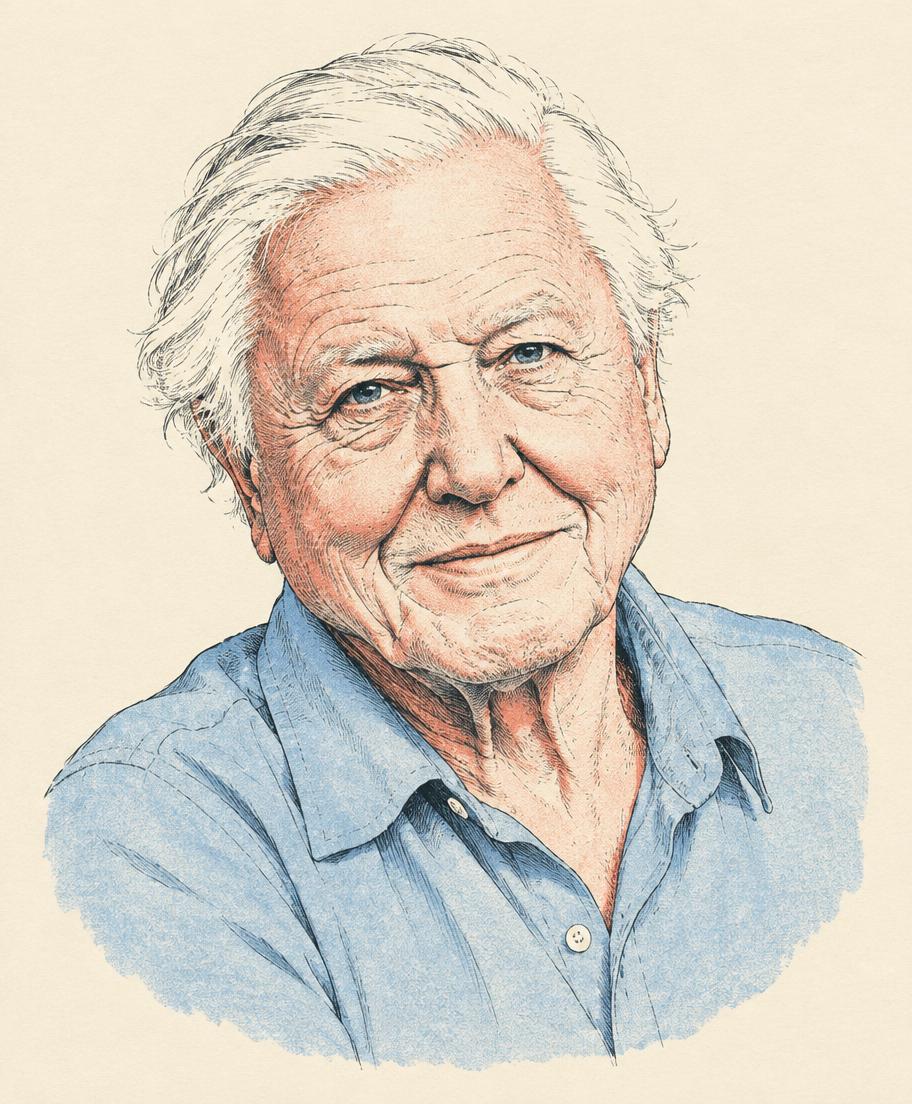
Broadcaster and natural historian
David Attenborough
The broadcaster whose natural history series have shaped how audiences understand life on Earth.
Read biography ↗
Animator and film director
Hayao Miyazaki
The animator and co-founder of Studio Ghibli whose hand-drawn films reached audiences worldwide.
Read biography ↗
Pope
Benedict I
Pope Benedict I was the bishop of Rome from 2 June 575 to his death on 30 July 579.
Read biography ↗