German writer (1895–1998)
Ernst Jünger
Ernst Jünger was a German author, soldier, philosopher, and entomologist who became publicly known for his World War I memoir Storm of Steel.
By globalcelebwiki Editorial Desk, adapted from Wikipedia · Published 29 September 2026
- Profession
- German writer (1895–1998)
- Born
- 29 March 1895
- Birthplace
- Heidelberg
- Nationality
- German

Overview
Ernst Jünger (German: [ɛʁnst ˈjʏŋɐ] ; 29 March 1895 – 17 February 1998) was a German author, soldier, philosopher, and entomologist who became publicly known for his World War I memoir Storm of Steel. A prolific writer of over forty books, Jünger wrote particularly in the furtherance of conservatism and against what he perceived as the spiritual oppression of man.
The son of a successful businessman and chemist, Jünger rebelled against an affluent upbringing and sought adventure in the Wandervogel German youth movement, before running away to briefly serve in the French Foreign Legion, which was an illegal act in Germany. However, he escaped prosecution due to his father's efforts and was able to enlist in the Imperial German Army on the outbreak of World War I in 1914. During an ill-fated offensive in 1918 Jünger was badly wounded and was awarded the Pour le Mérite, a rare decoration for one of his rank and was the last living recipient when he died in 1998.
Jünger wrote against liberal values, democracy, and the Weimar Republic, but rejected the advances of the Nazis who were rising to power. During World War II Jünger served as an army captain in occupied Paris, but by 1943, he had turned decisively against Nazi totalitarianism, a change manifested in his work The Peace. Jünger was dismissed from the army in 1944 after he was indirectly implicated with fellow officers who had plotted to assassinate Hitler. A few months later, his son died in combat in Italy after having been sentenced to a penal battalion for political reasons.
Immediately after the war, Jünger was punished as a possible fellow traveller of the Nazis but his disengagement from politics in the following years meant his relationship with the radical right remained ambiguous. Jünger died an honoured figure in German literature; although critics continued to charge him with the glorification of war as a transcendental experience in some of his early works.
Early life
Ernst Jünger was born in Heidelberg as the eldest of six children of the chemical engineer Ernst Georg Jünger and of Karoline Lampl (1873–1950). Two of his siblings died as infants. His father acquired some wealth in potash mining. He was raised in Hanover and went to school there from 1901 to 1905, and during 1905 to 1907 to boarding schools in Hanover and Brunswick. He rejoined his family in 1907, in Rehburg, and went to school in Wunstorf with his siblings from 1907 to 1912. During this time, he developed his passion for adventure novels and for entomology.
He spent some time as an exchange student in Buironfosse, Saint-Quentin, France, in September 1909. With his younger brother Friedrich Georg Jünger (1898–1977) he joined the Wandervogel movement in 1911. His first poem was published with the Gaublatt für Hannoverland in November 1911. By this time, Jünger had a reputation as a budding bohemian poet.
In 1913, Jünger was a student at the Hamelin gymnasium. In November, he travelled to Verdun and then Marseilles enlisted in the French Foreign Legion for a five-year term, but with the intention of getting to North Africa. This was an illegal act in Germany. Stationed in a training camp at Sidi Bel Abbès, Algeria, he deserted and travelled to Morocco, but was captured and returned to camp. Six weeks later, he was dismissed from the Legion due to the intervention of the German Foreign Office, and escaped prosecution. On the return journey he was told by his father that the cost of representations to the authorities had amounted to a vast sum. Jünger was sent to a boarding school in Hanover, where fellow pupils included future communist leader Werner Scholem (1895–1940).
On 1 August 1914, the day Germany entered the First World War, Jünger, who as a student wasn't caught under the Imperial German conscription system, volunteered for military service. He had to wait for three days in the recruiting office and obtain an emergency school-leaving certificate in order to enlist as a one-year volunteer initially in the 44th Reserve Division. He had transferred to the 73rd Hanoverian Fusilier Regiment by the time he was deployed and after training was posted to the Champagne front in December 1914. After recovering from his first wound, he underwent officer training and was commissioned as a Leutnant in 1915.
As a platoon leader, and later acting company commander, he gained a reputation for aggressive leadership during patrols and reconnaissance missions, a Stoßtruppführer and a pioneer of stormtrooper tactics. Jünger fought in many of the major campaigns on the Western Front, including the Battles of the Somme, Langemarck and Cambrai as well as leading a stormtroop in Operation Michael, reaching the rank of temporary company commander. During the war he had been hit a total of fourteen times was wounded on seven occasions that required evacuation, and received a number of decorations including the Iron Cross and Imperial Germany's highest military decoration, the Pour le Mérite.
He spent his free time reading the works of Ariosto, Nietzsche, Schopenhauer and Kubin. Throughout the war he kept detailed diaries that formed the basis of his first published books starting with the Storm of Steel.
After the war Jünger continued to serve as a lieutenant in the army of the Weimar Republic revising infantry training techniques. In 1920 at the suggestion of his father he self-published Storm of Steel based on some of his war diaries and was afterwards signed up by the publisher E.S. Mittler & Sohn. He left the army in 1923. He enrolled in the University of Leipzig to study natural sciences which he continued in Naples while combining this with paid writing although he left university in 1926. He joined the Freikorps and Stahlhelm. His war experiences described in Storm of Steel gradually made him famous and the success of the book enabled him to become a professional writer. He married Gretha von Jeinsen in 1925 with whom he had two children, Ernst Jr. (1926–44) and Alexander (1934–93).
In later writings in the 1920s such as War as an Inner Experience, Copse 125 and Fire and Blood as well as his heavily edited 1924 version of Storm of Steel he more explicitly than in the first release of Storm of Steel portrayed war as a mystical experience that revealed the nature of existence painting trench soldiers as modern day heros, and these books together with the Storm of Steel he would call his "Old Testament". According to Jünger, the essence of the modern was found in total mobilisation for military effectiveness, which tested the capacity of the human senses.
By now an ardent militarist Jünger became a nationalist publicist and criticized the fragile and unstable democracy of the Weimar Republic, stating that he "hated democracy like the plague." He supported a "state of the front-line soldiers" brought about through the emergence of a young intellectual elite that would spring out from the trenches of WWI, ready to oppose bourgeois capitalism and to embody a new nationalist revolutionary spirit. In the 1920s, he wrote more than 130 articles in various nationalist magazines, mostly as editor in the Stahlhelm newspaper Die Standarte. He was also editor of the journal Arminius which aimed to unite nationalist movements and contributed to Ernst Niekisch's National-Bolshevik publication Widerstand. However, the historian Louis Dupeux argues that Jünger wanted to use nationalism as an "explosive" and not as an "absolute", to eventually let the new order arise by itself and the association of Jünger to the Conservative Revolutionaries is still a matter of debate among scholars.
In 1932, he published The Worker, which argued that modern econonomic life was an extension of wartime total monbilisation meaning that the bourgeois order brought in by the Enlightenment was giving way to a new society organised around the figure of the Worker. In the essay On Pain (German: Über den Schmerz) written and published in 1934, Jünger rejects the liberal values of liberty, security, ease, and comfort, and seeks instead the measure of man in the capacity to withstand pain and sacrifice. Around this time his writing included the aphorism "What doesn't kill me makes me stronger; and what kills me makes me incredibly strong."
As a famous war hero and prominent nationalist critic of the Weimar Republic, the ascendant Nazi Party courted Jünger as a natural ally, but Jünger rejected such advances and never joined the party. When Jünger moved to Berlin in 1927, he rejected an offer of a Nazi Reichstag seat. However he did write articles suggesting that Nationalists could work together with Nazis to create a new Germany and had corresponded with Hitler in the 1920s including exchanging a signed copy of Fire and Blood for one of Mein Kampf.
In 1930, he denounced Hitler's opposition to the Rural People's Movement. In the 22 October 1932 edition of the Völkischer Beobachter, the Nazi Party's official newspaper, the article "The never-ending dialectical debate" (Das endlose dialektische Gespräch) attacked Jünger for his rejection of the "blood and soil" doctrine, accusing him of being an "intellectualist" and a liberal. He also disliked Nazi mass politics, preferring an elitist approach, while also disapproving of their "legalistic" methods.
Jünger again refused the offer of a Reichstag seat following the Nazi Party's ascension to power in January 1933, and he also refused the invitation to head the Reich Chamber of Literature. Jünger left Berlin in 1933 choosing rural seclusion and his house was searched several times by the Gestapo.
On 14 June 1934, Jünger wrote a "letter of rejection" to the Völkischer Beobachter, in which he requested that none of his writings be published in it. Jünger also refused to speak on Joseph Goebbels's radio. He was one of the few nationalist authors whose names were never found on the frequent declarations of loyalty to Hitler. He found Nazi treatment of Jews as incompatible with military honour and with his brother Friedrich Georg quit the "Traditionsverein der 73er", the veterans' organization of the Hanoverian regiment they had served during World War I, when its Jewish members were expelled.
On the Marble Cliffs (1939), a short novel in the form of a parable, uses metaphor to describe Jünger's negative perceptions of the situation in Hitler's Germany.
At the outbreak of World War II he was drafted as an army captain. On the Western Front in 1939, he rescued a wounded soldier and was again awarded the Iron Cross Second Class. From 1941 to 1944 he was based in the Army headquarters in Paris, assigned to an administrative position as intelligence officer and mail censor. He socialized (often at the Georges V hotel or at Maxim's) with prominent artists of the day such as Picasso and Jean Cocteau. He also went to the salons of Marie-Louise Bousquet and Florence Gould. There he met Jean Paulhan, Henry de Montherlant, Marcel Jouhandeau and Louis-Ferdinand Céline. Jünger also met the latter at the German Institute on 7 December 1941. He noted in his Parisian diary (Strahlungen) that Céline on that occasion "spoke of his consternation, his astonishment, at the fact that we soldiers were not shooting, hanging, and exterminating the Jews". He passed on information about upcoming transports "at an acceptable level of risk" which saved Jewish lives. His office was in the Hotel Majestic and he was billeted at the Hotel Raphael.
The character of Werner von Ebrennac in Jean Bruller's wartime novel Le Silence de la mer is modelled on Jünger.
Jünger found his countrymen's discriminatory treatment of French Jews unacceptable. In his Parisian diaries, he wrote on 7 June 1942 that he had encountered for the first time the yellow star carried by three little girls who were passing by in the Rue Royale, and that he considered that day as fundamental in his personal history, because he said he was ashamed at that moment of wearing a German officer's uniform.
His early time in France is described in his aforementioned diary Strahlungen ("Radiations"), which includes "Gärten und Straßen" ("Gardens and Streets") and "Das erste Pariser Tagebuch" ("The First Parisian Diary"). He was also given the task of executing a German deserter who had beaten the women sheltering him and been turned in. Jünger considered avoiding the assignment but eventually attended to oversee the execution in, as he claimed in his journal, "the spirit of higher curiosity".
Jünger appears on the fringes of the Stauffenberg bomb plot. He was clearly an inspiration to anti-Nazi conservatives in the German Army, and while in Paris he was close to the old, mostly Prussian, officers who carried out the assassination attempt against Hitler. On 6 June 1944 Jünger went to Rommel's headquarters at La Roche-Guyon, arriving late at about 9 PM as the bridge at Mantes was down. Present were Rommel's chief-of-staff Hans Speidel, General Wagener, Colonel Linstow, Embassy Counsellor Peter Pfeiffer, reporter Major Wilhelm von Schramm and Speidel's brother-in-law Max Horst (Rommel was in Germany). At 9.30 PM they went to Speidel's quarters to discuss "Der Friede" (The Peace), Jünger's 30-page peace proposal (written in 1943), to be given to the Allies after Hitler's demise or removal from power; also proposed is a united Europe. He returned about midnight. The next day at the Paris HQ Jünger was stunned by the news of the Normandy landings.
After the war, Jünger was initially under some suspicion for his nationalist past, and he was banned from publishing in Germany for four years by the British occupying forces because he refused to submit to the denazification procedures. His work The Peace (German title: Der Friede), written in 1943 and published abroad in 1948, marked the end of his involvement in politics. When German Communists threatened his safety in 1945, Bertolt Brecht instructed them to "Leave Jünger alone." From 1949 to 1953, the Neue Rechte historian Armin Mohler served as Jünger's private secretary.
From the mid-1950s onwards his literary reputation in West Germany grew. From 1959 he was an editor of the conservative cultural magazine Antaios. The publisher Klett put out a ten-volume collected works (Werke) in 1965, extended to 18 volumes 1978–1983. This made Jünger one of just four German authors to see two subsequent editions of their collected works published during their lifetime, alongside Goethe, Klopstock and Wieland.
His diaries from 1939 to 1949 were published under the title Strahlungen (1948, Radiations). In the 1950s and 1960s, Jünger travelled extensively. His first wife, Gretha, died in 1960, and in 1962 he married Liselotte Lohrer. He continued writing prodigiously for his entire life, publishing more than 50 books.
Jünger was among the forerunners of magical realism. His vision in The Glass Bees (1957, German title: Gläserne Bienen), of a future in which an automated machine-driven world threatens individualism, could be seen as a story within the science fiction genre. A sensitive poet with training in botany and zoology, as well as a soldier, his works in general are infused with tremendous details of the natural world.
Throughout his life he had experimented with drugs such as ether, cocaine, and hashish; and later in life he used mescaline and LSD. These experiments were recorded comprehensively in Annäherungen (1970, Approaches). The novel Besuch auf Godenholm (1952, Visit to Godenholm) is clearly influenced by his early experiments with mescaline and LSD.
One of the most important contributions of Jünger's later literary production is the metahistoric figure of the Anarch, an ideal figure of a sovereign individual, conceived in his novel Eumeswil (1977), which evolved from his earlier conception of the Waldgänger, or "Forest Fleer"
by influence of Max Stirner's conception of the Unique (der Einzige).
In 1981, Jünger was awarded the Prix mondial Cino Del Duca. In 1982 he was awarded the Goethe Prize, but this was attended by a street demonstration in the City of Frankfurt on the day he received the award.
In 1984, he spoke at the Verdun memorial, alongside his admirers, French president François Mitterrand and Helmut Kohl the German chancellor, where he called the "ideology of war" in Germany before and after World War I "a calamitous mistake".
His younger son Alexander, a physician, committed suicide in 1993. Jünger's 100th birthday on 29 March 1995 was met with praise from many quarters, including the socialist French president François Mitterrand.
Jünger came from a mixed Christian Protestant, agnostic family and did not profess any particular denominational belief, but shortly before he died he converted to Roman Catholicism. A year before his death, Jünger was received into the Catholic Church and began to receive the Sacraments. Jünger died on 17 February 1998 in Riedlingen, Upper Swabia, aged 102. Since new awards of the military class ceased with the end of the Prussian monarchy in November 1918, Jünger was the last living recipient of the military version of the order Pour le Mérite. His last home, the Jünger-Haus Wilflingen, is now a museum.
After his death the diary that Storm of Steel and other works was based on was published in full.
Reception and Influence
Jünger was regarded as one of the most complex and contradictory figures in 20th-century German literature. By the later stages of the Cold War, his unorthodox writings about the impact of materialism in modern society were widely seen as conservative rather than radical nationalist, and his philosophical works came to be highly regarded in mainstream German circles.
Although he had been cleared of the accusation of Nazi collaboration since the 1950s, Jünger's national conservatism and his ongoing role as conservative philosopher and icon made him a controversial figure and Jünger said he never regretted anything he wrote, nor would he ever take it back although he and his estate both made ongoing efforts to manage his older literary output with no Jünger text "ever been called definitive". Huyssen (1993) argued that nevertheless "his conservative literature made Nazism highly attractive", and that "the ontology of war depicted in Storm of Steel could be interpreted as a model for a new, hierarchically ordered society beyond democracy, beyond the security of bourgeois society and ennui". Walter Benjamin wrote "Theories of German Fascism" (1930) as a review of War and Warrior, a collection of essays edited by Jünger.
Martin Heidegger was heavily influenced by Jünger's The Worker although he did not regard Jünger as a philosopher. Heidegger's interpretation of Jünger's work is compiled in volume 90 of his complete edition, titled "Zu Ernst Jünger".
He is still a popular writer on the far-right, with Alain de Benoist writing a book length apology in 2020.
Jünger was immensely popular in France, where at one time 48 of his translated books were in print.
Entomology
From the age of thirteen Jünger developed a passion for entomology and during his First World War service was sent entomological journals from home. During 1917, he was collecting beetles in the trenches and while on patrol, 149 specimens between 2 January and 27 July, which he listed under the title of Fauna coleopterologica douchyensis ("Coleopterological fauna of the Douchy region"). When he enrolled in the University of Leipzig in the 1920s he studied marine biology, zoology, botany, and philosophy. Over time he became a well-known entomologist.
In 1985, to mark Jünger's 90th birthday, the German state of Baden-Württemberg established Ernst Jünger Prize in Entomology. It is given every three years for outstanding work in the field of entomology. In 1995 he received an honorary membership of the German Society for General and Applied Entomology (Deutsche Gesellschaft für allgemeine und angewandte Entomologie).
Photography
Ernst Jünger's photobooks are visual accompaniments to his writings on technology and modernity. The seven books of photography Jünger published between 1928 and 1934 are representative of the most militaristic and radically right wing period in his writing. Jünger's first photobooks, Die Unvergessenen (The Unforgotten, 1929) and Der Kampf um das Reich (The Battle for the Reich, 1929) are collections of photographs of fallen World War I soldiers and the World War front, many that he took himself. He also contributed six essays on the relationship between war and photography in a photobook of war images called Das Antlitz des Weltkrieges: Fronterlebnisse deutscher Soldaten (The Face of the World War: Front Experiences of German Soldiers, 1930) and edited a volume of photographs dealing with the first world war, Hier spricht der Feind: Kriegserlebnisse unserer Gegner (The Voice of the Enemy: War Experiences of our Adversaries, 1931). Jünger also edited a collection of essays, Krieg und Krieger (War and Warriors, 1930, 1933) and wrote the foreword for a photo anthology of airplanes and flying called Luftfahrt ist Not! (Flying is imperative! [i.e., a necessity], 1928).
1917 Knight's Cross with Swords of the Royal House Order of Hohenzollern
1934 The Honour Cross of the World War 1914/1918
1939 Clasp to the Iron Cross Second Class
Ernst Jünger was the youngest ever as well as the last living recipient of the military class of the 'Pour le Mérite', Imperial Germany's highest military decoration, and was one of only eleven infantry company commanders to receive it. It was given on the recommendation of division commander Johannes von Busse.
1956 Bremen Literature Prize (for Am Sarazenentum); Culture Prize of the city of Goslar
1960 Honorary Citizen of the Municipality Wilflingen; honorary gift of the Cultural Committee of the Federation of German Industry
1965 Honorary Citizen of Rehburg; Immermann Prize of the city of Düsseldorf
1970 Freiherr- vom-Stein- Gold Medal of the Alfred Toepfer Foundation
1973 Literature Prize of the Academy Amriswil (Organizer: Dino Larese; Laudations: Alfred Andersch, François Bondy, Friedrich Georg Jünger)
Sources and references
Spotted something wrong? Report a correction.
Related profiles
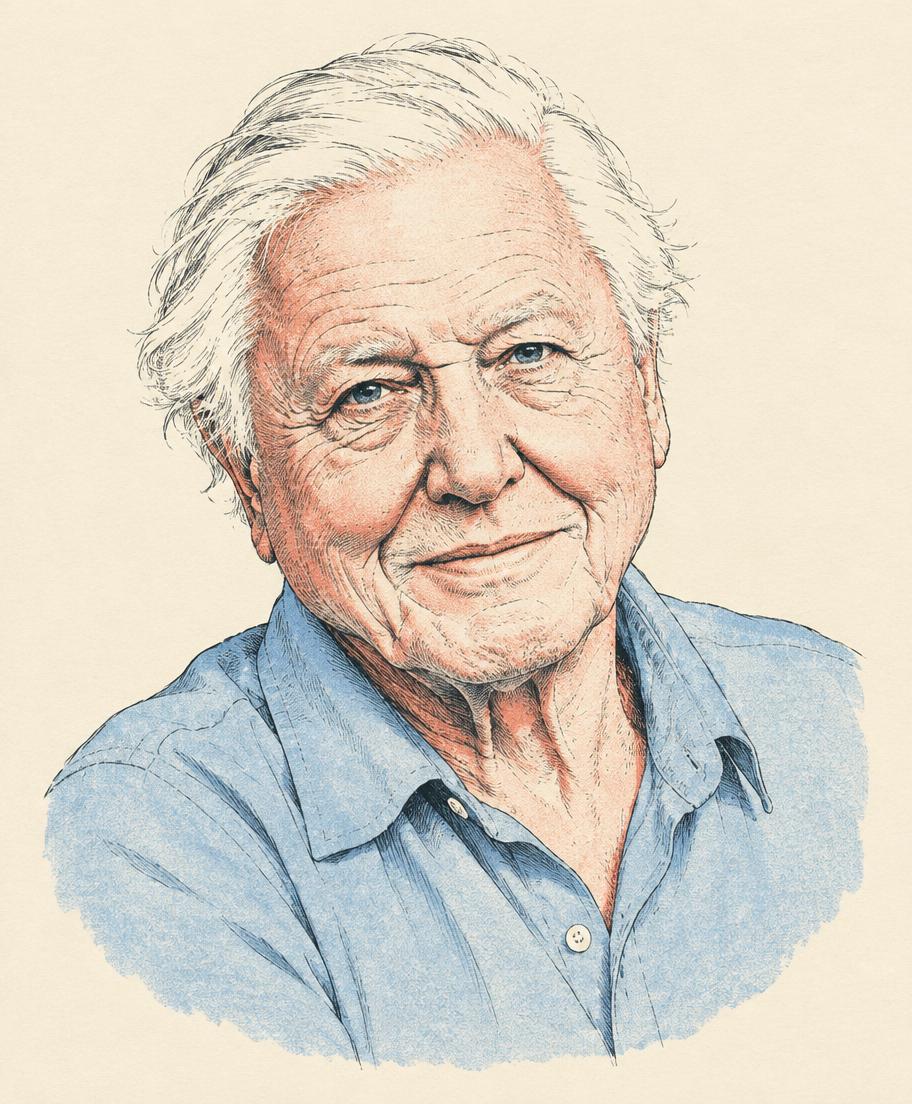
Broadcaster and natural historian
David Attenborough
The broadcaster whose natural history series have shaped how audiences understand life on Earth.
Read biography ↗
Animator and film director
Hayao Miyazaki
The animator and co-founder of Studio Ghibli whose hand-drawn films reached audiences worldwide.
Read biography ↗
Pope
Benedict I
Pope Benedict I was the bishop of Rome from 2 June 575 to his death on 30 July 579.
Read biography ↗